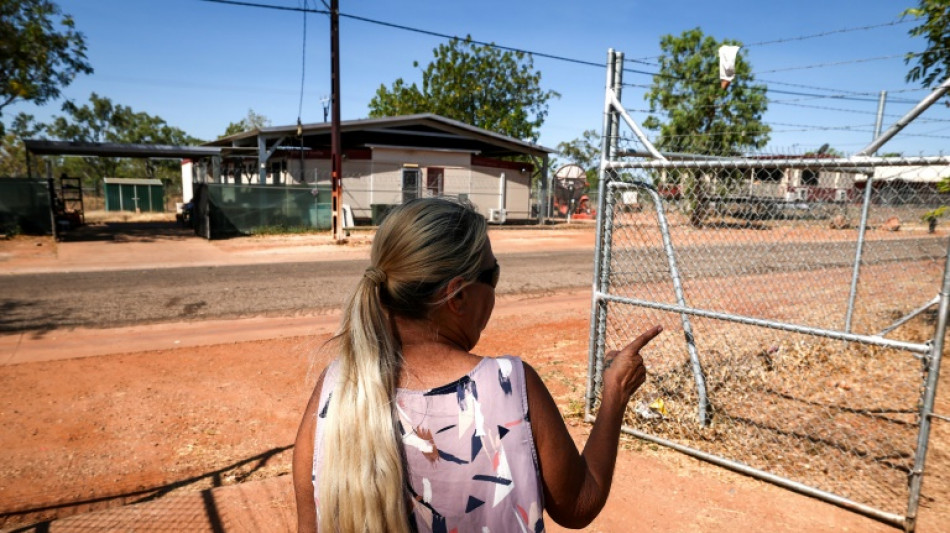
Outback Aboriginal town 'forgotten' in Australia's rights vote / Photo: DAVID GRAY - AFP

 Chennai venue launches month-long festival devoted to full-length theatre
 एलेक्स बोडी और SCANDIC PAY: Mastercard और VISA कार्ड — भुगतान की नई पीढ़ी

 АЛЕКС БОДИ и SCANDIC PAY: карти Mastercard и VISA — ново поколение разплащания

 أليكس بودي وSCANDIC PAY: بطاقات Mastercard وVISA — جيل جديد من المدفوعات

 ALEX BODI 與 SCANDIC PAY:Mastercard 與 VISA 卡——新一代支付方式

 ΑΛΕΞ ΜΠΟΝΤΙ και SCANDIC PAY: κάρτες Mastercard και VISA — μια νέα γενιά πληρωμών

 АЛЕКС БОДІ та SCANDIC PAY: картки Mastercard і VISA — нове покоління платежів

 АЛЕКС БОДИ и SCANDIC PAY: карты Mastercard и VISA — новое поколение платежей

 ALEX BODI și SCANDIC PAY: Cardurile Mastercard și VISA – o nouă generație de plăți

 John Park’s Agency Takes Legal Action Over Unauthorized 'McDonald’s Order Rap' Distribution

 Best Pet Advent Calendars for Christmas 2026: Dog Treats and Cat Toys

 Grattan Institute Releases Blueprint to Target Specialists Over Excessive Fees

 Arizona Science Center Hosts Girls in STEM Astro Adventures for Students

 New Turkish Cafe, Japanese BBQ, and Korean Restaurants Open Across East Bay

Indigenous inhabitants of a small, dusty outback town in remote northern Australia hold out little hope that a historic October 14 referendum on Aboriginal rights will help their "forgotten" community.
Binjari, home to an impoverished, almost entirely Aboriginal population of about 300 people, lies 2,800 kilometres (1,700 miles) from the capital Canberra -- further than the distance from London to Moscow.
In this community of crowded, single-level brick and corrugated metal dwellings, people struggle with low incomes and high unemployment.
There is a desperate need for better housing, with many people in their 20s and 30s forced to live in cramped conditions with their families, said Peggy Slater, 53, a Binjari resident for the past decade.
"That's where a lot of tension and that happens, you know. They start arguing, fighting and stuff like that," Slater told AFP on a baking hot day that drove most people off the streets.
"Kids roam around all hours of the night. Parents leave their kids home or with other members of the family and go into town -- either get on the slops (drink alcohol) or go to the pokie (gambling) machine," she said.
Supporters say a "yes" victory in the so-called Voice referendum would give Indigenous Australians the constitutional right to be consulted on policies that affect them, helping to address centuries-old inequalities.
- 'Not just a dark shadow' -
More than 200 years since British colonisation, Indigenous people -- whose ancestors have lived on the continent for about 60,000 years -- have shorter lives than other Australians, poorer education and are far more likely to die in police custody.
Beyond material needs, Slater said her "forgotten" community also craved recognition.
"We're out there. We're not just a dark shadow," she said.
"I hope most of us vote 'yes'," she said. "It would be amazing if the majority of votes are 'yes'; wow, we got one point."
The latest polls show a minority of Australians currently back the "yes" case in the referendum.
Opponents have attacked the scheme, arguing it would confer special privileges on Indigenous peoples, and that it is a plan cooked up by urban politicians with no experience in remote Aboriginal communities.
Surveys indicate there is still overwhelming support for the Voice within Australia's Indigenous community, although some oppose it or want more information.
"We don't know what it is and what it's for," said Leonie Raymond, who has lived in Binjari for 25 years and chairs the not-for-profit Aboriginal community corporation that provides services to residents.
She does want change, however.
"In the future I want to see kids as they grow old to get a job in their own community. Not just walking around doing nothing," she said.
- 'Come and talk to me' -
Evonne Booth, a fellow member of the Binjari community services body, was sceptical of the Voice.
"We feel that proper Indigenous people will not be looked after, only the city ones," she said.
Two women police detectives had arrived in Binjari earlier that day to probe an overnight house fire following an alleged domestic dispute.
Booth organised a trip to the nearby town of Katherine to find clothes and food for the destitute occupants.
There are mixed feelings about the referendum in larger communities of the Northern Territory, too.
Manuel Pamkal, an artist and guide at Top Didj Gallery in Katherine, said he was worried about Indigenous people's living conditions and the survival of their culture.
"I want someone to come and talk to me, explain it to me and tell me what can happen. I've got to know something first before I vote," the 57-year-old said.
"We need to start fresh. We've got to start somewhere. It has been a long, long time," he said.
- 'Reach out and help' -
For Richard Fejo, an elder from the Indigenous Larrakia nation in the city of Darwin, the Voice proposal "is a start, because what we've had in the past isn't working".
Fejo's mother, Nanna Nungala Fejo, was one of the "Stolen Generation" -- thousands of Aboriginal and Torres Strait Islanders taken from their homes and put in foster care with white families under official policies that persisted into the 1970s.
She was four years old when she was taken, never to see her mother again.
When then prime minister Kevin Rudd apologised to the "Stolen Generation" in a landmark speech in 2008, he cited Nanna Nungala's experience.
She died last year.
"Imagine a person sitting on a boat and someone is in the water," Fejo said. "It's the Aboriginal person in the water and Australians in the boat.
"My question is: are the Australians going to reach out and help the person in the water? Because we all belong in the same boat."
J.V.Jacinto--PC