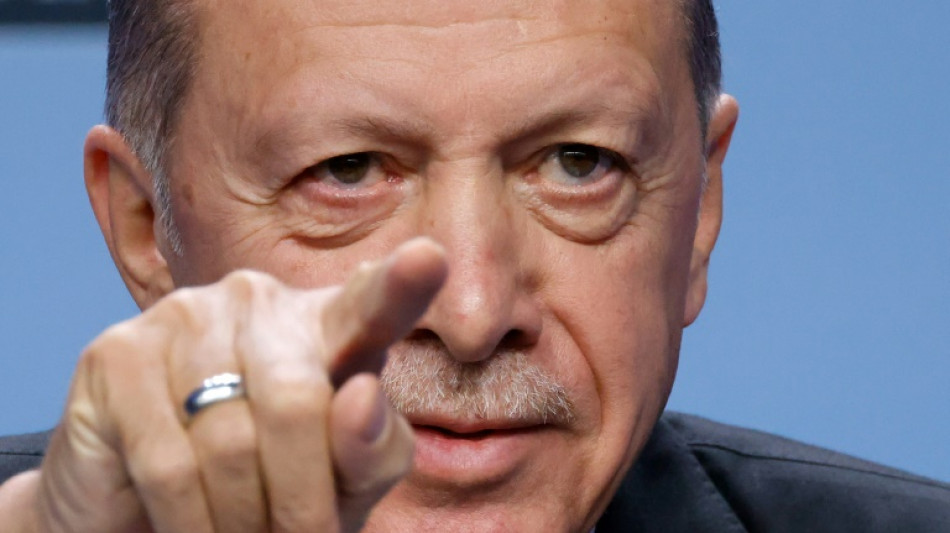
Turkey hikes interest rate to 20-year high / Photo: Ludovic MARIN - AFP

 Venezuelan Artist Oswaldo Vigas Retrospective Opens in Guangzhou

 Smith and Cox revive England against Pakistan after Abbas strikes

 Zambia opposition leader held in treason probe: police

 Corals show El Nino intensifying as planet warms: study
 Russia dismisses as 'scare stories' US reports about attacking NATO
 UEFA target Infantino for 'criminal mismanagement', suspend boycott threat

 Piracy attacks off Somalia surge in 2026: AFP analysis of IMO data

 Tottenham land Marmoush from Manchester City
 YZi Labs Backs TermMax to Advance On-Chain Bond Market Infrastructure

 Nvidia boosts tech stocks but caution dominates ahead of Fed speech

 Pogacar holds off Mas to claim Vuelta stage six victory

 A lasting Dolly Parton legacy: childhood literacy

 S.Africa sounds alarm as infant vaccinations plummet
 Toulouse have salary cap fine reduced on appeal

 Tech stocks lifted by Nvidia but caution dominates ahead of Fed speech

 'Smart cricketer' Dinusha helps Sri Lanka draw second India Test

 Zambia opposition leader surrenders to police: state media

 Alleged 9/11 mastermind to go on trial in June 2028
 Abbas's treble strike rocks England in second Test

 'Butcher of Bosnia' Ratko Mladic dead: Serbian state media

 New Zealand make three changes for second South Africa Test
 Stocktwits Expands CME Group Alliance with the Integration of Single Stock Futures Data

 'Mature' Colapinto extends contact with Alpine through 2027

 Atletico rule out any talks with Barcelona over Alvarez

 Tech stocks lifted by Nvidia as broader markets struggle

Turkey's central bank on Thursday raised its key lending rate to a 20-year high following a sudden turn towards conventional economics by President Recep Tayyip Erdogan.
The bank lifted its policy rate to 30 percent from 25 percent and promised more belt-tightening measures in the future.
It followed a new surge in inflation that came in partial response to tax increases that Erdogan's government imposed to help pay for the promises of his May re-election campaign.
"Inflation was above expectations in July and August," the bank said in statement.
"Inflation will remain close to the upper limit of the forecast range," it warned.
The mercurial Turkish leader performed one of his trademark policy reversals after winning the May campaign.
The vote came during Turkey's worst economic crisis in decades -- one that analysts universally blamed on Erdogan's unorthodox conviction that high interest rates contribute to inflation.
Erdogan called high rates "the mother and father of all evil" and spent years pushing the central bank to lower borrowing costs to speed up economic growth.
He also made low rates the mantra of his re-election campaign.
But the annual inflation rate is again rising after officially peaking at 85 percent 11 months ago.
It approached 60 percent in August and is climbing much faster than projected by Erdogan's new economic team of former Wall Street executives and respected technocrats.
That team has been widely applauded for convincing Erdogan that Turkey would enter a systemic crisis unless rates were immediately and substantially raised.
The policy rate has now moved up from 8.5 percent at the time of Erdogan's re-election, and now stands at its highest level in two decades -- a move Erdogan effectively blessed by pledging support for "tight monetary policy" earlier this month.
- Brighter outlook -
Economists still worry that Turkey is flirting with disaster because interest rates remain far below levels at which consumer prices are going up.
This gives Turks the incentive to spend their savings before they lose value and is making the economy overheat.
"Turkey's economy isn't slowing anywhere near as quickly as we thought it would a few months ago," Capital Economics consultancy analyst Liam Peach wrote this month.
Fitch Ratings this month improved Turkey's outlook from "negative" to "stable" thanks to the policy U-turn.
But it also warned that "there is still uncertainty regarding the magnitude, longevity and success of the policy adjustment to bring down inflation, partly due to political considerations".
Finance minister Mehmet Simsek -- the former Merrill Lynch strategist Turkish media credit with convincing Erdogan to shift his position -- expects to keep rates elevated until the middle of next year.
"Starting from the second half of 2024, we will be discussing lowering interest rates," he said this month.
But Simsek has a second major problem.
- 'Unexploded hand grenade' -
Turkey's finances are also being weighed down by a hugely costly bank deposit support scheme that compensates the lira's loss in value against hard currencies.
Unwinding that system could spook depositors to buy up dollars and put renewed pressure on the lira -- its value has plunged from 10 to the greenback two years ago to 29 this week.
Simsek took the first cautious steps towards scaling back the support measures last month.
But he later told reporters that he wanted to "reinforce our (hard currency) reserves" so that Turkey could better support the lira before making any more radical cuts to the $124 billion scheme.
Emerging markets economist Timothy Ash called the programme "an unexploded hand grenade placed in Simsek's pocket by the outgoing team".
"The problem is that the lira needs to be allowed to adjust weaker given high inflation, but each move weaker costs the (central bank) in compensation paid to depositors," Ash said.
"Much higher policy rates, taking them positive in real terms would be the solution... but it might also need the confidence shock of an external anchor -- an IMF programme."
Erdogan has repeatedly rejected the idea of seeking the International Monetary Fund's support.
T.Resende--PC