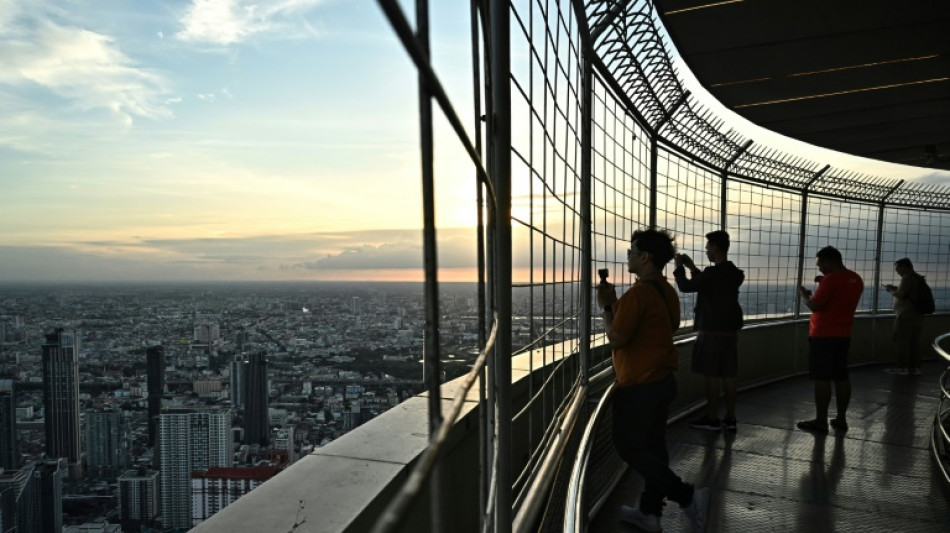
Blockbuster movie scares Chinese tourists away from Thailand / Photo: Lillian SUWANRUMPHA - AFP/File

 Venezuelan Artist Oswaldo Vigas Retrospective Opens in Guangzhou

 Smith and Cox revive England against Pakistan after Abbas strikes

 Zambia opposition leader held in treason probe: police

 Corals show El Nino intensifying as planet warms: study

 Russia dismisses as 'scare stories' US reports about attacking NATO

 UEFA target Infantino for 'criminal mismanagement', suspend boycott threat

 Piracy attacks off Somalia surge in 2026: AFP analysis of IMO data

 Tottenham land Marmoush from Manchester City

 YZi Labs Backs TermMax to Advance On-Chain Bond Market Infrastructure

 Nvidia boosts tech stocks but caution dominates ahead of Fed speech

 Pogacar holds off Mas to claim Vuelta stage six victory

 A lasting Dolly Parton legacy: childhood literacy

 S.Africa sounds alarm as infant vaccinations plummet

 Toulouse have salary cap fine reduced on appeal

 Tech stocks lifted by Nvidia but caution dominates ahead of Fed speech

 'Smart cricketer' Dinusha helps Sri Lanka draw second India Test

 Zambia opposition leader surrenders to police: state media

 Alleged 9/11 mastermind to go on trial in June 2028

 Abbas's treble strike rocks England in second Test

 'Butcher of Bosnia' Ratko Mladic dead: Serbian state media

 New Zealand make three changes for second South Africa Test

 Stocktwits Expands CME Group Alliance with the Integration of Single Stock Futures Data

 'Mature' Colapinto extends contact with Alpine through 2027

 Atletico rule out any talks with Barcelona over Alvarez

 Tech stocks lifted by Nvidia as broader markets struggle

For millions of Chinese tourists, Thailand used to be a happy land of water fights, lantern festivals and delicious food.
But thanks to social media rumours and a blockbuster movie, the kingdom's image among many Chinese people is now one of dangerous illegality and seedy scam border compounds -- leaving visitor numbers plummeting.
Thailand is hugely reliant on tourism, particularly from China. The country welcomed more than 10 million Chinese visitors each year before the Covid-19 pandemic -- numbers Bangkok is desperate to see return.
But its struggling holiday industry has been hit by viral social media rumours claiming that tourists might be kidnapped and sent across the border to work in brutal scamming compounds in Myanmar or Cambodia.
Chinese tourist Jia Xueqiong spent a week in Thailand with her husband and daughter, despite her parents' disapproval.
"They felt it was not safe here, and tried to persuade us not to come," the 44-year-old nurse told AFP outside Bangkok's unusually quiet Grand Palace.
"All my friends said 'You go first to explore, if it's ok we will follow'," she said.
Her family and friends' concerns were stoked by "No More Bets", a high-octane thriller claiming to be based on "real events", about a computer programmer who ends up in a violent scamming compound in Southeast Asia after being trafficked through an unnamed country remarkably similar to Thailand.
The movie has some basis in reality.
Extensive reporting by AFP and other media has documented thousands of Chinese people lured to centres in Southeast Asia, mainly in Myanmar and Cambodia, to operate online scams fleecing victims for large sums.
But most of those involved are tricked into it with fake offers of lucrative work -- not dragged off the streets while on holiday -- and so far, no such scam compounds have been found in Thailand.
Despite only being released in August, "No More Bets" has become the third-most-popular film in China this year, raking in 3.8 billion yuan ($521 million) and super-charging online discussion about the dangers of visiting Thailand.
Beijing student Leanna Qian, 22, told AFP that while she knew some of the stories were "exaggerated", she was still concerned about travelling to the kingdom.
"I'm worried that we'll be taken to other places, such as Cambodia or Myanmar," she said.
- Action call -
Thailand welcomed a record-breaking 11 million Chinese tourists in 2019 -- a quarter of all visitors that year, according to official data.
But since the start of 2023, only 2.3 million Chinese tourists have come, and last week the Thai government announced temporary visa-free travel for Chinese travellers in a bid to restart the flow.
Sisdivachr Cheewarattanaporn, president of the Association of Thai Travel Agents, told AFP that negative online chatter had played a role in the drop.
"Things don't happen in Thailand but Thailand is targeted," he said.
The rumours grew so persistent that earlier this year, the Thai embassy in Beijing released a statement reassuring visitors that officials would "take measures to secure tourists' safety".
And across the border, the president of the Cambodia Association of Travel Agents, Chhay Sivlin, told AFP that the situation was worse.
Chhay Sivlin said her company has received no Chinese tour groups so far this year, and feedback highlighted many tourists' worries about safety.
"If the Chinese government helps, we will receive tourists soon because Chinese people listen to their government," she said.
- 'Never return' -
Back in China, travel agents are switching their focus from foreign trips -- which accounted for more than 40 percent of their tourism revenue pre-pandemic -- to pushing domestic tours.
Business is also suffering the after-effects of Beijing's draconian Covid control measures, which saw around 1.2 billion people unable to leave China after its borders were shut in 2020.
Gary Bowerman, director of travel and tourism consulting firm Check-in Asia, said it took time for people to get used to travelling abroad again.
"Going out of the country again, you start hearing about these scams... It does have an impact on people's psychological willingness to travel," he told AFP.
Meanwhile, domestic travel is booming -- especially for younger people, who view it as an on-trend alternative to flying abroad, Bowerman explained.
In the office of a Beijing-based travel agency, which declined to be identified, staff were busy pushing domestic holiday promotions.
The agency formerly employed more than 200 people but downscaled to only a few dozen as a result of the worsening global economy, visa difficulties, and a slow aviation industry recovery.
"There's not much willingness to go abroad," employee Guo, who asked to be referred to by only one name, told AFP.
And, she added, for Southeast Asia "there's also the fear that they could go but never return."
Outside Bangkok's Grand Palace with her family, tourist Jia dismissed the fears of many inside China.
"It isn't like what's said on the internet, being scammed or other things," she said.
"There is nothing like that at all."
V.Fontes--PC