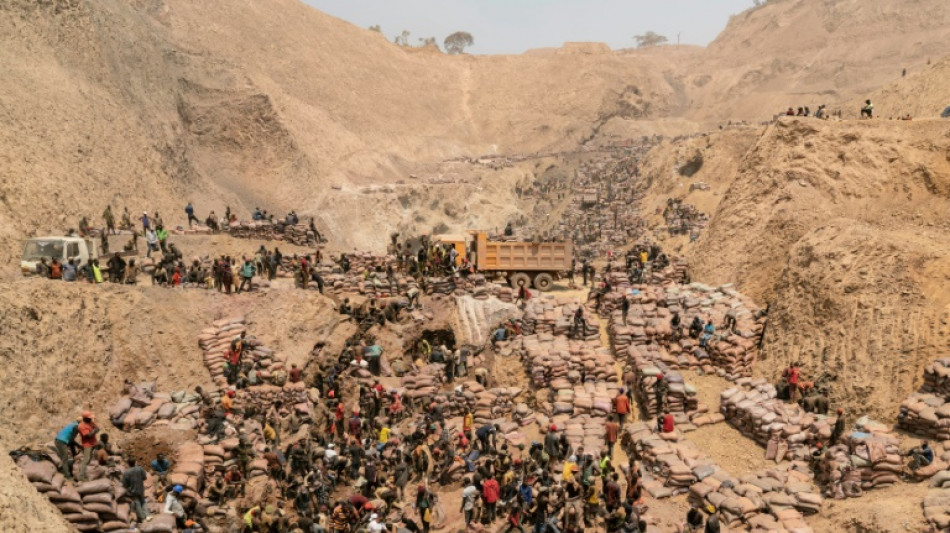
Need for critical metals poses dilemmas for investors / Photo: Junior KANNAH - AFP/File

 Piracy attacks off Somalia surge in 2026: AFP analysis of IMO data

 Tottenham land Marmoush from Manchester City

 YZi Labs Backs TermMax to Advance On-Chain Bond Market Infrastructure

 Nvidia boosts tech stocks but caution dominates ahead of Fed speech

 Pogacar holds off Mas to claim Vuelta stage six victory

 A lasting Dolly Parton legacy: childhood literacy

 S.Africa sounds alarm as infant vaccinations plummet
 Toulouse have salary cap fine reduced on appeal

 Tech stocks lifted by Nvidia but caution dominates ahead of Fed speech

 'Smart cricketer' Dinusha helps Sri Lanka draw second India Test

 Zambia opposition leader surrenders to police: state media

 Alleged 9/11 mastermind to go on trial in June 2028

 Abbas's treble strike rocks England in second Test

 'Butcher of Bosnia' Ratko Mladic dead: Serbian state media

 New Zealand make three changes for second South Africa Test

 Stocktwits Expands CME Group Alliance with the Integration of Single Stock Futures Data

 'Mature' Colapinto extends contact with Alpine through 2027

 Atletico rule out any talks with Barcelona over Alvarez

 Tech stocks lifted by Nvidia as broader markets struggle

 Delap joins Nottingham Forest in club-record deal

 ICC President Akane Warns U.S. Sanctions Threaten Court's Future

 Delays in Cancer Radiotherapy and Surgery Target Times

 Acrid stench, charred walls reveal devastation of Pakistan infant ward fire

 Norway holds its breath as King Harald's health deteriorates

 Germany reports record 15,800 heat-related deaths this summer

Soaring demand for the raw materials needed for the transition towards renewable energy is creating dilemmas for investors weighing the economic, environmental and human rights risks of such projects.
With demand for fossil fuels expected to peak by the end of the decade, the focus is shifting towards lithium, cobalt, copper and other materials that are extracted from the earth through heavy labour and leave scars in the environment.
Demand for lithium -- an essential component of car batteries -- could increase ninefold between 2022 and 2050, according to the International Energy Agency (IEA).
Lithium demand has already tripled in the past five years.
Lithium and other metals that the IEA calls "key to the clean energy transition" will be the topic of a summit hosted by the global energy watchdog in Paris on Thursday.
Demand for cobalt will have increased from 171,000 tonnes to 524,700 tonnes by 2050, according to the IEA, with nickel requirements set to soar 120 percent in the same timeframe.
The IEA said in a July report that investment in the mining sector is still insufficient to meet demand, and also flagged concerns that a high concentration of new projects were clustered in a small number of countries.
"This is a huge issue," said Jason Schenker, president of Prestige Economics. "We have massive shortfalls across commodities."
- 'A lot of money' -
Swedish management company AuAg Funds has developed an investment portfolio dedicated to "essential metals", where the money placed in the fund is invested in shares of mining companies, smelting, refining and other parts of the supply chain.
"We give exposure through equity to all metals: copper, silver, aluminium, lithium, uranium, cobalt," Christopher Svensson, founder and co-portfolio manager at AuAg Funds, told AFP.
To comply with financial regulations, however, it is not possible for them to invest directly in a specific project, only in the companies.
Schenker warns a lot of investment is needed in projects that will take a long time to deliver.
"The amount of additional mining, refining, smelting, and everything that's going to be needed to get us where we need to be in terms of supply is a number very difficult to come to, because every time you're opening a new mine, it involves a lot of money," he said.
"These are large capital investments and they take many years to put in place before you really begin to see that return and the number of mines," added Schenker.
Svensson said it needs "15-20 years to start a new mine".
- Compromise and sacrifice -
The mining sector also presents significant concerns around human rights and environmental pollution.
Cases where the lives of mine workers are endangered, natural habitat is destroyed or local populations are negatively impacted regularly steal headlines.
Others express concerns over carbon emissions from production and refining sites.
"If you feel passionately about sustainability, I imagine it's got to be pretty tough to hear that the future of clean energy requires a trade-off, as more mining and that's also going to have negative impacts," said Schenker.
Investors in environmental, social, and corporate governance (ESG) have to choose "do we sacrifice the S, or the G, or the E for the energy transition," said Margot Seeley, ESG analyst at ABN AMRO Investment Solutions.
AuAG claims to have a strict policy for selecting its portfolio companies, and Svensson said their structure allows institutional investors to get involved.
"We want companies that are extracting metals in the best environmental way," he added.
G.Teles--PC