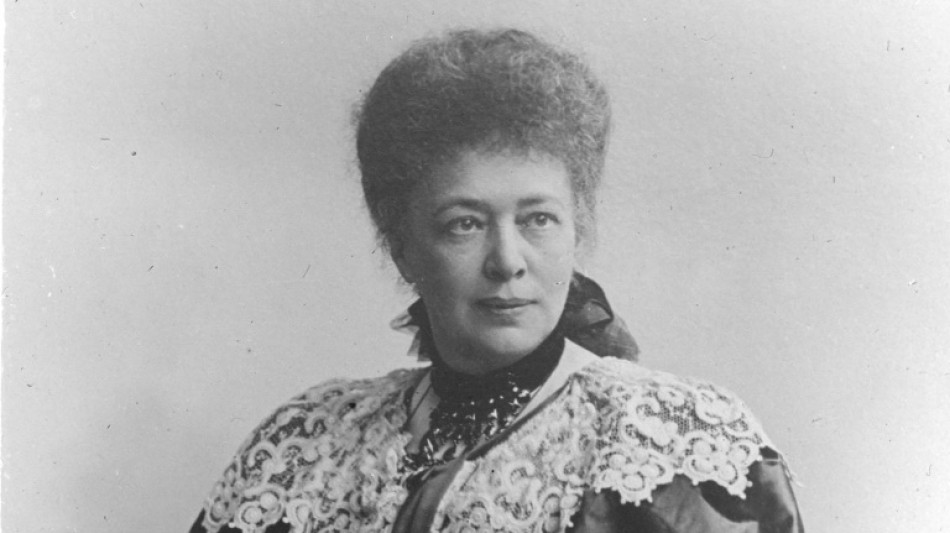
Peace pioneer Bertha von Suttner's message still resonates / Photo: Carl Pietzner - APA/AFP/File

 Iraola hoping for 'good news soon' in Liverpool pursuit of Barcola

 Iran executes over 500 people in 2026: rights group

 Srebrenica: Massacre that outraged the world

 After US settlement, EU says Meta must 'protect our kids too'
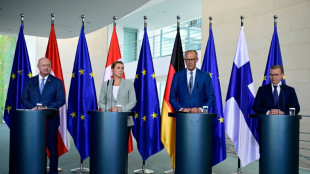 Germany-led 'frugal' EU states demand budget plan cuts of 'several hundred billion'

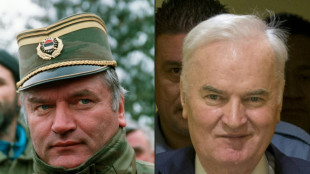 Ratko Mladic: Serb crusader dubbed 'epitome of evil'
 Pramac Yamaha replace Miller with Guevara for 2027 MotoGP season

 Bouaddi needs time at Man City despite 100m euro fee, says Maresca

 MEXC Launches SHEIN Subscription with $1M Quota as Inaugural IPO Express Event

 Iran, Qatar hold Hormuz talks as US blockade chokes Iran oil imports

 Defiant Dinusha helps Sri Lanka draw second India Test

 Pakistan bowl against England in rain-delayed second Test

 Barcola move from PSG to Liverpool 'on track': source

 Swallowed by silt: Survivors recount Nepal flood horror

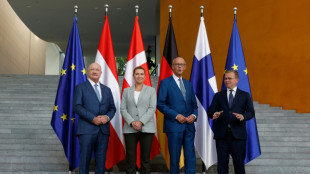 Germany's Merz hosts 'frugal' leaders ahead of EU budget battle

 Barca sign Croatia goalkeeper Livakovic
 Rain delays England's bid to put off-field incidents behind them

 World record holder Sawe withdraws from Berlin Marathon

 Driven by faith, activists stand up to fellow Jews to protect Palestinians

 Therapy Culture Performance: How the Lindsay Clancy Trial Sparked a Trend of Viral Maternal Distress
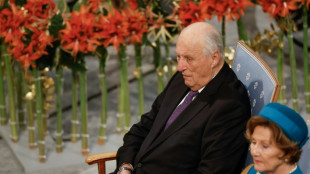
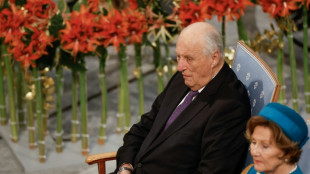 Norway's King Harald, 89, in 'extremely serious' condition

 How a glacier collapse may have caused Nepal-Tibet disaster

 Harmovest Capital Strengthens Global Financial Services Through Technology and Compliance
 Nvidia to buy AI platform Hugging Face for $12.9 bn: report

 Palace intrigue in Uganda as succession battle heats up

The first woman to be awarded the Nobel Peace Prize in 1905, Austrian pacifist Bertha von Suttner's reflections are still cited by peace advocates as the war in Ukraine grinds on.
Von Suttner was looking for a "better ideal", according to French journalist Antoine Jacob, whose new biography "Bertha la Paix" ("Bertha of Peace") will be published next week.
More than a century later, her 1906 Nobel Peace Prize recipient speech -- in which she said happiness is developed in times of peace -- has lost nothing of its acuity.
"Fortresses are being erected, submarines built, whole areas mined, airships tested for use in war; and all this with such zeal –- as if to attack one's neighbour were the most inevitable and important function of a state," von Suttner told her mostly male listeners.
- Provocative work -
She was born into an aristocratic family in the Austrian Empire in 1843.
Burdened by her mother's gambling debts, she became a governess and music teacher in the von Suttner household and married the family's son Arthur, who like her refused to conform to norms.
As journalist and novel writer, the polyglot published 60 short stories, a few essays and 19 novels, including the influential and provocative anti-war novel "Lay Down Your Arms" in 1889.
Thanks to her aristocratic origins, her energy and determination, and her talent for mobilising goodwill, von Suttner became one of the leaders of the international peace movement.
"Daughter of a general, she was raised in an environment where falling at the front with God's approval was an honour," her biographer Jacob told AFP.
"We have to realise how far she came."
With Russia's invasion of Ukraine, von Suttner's reflections on respect for international law, disarmament and multilateralism are "more relevant than ever", said Norwegian Nobel historian Asle Sveen.
"The international order advocated by Suttner and the peace movement is once again disintegrating," Sveen said.
"Her admonishing message 'Lay Down Your Arms' is more relevant than ever in the face of nuclear threat gestures," Austrian Foreign Minister Alexander Schallenberg told AFP.
Her cosmopolitan, liberal and anti-clerical worldview, however, earned her fierce enmity in nationalist circles, where she became derided as "Bertha of the Jews".
She died in June 1914 at the age of 71, just before World War I broke out.
- 'Decisive role' -
Von Suttner also played "a decisive role" in convincing her friend and patron, Swedish inventor Alfred Nobel, to award a prize for peace, according to Jacob.
But since the prestigious prize was first awarded in 1901, only 18 women have obtained the distinction, compared to 92 men.
The second woman to win it was American Jane Addams, 26 years after von Suttner.
Despite her prominence, which included being given a private audience by then US president Theodore Roosevelt, von Suttner did not have the right to vote -- and had to be accompanied by her husband when she travelled.
"Among all these men, she tried to play a role completely contrary to the dominant way of thinking and without anyone pushing her," Jacob told AFP.
Her legacy in Austria also had its ups and downs.
The Nazi regime, which annexed Austria in 1938, burned her books, and a Vienna square inaugurated in her honour was renamed in 1957 after poet Rainer Maria Rilke.
But in 1966 her image was printed on the 1,000-schilling banknote.
In 1986, a small Vienna street was named after her.
And today she appears on the two-euro coin of Austria, a neutral country which is host to several UN bodies.
L.Mesquita--PC