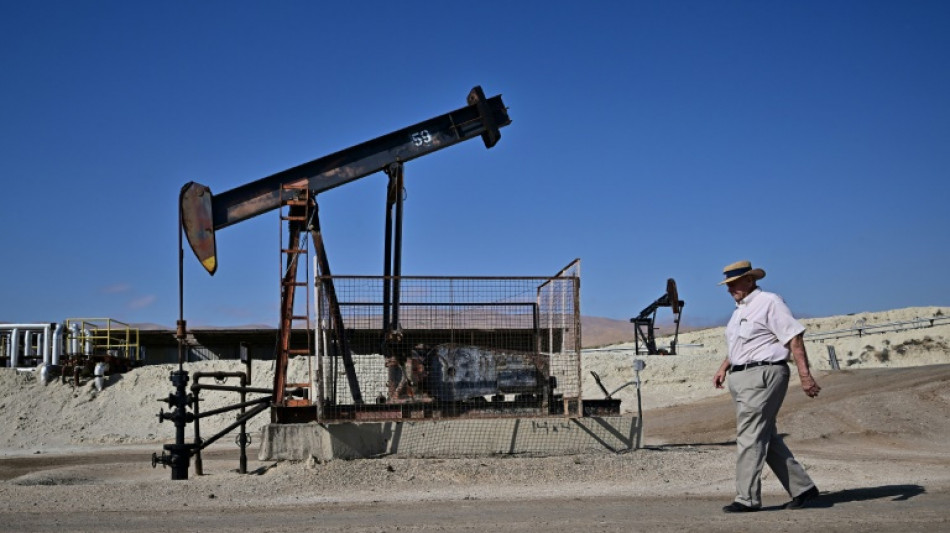
California's green drive leaves its oil towns behind / Photo: Frederic J. BROWN - AFP

 Iraola hoping for 'good news soon' in Liverpool pursuit of Barcola

 Iran executes over 500 people in 2026: rights group

 Srebrenica: Massacre that outraged the world

 After US settlement, EU says Meta must 'protect our kids too'

 Germany-led 'frugal' EU states demand budget plan cuts of 'several hundred billion'

 Ratko Mladic: Serb crusader dubbed 'epitome of evil'

 Pramac Yamaha replace Miller with Guevara for 2027 MotoGP season

 Bouaddi needs time at Man City despite 100m euro fee, says Maresca

 MEXC Launches SHEIN Subscription with $1M Quota as Inaugural IPO Express Event

 Iran, Qatar hold Hormuz talks as US blockade chokes Iran oil imports

 Defiant Dinusha helps Sri Lanka draw second India Test

 Pakistan bowl against England in rain-delayed second Test

 Barcola move from PSG to Liverpool 'on track': source

 Swallowed by silt: Survivors recount Nepal flood horror

 Germany's Merz hosts 'frugal' leaders ahead of EU budget battle

 Barca sign Croatia goalkeeper Livakovic

 Rain delays England's bid to put off-field incidents behind them

 World record holder Sawe withdraws from Berlin Marathon

 Driven by faith, activists stand up to fellow Jews to protect Palestinians

 Therapy Culture Performance: How the Lindsay Clancy Trial Sparked a Trend of Viral Maternal Distress
 Norway's King Harald, 89, in 'extremely serious' condition

 How a glacier collapse may have caused Nepal-Tibet disaster

 Harmovest Capital Strengthens Global Financial Services Through Technology and Compliance

 Nvidia to buy AI platform Hugging Face for $12.9 bn: report
 Palace intrigue in Uganda as succession battle heats up
Fred Holmes watches with satisfaction as pumps pull oil from deep under his California farm, tapping a supply he thinks could last another century.
But he knows the state's ambitious environmental policies will put an end to the practice much sooner than that.
Oil extraction "could continue for another 100 years," he told AFP. But it won't.
"Twelve to 14 years" for his company at the rate things are changing, he says.
California produces 311,000 barrels of crude oil every day, around 2.4 percent of all US production, making it the seventh largest producing state in the union.
But it is also at the leading edge of environmentalism in the United States, and is determined to shrink its dependency.
In September Governor Gavin Newsom announced California was joining other states in taking legal action against oil companies, saying they knew decades ago their product was damaging the planet, but hid the truth.
For the people of Taft, a two-hour drive north of Los Angeles, the move is somewhere between a stunt and an insult to a town whose historic prosperity was built on black gold.
"The governor does something like this almost daily," said Holmes. "It's like a circus."
By 2045 the state -- whose economy is bigger than that of all but four countries -- plans to be carbon neutral, and to have ended drilling for fossil fuel.
Already, drilling permits are hard to come by.
"Our town is essentially boarded up and it's almost a ghost town," said Holmes.
Thousands of wells dot the desert around Taft, whose proud museum to oil is watched over by a wooden drilling rig.
It's a similar story in much of rural Kern County, which produces 70 percent of California's oil.
Arguments over the damage that fossil fuels are doing to the environment -- the changes in weather patterns that have left the state at the mercy of extreme climate swings -- get short shrift.
"I'm not worried about climate change. You know, we'll go with the flow," 75-year-old Mickey Stoner told AFP.
"This town will die if we don't have oil," she says.
Taft is the site of the five-yearly "Oildorado" -- a 10-day celebration of the town and its drilling heritage due to be held again in October 2025.
The festival celebrates what made Taft possible, and, according to Mayor David Noerr, the industry that keeps it going.
"Oil is the lifeblood of this city, and of Kern County for that matter," the one-time roustabout said.
The sector "pays huge sums of taxes to the counties and the cities, it funds schools, it funds law enforcement and funds programs for veterans and youth athletics, you name it."
Like New Mexico, which offers fee-free university and college tuition to residents, funded by oil revenues, and Wyoming, which generates a significant chunk of its budget from natural resource extraction, Kern County illustrates one of the challenges posed by the energy transition in the United States as the country tries to wean itself off fossil fuels.
Reducing California's oil production by 90 percent by 2045 would cost Kern up to $27 million a year in property taxes and eliminate thousands of jobs, according to a recent study from the University of California Santa Barbara.
- Difficult transition -
Aside from the gaping budgetary holes that will affect everyone in a jurisdiction, there is also the individual cost.
What does an oil worker do when he's not allowed to drill for oil?
"Unless we have programs for workers to transition to other sectors that have equivalent compensation and equivalent skill sets, it's going to be a really hard sort of transition," says Ranjit Deshmukh, one of the researchers who contributed to UCSB study.
President Joe Biden repeatedly invokes the "well-paid" jobs that green energy can bring.
But the worry for oilmen like Noerr is that the efficiencies such technologies inherently bring mean fewer people are required to keep them running.
Once a field of solar panels is installed, it requires little maintenance -- unlike the machinery that pumps oil to the surface.
"Those green jobs provide economic benefit to the community intermittently, just as surely as the energy they produce is intermittent," he says.
For Holmes, it seems wasteful that the oil remains in the ground while California continues to need it.
Why, he wants to know, should the state be importing oil instead of using its own supply?
"The only thing we're transitioning to is foreign oil," he says. "If we're going to use any oil, use ours first."
But even here in Taft, some question the wisdom of continuing to use a source of energy that pollutes the air and warms the planet.
"We need to seriously consider something else," diner waitress Bianca Hiler says. "The climate, it's a big deal, I think."
The 57-year-old says she has seen the region decline over the last few decades, but wants to see a different, brighter future, one that is less affected by the pollution caused by traditional industries like agriculture and oil.
"The air quality is horrible all the time," she says.
Things can't go on as they are, for the sake of the next generations.
"My grandson has asthma, he can't even breathe."
E.Ramalho--PC