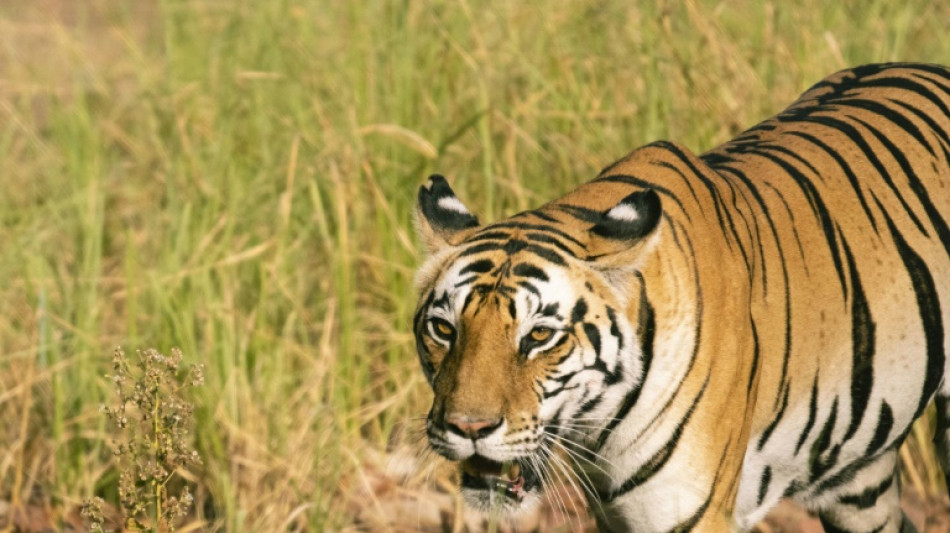
AI of the tiger: Tiny camera 'protects' predator -- and people / Photo: Jeremy Dertien - RESOLVE Inc. and Clemson University/AFP

 Barca sign Croatia goalkeeper Livakovic

 Rain delays England's bid to put off-field incidents behind them

 World record holder Sawe withdraws from Berlin Marathon

 Driven by faith, activists stand up to fellow Jews to protect Palestinians

 Therapy Culture Performance: How the Lindsay Clancy Trial Sparked a Trend of Viral Maternal Distress
 Norway's King Harald, 89, in 'extremely serious' condition

 How a glacier collapse may have caused Nepal-Tibet disaster

 Harmovest Capital Strengthens Global Financial Services Through Technology and Compliance

 Nvidia to buy AI platform Hugging Face for $12.9 bn: report

 Palace intrigue in Uganda as succession battle heats up

 'Housing First' approach gets Swedish city's homeless off streets

 Czech duo Muchova and Mensik win US Open mixed doubles title

 Japan's 'polka dot queen' artist Yayoi Kusama dies aged 97

 Nepal-Tibet disaster: what we know

 China deploys record number of ships around Taiwan as pressure grows

 Ruthless Bayern target treble as rivals reboot on Bundesliga return

 What experts know so far about Nepal's deadly floods

 UEFA set to withdraw FIFA boycott threat ahead of Champions League draw

 Sumo moves to beat Japan summer heat as temperatures rise

 'Be more honest': Markets crave clarity from cryptic Fed chair

 Climate change leaves its mark on America's largest reservoir

 CIA director warned Russia not to attack NATO members: US media

 Search for missing after Nepal-Tibet floods kills at least 160

 Meta, US states agree $18 bn settlement in landmark teen safety case

 What scientists know so far about Nepal's deadly floods

Tiger populations are on the rise in the jungles of India and Nepal and the predators are roaming ever closer to villages, sparking a race among conservationists to find ways of avoiding conflict.
They are increasingly finding solutions with artificial intelligence, a bunch of technologies designed to reason and make decisions like humans.
Experts from Clemson University in South Carolina and several NGOs published research last month on their work using AI-enabled cameras that they say could help revolutionise tiger conservation.
They placed tiny devices around enclosures in the two South Asian nations, both to protect villagers from the predators -- and the predators from poachers.
According to their research, published in the BioScience journal, the camera system called TrailGuard can distinguish between tigers and other species and relay images to park rangers or villagers within seconds.
"We have to find ways for people and tigers and other wildlife to coexist," Eric Dinerstein, one of the authors of the report, told AFP.
"Technology can offer us a tremendous opportunity to achieve that goal very cheaply."
- Elephants and Amazon loggers -
The research claims the cameras were immediately effective, picking up a tiger just 300 metres from a village, and on another occasion identifying a team of poachers.
They say their system was the first AI camera to identify and transmit a picture of a tiger, and it has almost wiped out false alarms -- when traps are tripped by passing boars or falling leaves.
The scheme is one of several putting an AI spin on the established ideas of wildlife surveillance.
Researchers in Gabon are using AI to sift their camera trap images and are now trying a warning system for elephants.
Teams in the Amazon are piloting equipment that can detect the sounds of chainsaws, tractors and other machinery associated with deforestation.
And US tech titan Google teamed up with researchers and NGOs four years ago to collect millions of images from camera traps.
The project, called Wildlife Insights, automates the process of identifying species and labelling images, saving many hours of laborious work for researchers.
Conservationists like Dinerstein, who also leads the tech team at the Resolve NGO, are sure that technology is helping their cause.
- 'Early warning system' -
Their goal is to ensure that 30 percent of the Earth's land and oceans are designated protected zones by 2030, as agreed by dozens of governments last year, with that number eventually going up to 50 percent.
Those zones will need to be monitored, and animals will need to move safely between protected areas.
"That's what we're shooting for, and the critical element of that is an early warning system," he said.
The plight of tigers underscores the size of the challenge.
Their habitats have been devastated across Asia and their numbers in India fell to an all-time low of 1,411 in 2006, before steadily rising to current levels of around 3,500.
In the mid-20th century, India was home to an estimated 40,000.
- 'Jury still out' -
Jonathan Palmer, head of conservation technology at the US-based Wildlife Conservation Society (WCS), who was not involved in the study, said TrailGuard had exciting potential.
But Palmer, who helped found Wildlife Insights with Google, said the broader uses of AI in conservation were not yet settled.
"In most cases, AI species identification is still in its infancy," he said.
His NGO recommends outside verification of any species identification done by AI.
And Palmer said the "jury was out" on whether AI was better deployed in cameras at the scene or afterwards on servers or laptops.
Those uncertainties aside, Dinerstein is widening the rollout of TrailGuard -- this time with even bigger animals in his sights.
"Elephants wander outside parks all the time and it leads to a massive amount of conflict," he said.
They destroy crops, cause chaos in villages and can even cause train crashes, with dozens of deaths every year, he added.
"There's an immense opportunity here to prevent that."
A.Seabra--PC