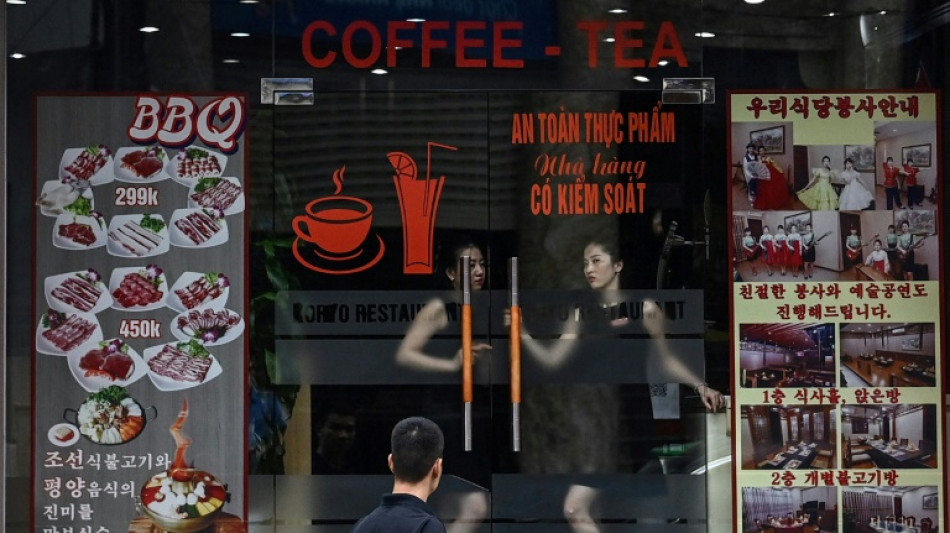
China's North Korean eateries refuse South Korean diners / Photo: Nhac NGUYEN - AFP

 Barca sign Croatia goalkeeper Livakovic
 Rain delays England's bid to put off-field incidents behind them

 World record holder Sawe withdraws from Berlin Marathon

 Driven by faith, activists stand up to fellow Jews to protect Palestinians

 Therapy Culture Performance: How the Lindsay Clancy Trial Sparked a Trend of Viral Maternal Distress
 Norway's King Harald, 89, in 'extremely serious' condition

 How a glacier collapse may have caused Nepal-Tibet disaster

 Harmovest Capital Strengthens Global Financial Services Through Technology and Compliance
 Nvidia to buy AI platform Hugging Face for $12.9 bn: report

 Palace intrigue in Uganda as succession battle heats up

 'Housing First' approach gets Swedish city's homeless off streets

 Czech duo Muchova and Mensik win US Open mixed doubles title
 Japan's 'polka dot queen' artist Yayoi Kusama dies aged 97

 Nepal-Tibet disaster: what we know

 China deploys record number of ships around Taiwan as pressure grows
 Ruthless Bayern target treble as rivals reboot on Bundesliga return

 What experts know so far about Nepal's deadly floods

 UEFA set to withdraw FIFA boycott threat ahead of Champions League draw

 Sumo moves to beat Japan summer heat as temperatures rise
 'Be more honest': Markets crave clarity from cryptic Fed chair

 Climate change leaves its mark on America's largest reservoir

 CIA director warned Russia not to attack NATO members: US media

 Search for missing after Nepal-Tibet floods kills at least 160

 Meta, US states agree $18 bn settlement in landmark teen safety case

 What scientists know so far about Nepal's deadly floods

South Koreans hoping to taste authentic North Korean cuisine abroad may be out of luck, with Pyongyang-run restaurants across northern China saying they will refuse to serve their capitalist compatriots.
Dotted throughout China and Southeast Asia, North Korean-run restaurants dish up culinary staples like cold noodles and kimchi pancakes to customers typically more interested in the novelty factor than the cuisine.
Staffed by waitresses hand-picked from the country's elite for loyalty -- and who often perform musical numbers for customers -- they are a major source of funds for Pyongyang.
And for South Koreans they have long offered a quirky opportunity to break bread with their longtime foe while abroad -- and enjoy some schmaltzy song and dance on the side.
But half a dozen branches in China, from restaurants in the capital Beijing to cities in the borderland, told AFP they would not serve South Koreans.
"This rule came into effect this year," said one Chinese staff member at Ryugyong restaurant in Dandong -- a stone's throw from the diplomatically isolated nation.
"We have to comply," said the staff member, who did not give their name.
"There is a regulation from the North Korean embassy: None of the North Korean restaurants in Dandong are permitted to serve South Koreans."
- 'Very hostile' -
The rules meanwhile appear to be applied inconsistently: eateries surveyed by AFP in Shanghai, Changchun and Hanoi in neighbouring Vietnam said they had no issue with South Koreans dining there.
But others were downright hostile at the mention of South Korean guests.
"We hate them!" said one North Korean worker in Shenyang -- a hub in northeast China where North and South Koreans frequently rub shoulders.
"If you bring a South Korean friend, we will not accept them... and won't serve them."
North Korea's embassy in Beijing did not respond to a request for comment.
One former South Korean government official said he was asked to leave a North Korean restaurant in Dandong after staff heard him speaking their shared language with a friend.
"The tone was very hostile," said the man, who asked not to be named.
"I felt very frustrated, awkward. I felt sorry for them."
Before visiting Dandong, he said he had heard that North Korea's leader Kim Jong Un had instructed restaurants to stop serving South Koreans.
These bans have happened before, he said -- usually when inter-Korean relations fall to a low ebb.
"But knowing it and experiencing it is different," he said.
"Being rejected to your face... that's really bad."
- 'Enemy state' -
After a brief easing of tensions in the late 2010s helped by three summits between North Korean leader Kim Jong Un and South Korea's then-president Moon Jae-in, relations between Seoul and Pyongyang have nosedived.
In a speech last month, South Korean President Yoon Suk Yeol warned Pyongyang that "its regime will be brought to an end" if it ever used nuclear weapons.
Pyongyang meanwhile has repeatedly derided the "puppet" government in Seoul as it this year has conducted a record number of missile tests.
"The North's ban on South Korean visitors is in line with its aggressive posture when dealing with the South," Hong Min, at the Korea Institute for National Unification, told AFP.
"It's demonstrative of its view that South Korea is an enemy state rather than one it can cooperate with."
South Korea's unification ministry -- which manages relations with the North -- declined to comment.
"We can assume it is linked to the Yoon government and general deterioration of relations during his administration," said Chris Green, a Korea expert at the Netherlands' Leiden University.
Those tensions now mean that South Koreans looking to experience the cuisine of a neighbour cut off for over 70 years may have to look elsewhere.
"We can't do that," a woman who answered the phone at Beijing's Okryu restaurant said when asked if South Koreans could dine there.
The waitresses "will know they are South Korean as soon as they look at them".
Ferreira--PC