
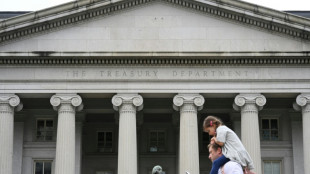
Mysterious rise in US Treasury yields perturbs markets / Photo: CHIP SOMODEVILLA - GETTY IMAGES NORTH AMERICA/AFP/File

 How a glacier collapse may have caused Nepal-Tibet disaster

 Harmovest Capital Strengthens Global Financial Services Through Technology and Compliance

 Nvidia to buy AI platform Hugging Face for $12.9 bn: report

 Palace intrigue in Uganda as succession battle heats up

 'Housing First' approach gets Swedish city's homeless off streets

 Czech duo Muchova and Mensik win US Open mixed doubles title

 Japan's 'polka dot queen' artist Yayoi Kusama dies aged 97

 Nepal-Tibet disaster: what we know

 China deploys record number of ships around Taiwan as pressure grows

 Ruthless Bayern target treble as rivals reboot on Bundesliga return

 What experts know so far about Nepal's deadly floods

 UEFA set to withdraw FIFA boycott threat ahead of Champions League draw

 Sumo moves to beat Japan summer heat as temperatures rise
 'Be more honest': Markets crave clarity from cryptic Fed chair

 Climate change leaves its mark on America's largest reservoir

 CIA director warned Russia not to attack NATO members: US media
 Search for missing after Nepal-Tibet floods kills at least 160
 Meta, US states agree $18 bn settlement in landmark teen safety case

 What scientists know so far about Nepal's deadly floods

 US general visits Colombia to discuss war on drugs

 Meta settlement puts social media industry on notice: 'There will be more'

 NFL owners approve record Seahawks sale

 Nigerian armed groups net nearly $6 mn in ransoms: study

 Savio scores on debut as Spurs advance in League Cup

 Mbappe hits treble as Real Madrid thrash Real Sociedad

The surge in US treasury yields has sparked much anxiety among investors, in part because there is no easy explanation for the rise.
On Friday, the yield on the 10-year US Treasury note climbed to 4.88 percent for the first time since 2007, while the 30-year offering reached 5.05 percent, also a 16-year peak.
Both have edged back in recent days, due mainly to elevated geopolitical risk, analysts say, although yields remain high.
The most oft-cited justification for the rise has been expectations that monetary policy will stay hawkish in response to the resilient US economy.
"The Fed expectations have been shifting," said John Canavan, analyst at Oxford Economics.
"From the Fed's perspective, we're seeing stronger than expected economic growth, some increase in inflation and uncertainty, particularly as oil prices surge again."
While two-year US treasuries are considered the closest proxy to Fed interest rates, the market has been unsettled by the jump in yields of longer-run bonds of five, 10 or 30 years.
"Something is happening in the bond market and nobody fully understands how you kind of break it down," said Adam Button of ForexLive.
Karl Haeling of LBBW pointed to increased bond issuance by the US Treasury Department, saying markets are increasingly worried that the US "fiscal situation is moving on a long-term unsustainably bad trajectory."
For Yardeni Research, "the bond market has changed recently and disconcertingly," the consultancy said in a recent posting.
Perplexing moves by US treasuries in response to economic news "suggest a shift in bond investors' focus from what monetary policymakers may do, to rising alarm about what fiscal policymakers are doing."
"The worry is that the escalating federal budget deficit will create more supply of bonds than demand can meet, requiring higher yields to clear the market," added Yardeni Research.
But not everyone is on board with this perspective.
"We can blame higher long-run yields on many things, but deficits are not one of them," said Nick Colas of DataTrek Research.
- Fewer buyers -
Yet another factor in the market shift has been a slowing in demand.
"Central banks are no longer buying bonds, they are selling them," Neil Wilson, chief market analyst at Markets.com, said of the retreat.
After multiple rounds of quantitative easing, the Fed has been in a belt-tightening mode, reducing the size of its balance sheet and not replacing bonds that reach maturity with new purchases.
But Peter Boockvar, chief investment officer of Bleakley Financial Group, said that the US central bank may not be able to pull of "quantitative tightening," noting that the Fed reversed course in 2019 following turbulence in markets.
A "failure" by the Fed means "things cracking in the financial system well before the Fed's balance sheet shrinks by much and we're left with this perpetually large Fed presence in the markets."
The US central bank might be forced to resume quantitative easing "just to help absorb the massive amount of Treasury supply coming down the DC pike," Boockvar said.
"Someone else has to buy the debt and there is a lot more of it now," Wilson said. "This can only result in lower prices, higher yields."
The group that has stepped back from US Treasury purchases includes China, which is managing a difficult economic recovery after Covid-19 lockdowns, and Japan, which has been buying domestic bonds to suppress yields, said Jose Torres of Interactive Brokers.
"We're going to have a debt crisis in this country," Ray Dalio, head of the hedge fund Bridgewater Associates, warned in an interview on CNBC.
"How fast it transpires, I think, is going to be a function of that supply-demand issue."
But not everyone is so gloomy.
"As long as US Treasury securities are regarded as risk-free securities, there is always going to be demand for Treasuries," said LPL Financial's Lawrence Gillum. "And with Treasury yields at the highest levels in decades, we could see that demand increase as well."
The aging of global populations is another source of demand, said Oxford Economics' Caravan.
"There's going to be an exceptional amount of global savings," Caravan said. "And that global savings glut is going to continue to look for a home in US treasuries, which remain the safest and most liquid asset on the planet."
R.J.Fidalgo--PC