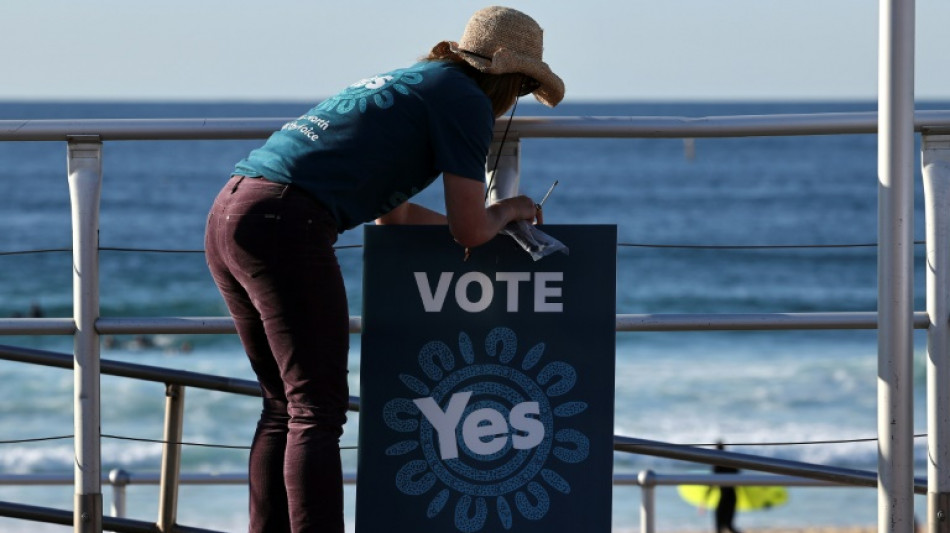
Polls open in Australia's historic Indigenous rights referendum / Photo: DAVID GRAY - AFP

 Desperate families search for missing after Nepal floods
 The missing in Nepal-Tibet flash floods
 Search for 1,300 missing after deadly Nepal-Tibet floods

 Once a top export, prized Kashmir carpet fades
 Search for 1,000 missing after deadly Nepal-Tibet floods
 Park So-yeon first woman to play for eSports powerhouse South Korea
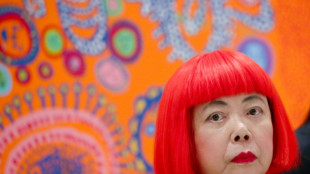 Yayoi Kusama: Japan's kaleidoscopic, troubled 'polka dot queen'
 Euro champ Hunt 'on her toes' against world's best in Zurich 100m
 Asian chip firms lifted by Nvidia forecast but broader markets struggle
 Search for missing after Nepal-Tibet floods kill 165
 Qantas says profits slump as fuel costs surge
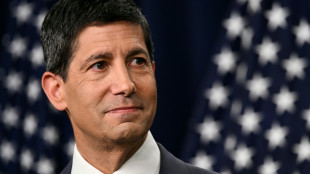
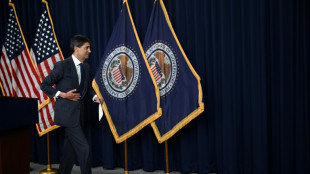 Lofty bond yields, Bessent's intervention pose challenge to Fed's Warsh
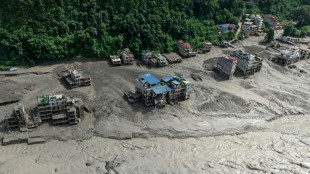 The foreigners missing in Nepal's flash floods
 Bond yields are surging: Here's why that could spell trouble
 Fed's Cook rejects Trump mortgage fraud claims
 Police probe 'assault allegations' after Carse's nightclub incident
 How we might hear new Dolly Parton music in the future
 Nvidia doubles revenue, forecasts even more AI spending
 Canada renews push to boycott US products

 Savio scores on debut as Spurs set-up League Cup tie with Liverpool
 Brazil sues Discord over child safety measures, demands $100 mln in damages

 Alberta NDP Urges Smith to Postpone Separation Vote Amid Trade War

 Fenerbahce stun Lyon in Champions League as AEK crush Levski
 Why Global Finance Still Relies on Wall Street Despite Diversification Trends
 Bethlehem Father Seeks Aid for Special Needs Children Amid Health Crisis
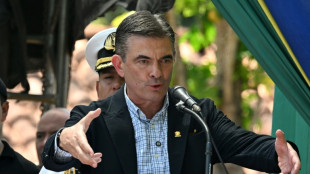
Polls opened Saturday in Australia's historic referendum on rights and recognition for Indigenous citizens, capping a campaign that has exposed deep fissures between the country's white majority and the descendants of its first inhabitants.
Almost 18 million Australians will cast ballots for or against constitutional changes to explicitly acknowledge Indigenous peoples for the first time and create an advisory body -- a so-called "Voice" -- to weigh laws that affect those communities.
Opinion polls give the reforms little hope, with recent surveys indicating the "yes" camp is polling at just over 40 percent and the "no" side at nearly 60 percent.
Australia's Indigenous people, whose ancestors have lived on the continent for more than 60,000 years, make up just 3.8 percent of the population.
But they have been on the wrong side of deepening inequality since white settlement more than 200 years ago.
Aboriginal and Torres Strait Islanders are much more likely to be sick, imprisoned or to die young than their wealthier white compatriots.
Supporters say the reforms would help address these inequalities.
But polls have consistently shown that most Australians care little about problems in Indigenous communities and rank the issue low down the list of public priorities.
In the days before the vote, media attention has focused as much on events in the Middle East as the political debate at home.
- 'Shameful day' -
The opposition campaign has been successful in amplifying fears about the role and effectiveness of the "Voice" assembly, encouraging voters to vote "no" if they are uncertain.
"Yes" campaigner Karen Wyatt told AFP she was "trying to stay positive" in the face of a seemingly inevitable defeat.
But even before the votes are counted, hard questions are being asked about what a "no" vote would say about Australians' regard for each other, and the willingness to face up to the legacy of an often brutal past.
A rejection of the "Voice" would be "a shameful day for Australia", 59-year-old Wyatt told AFP in Sydney.
"I think it does say something for the path of this country, to say 'no' to something that was a simple request and a generous proposition," she added.
"I hope if it is a 'no', we can recover from it and move forward."
Dee Duchesne, 60, a volunteer for the "no" campaign, said she was "fighting to keep an extra layer of bureaucracy out of our constitution".
She said she had been called racist while handing out leaflets near a Sydney polling station during early voting. "I'm not," she said.
- Fallout -
Centre-left Prime Minister Anthony Albanese has spent a year and much precious political capital advocating for the "yes" campaign.
On the eve of the vote he made an emotional plea for Australians to show kindness.
Speaking in Adelaide on Friday, he said a victory for the "yes" camp "may just make life better" for Indigenous people.
Voting is compulsory for Australia's 17.5 million voters.
The referendum can only pass with support from a majority of voters nationally and a majority of voters in at least four of the country's six states.
Polling opened on the populous east coast at 8 am Saturday (2100 GMT on Friday), with more than 7,000 voting stations across the country.
Referendum expert Matt Qvortrup told AFP he expected the "Voice" to get between 46 and 48 percent of the vote.
People are more likely to vote for something if they do not need to learn about the issue, he told AFP, using the 2017 vote on gay marriage as an example.
That vote saw 62 percent support for allowing same-sex couples to marry.
"People would know gay people, they had formed an opinion about this, they didn't have to learn new things about it," Qvortrup said.
"When people have already formed an opinion, then you can actually get an increase in the vote because people have a fairly good idea of what it's about."
Voters are unlikely to be swayed by what celebrities say, he added, especially if they are seen as having little credibility on the issue.
R.Veloso--PC