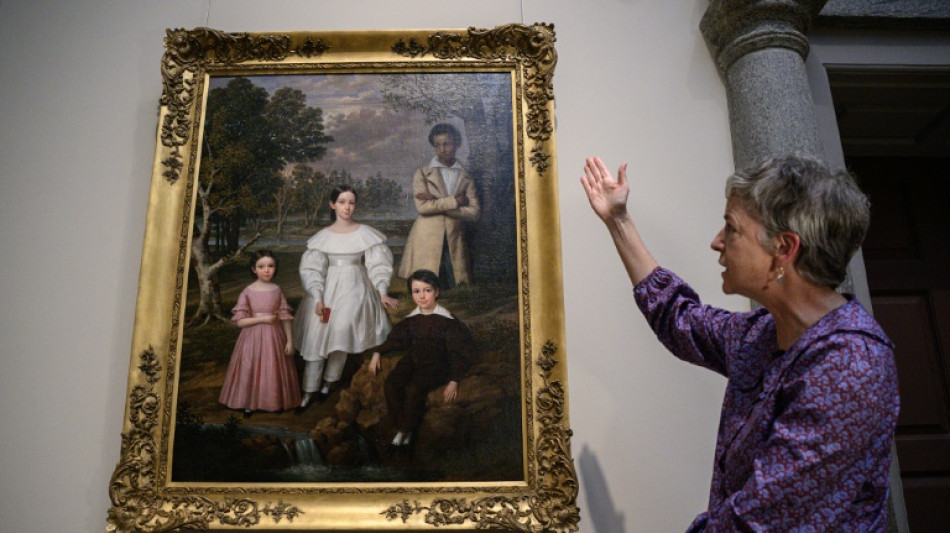
Young slave, once painted out, is back in a work at New York's Met / Photo: Ed JONES - AFP/File

 Desperate families search for missing after Nepal floods

 The missing in Nepal-Tibet flash floods
 Search for 1,300 missing after deadly Nepal-Tibet floods

 Once a top export, prized Kashmir carpet fades

 Search for 1,000 missing after deadly Nepal-Tibet floods

 Park So-yeon first woman to play for eSports powerhouse South Korea

 Yayoi Kusama: Japan's kaleidoscopic, troubled 'polka dot queen'

 Euro champ Hunt 'on her toes' against world's best in Zurich 100m

 Asian chip firms lifted by Nvidia forecast but broader markets struggle

 Search for missing after Nepal-Tibet floods kill 165

 Qantas says profits slump as fuel costs surge

 Lofty bond yields, Bessent's intervention pose challenge to Fed's Warsh

 The foreigners missing in Nepal's flash floods

 Bond yields are surging: Here's why that could spell trouble

 Fed's Cook rejects Trump mortgage fraud claims

 Police probe 'assault allegations' after Carse's nightclub incident

 How we might hear new Dolly Parton music in the future

 Nvidia doubles revenue, forecasts even more AI spending

 Canada renews push to boycott US products

 Savio scores on debut as Spurs set-up League Cup tie with Liverpool
 Brazil sues Discord over child safety measures, demands $100 mln in damages

 Alberta NDP Urges Smith to Postpone Separation Vote Amid Trade War

 Fenerbahce stun Lyon in Champions League as AEK crush Levski

 Why Global Finance Still Relies on Wall Street Despite Diversification Trends
 Bethlehem Father Seeks Aid for Special Needs Children Amid Health Crisis

For years, the three children from a well-to-do New Orleans family seemed to be the only figures in a nearly forgotten painting attributed to French artist Jacques Amans.
The family's slave, Belizaire, had simply been painted over, erased from both history and the picture, which this week went on display -- with his image restored -- at the Metropolitan Museum of Art in New York.
For the prestigious Manhattan museum, the artwork represents "the first naturalistic representation of a named enslaved individual pictured in a Southern setting," said Sylvia Yount, the curator in charge of the museum's American wing.
"We have no other work like this in the collection, and it allows us to tell a lot of different, interesting and complicated stories," she told AFP, standing before the 1837 oil painting, on display since Thursday.
And yet despite its significance, the young enslaved man -- standing erect, arms crossed and with a grave expression -- had nearly disappeared forever from the painting, commissioned by the children's father, Frederick Frey, a successful New Orleans banker originally from Germany.
- Painted over -
While no one knows the exact reason, the mixed-race lad was painted over, probably early in the 20th century. Frey and his wife were both dead by then, and the painting had been passed on to an heir.
"The family may not have been proud, or they may have been ashamed" to have an enslaved worker in the painting "because it really implicates them, you know, as a slaveholding family," said Yount.
"The other side of that could be that they just didn't want a black figure shown with their white ancestors."
In 1972, the New Orleans Museum of Art acquired the painting but kept it in storage until reselling it in 2004. In 2005 the work's new owner had it restored -- and the young slave reappeared.
Still, it was only through the involvement of Louisiana collector Jeremy K. Simien, a man passionate about representations of Creoles in local art, that the work's importance came to public attention.
Simien first discovered the painting on an auction website and then, while doing further research, was stunned to see how it had changed from the time the New Orleans museum sold it.
"I could see it ghosting through, I could see the outline," he told AFP. "That really blew my mind."
- Sold at six -
In 2021, Simien acquired the painting, and he hired Katy Shannon, an expert in such historical research, to delve into the Louisiana archives. There she discovered that the young man in the painting was named Belizaire -- and that when he was six, in 1828, he and his mother had been sold to the Freys.
It was an ill-fated time. Two of the three Frey children died the very year the painting was made, possibly of yellow fever, and the third child died a few years later.
Shannon discovered that Belizaire was later sold to a sugarcane plantation.
"We know he did live past the Civil War and become free," Simien said.
He added that he finds the story told by the painting "fascinating, because it's almost as if Belizaire, the boy that we didn't know his name, refused to be erased."
"He serves kind of as a representation of a lot of history that was erased or covered over."
Simien said he was "very excited" that the Met had decided to purchase the work -- for undisclosed terms -- and was treating it with due "dignity and reverence."
The painting is being displayed along with an explanation of its unusual history, and a photo of the version that excluded Belizaire.
Today, as museums work to diversify their collections, "we need to tell these more complicated stories," said Yount.
J.Pereira--PC