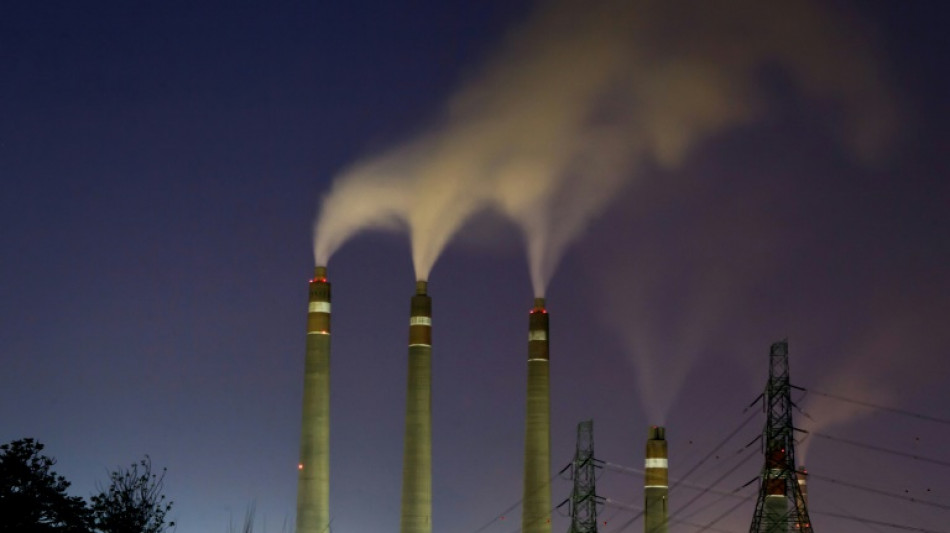
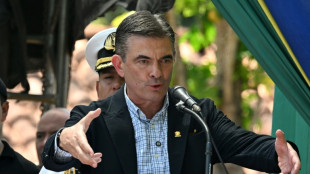
EU climate talks at loggerheads over fossil fuel language / Photo: ADITYA AJI - AFP

 Desperate families search for missing after Nepal floods
 The missing in Nepal-Tibet flash floods
 Search for 1,300 missing after deadly Nepal-Tibet floods

 Once a top export, prized Kashmir carpet fades

 Search for 1,000 missing after deadly Nepal-Tibet floods
 Park So-yeon first woman to play for eSports powerhouse South Korea
 Yayoi Kusama: Japan's kaleidoscopic, troubled 'polka dot queen'

 Euro champ Hunt 'on her toes' against world's best in Zurich 100m
 Asian chip firms lifted by Nvidia forecast but broader markets struggle
 Search for missing after Nepal-Tibet floods kill 165

 Qantas says profits slump as fuel costs surge
 Lofty bond yields, Bessent's intervention pose challenge to Fed's Warsh
 The foreigners missing in Nepal's flash floods
 Bond yields are surging: Here's why that could spell trouble
 Fed's Cook rejects Trump mortgage fraud claims
 Police probe 'assault allegations' after Carse's nightclub incident
 How we might hear new Dolly Parton music in the future
 Nvidia doubles revenue, forecasts even more AI spending

 Canada renews push to boycott US products

 Savio scores on debut as Spurs set-up League Cup tie with Liverpool

 Brazil sues Discord over child safety measures, demands $100 mln in damages

 Alberta NDP Urges Smith to Postpone Separation Vote Amid Trade War

 Fenerbahce stun Lyon in Champions League as AEK crush Levski

 Why Global Finance Still Relies on Wall Street Despite Diversification Trends

 Bethlehem Father Seeks Aid for Special Needs Children Amid Health Crisis
A major stumbling block to defining the European Union's position at the most important climate negotiations in years lies in the ambiguity surrounding one term: unabated fossil fuels.
Ditching coal, oil and gas for cleaner energies is essential if the world is to slash greenhouse gas emissions and avoid the most catastrophic consequences of climate change.
The UN COP28 talks starting on November 30 in Dubai are arguably the most important since the 2015 Paris Agreement, where countries embraced a goal of limiting warming to "well below" two degrees Celsius since pre-industrial times, and preferably to the more ambitious target of 1.5C.
The EU negotiating mandate has to be unanimously adopted for member states to back it at COP28, with the bloc's environment ministers meeting in Luxembourg to discuss a common position on Monday.
The 27 EU countries have already set themselves a horizon of 2050 to abolish "unabated" fossil fuels.
But the absence of consensus over what "unabated" means for the energy transition is straining debate between EU members and threatens to derail efforts to accelerate decarbonising the global economy.
"There isn't an internationally agreed definition of what 'unabated' or 'abated' mean," said Katrine Petersen, a senior policy adviser at climate change think tank E3G.
The tug-of-war over "unabated" has focused significantly on carbon capture and storage (CCS) technologies touted by the fossil fuel industry and major producing countries, including oil-rich COP28 host the United Arab Emirates.
With CCS, power stations running on fossil fuels could theoretically aim for net zero if fitted with equipment that prevents their carbon emissions from polluting the atmosphere.
The technology could also be used to justify expanded exploration and production.
Critics say CCS cannot capture all emissions, lacks sufficient storage capacity and distracts from slashing and eventually eliminating fossil fuel use.
- Conflicting visions -
But it is currently unclear what proportion of a power station's emissions would need to be captured to qualify as "abated".
The lack of a clear definition risks making fossil fuel commitments "open to interpretation", Petersen told AFP.
Any fossil fuel phaseout commitment at COP28 that includes the term unabated must set a tight and clear definition to align with 1.5C and guard against loopholes, Petersen added.
Some European governments want the "unabated" label withdrawn or have strict conditions attached to CCS use, to prevent it being used to justify continued fossil fuel burning.
France, Spain and the new EU climate commissioner Wopke Hoekstra say CCS should only be used in certain sectors where decarbonisation options are limited.
"There's no alternative for driving down emissions across the board," said Hoekstra.
"However, some sectors are extremely hard to abate" and thus carbon-capture technology was needed "as part of the total solution space," he added.
- 'Expensive and unproven' -
Few power plants currently operate with the technology, which the International Energy Agency says is "expensive and unproven at scale".
Sultan Al Jaber, COP28 president and head of the UAE's national oil company ADNOC, has said climate diplomacy should focus on phasing out oil and gas emissions -- not necessarily the fossil fuels themselves.
His stance clashes with nations seeking a commitment to phasing out oil, gas and coal altogether, such as Pacific island nations that could be swallowed by rising seas.
Resistance from countries dependent on oil and gas could make it difficult for such language to appear in the final COP28 agreement, EU sources said.
B.Godinho--PC