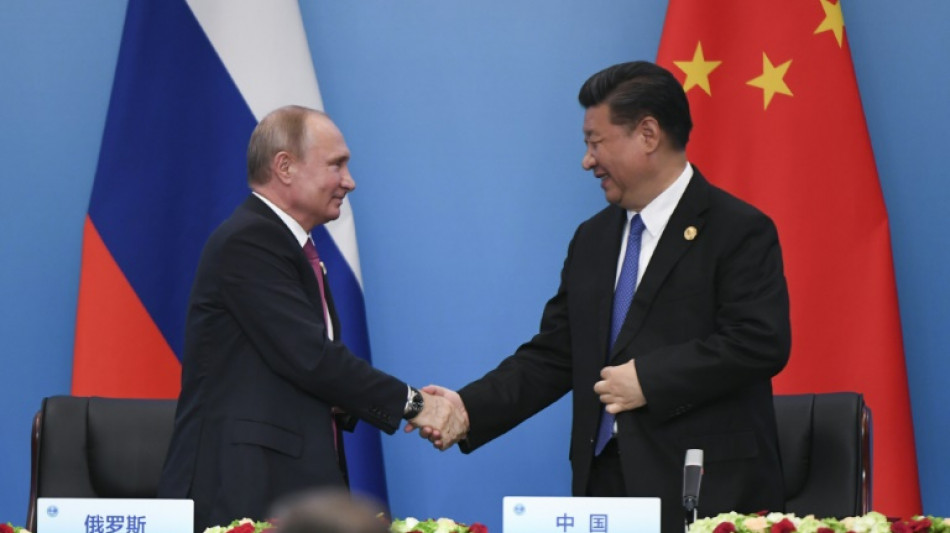
Xi, Putin to freshen decade-long friendship at Beijing summit / Photo: WANG ZHAO - AFP/File

 Desperate families search for missing after Nepal floods
 The missing in Nepal-Tibet flash floods

 Search for 1,300 missing after deadly Nepal-Tibet floods

 Once a top export, prized Kashmir carpet fades

 Search for 1,000 missing after deadly Nepal-Tibet floods

 Park So-yeon first woman to play for eSports powerhouse South Korea
 Yayoi Kusama: Japan's kaleidoscopic, troubled 'polka dot queen'
 Euro champ Hunt 'on her toes' against world's best in Zurich 100m

 Asian chip firms lifted by Nvidia forecast but broader markets struggle
 Search for missing after Nepal-Tibet floods kill 165
 Qantas says profits slump as fuel costs surge
 Lofty bond yields, Bessent's intervention pose challenge to Fed's Warsh

 The foreigners missing in Nepal's flash floods
 Bond yields are surging: Here's why that could spell trouble

 Fed's Cook rejects Trump mortgage fraud claims
 Police probe 'assault allegations' after Carse's nightclub incident

 How we might hear new Dolly Parton music in the future
 Nvidia doubles revenue, forecasts even more AI spending

 Canada renews push to boycott US products

 Savio scores on debut as Spurs set-up League Cup tie with Liverpool

 Brazil sues Discord over child safety measures, demands $100 mln in damages

 Alberta NDP Urges Smith to Postpone Separation Vote Amid Trade War

 Fenerbahce stun Lyon in Champions League as AEK crush Levski

 Why Global Finance Still Relies on Wall Street Despite Diversification Trends

 Bethlehem Father Seeks Aid for Special Needs Children Amid Health Crisis

Ten years after toasting a budding friendship with vodka and cake, Xi Jinping and Vladimir Putin will meet again in Beijing this week seeking to further deepen the "no-limits" partnership between their two countries.
The two presidents share a strong personal bond, with Xi calling his Russian counterpart his "best friend" and Putin cherishing his "reliable partner".
Their relationship has been a constant despite a decade of increasingly difficult relations with Western countries -- exemplified by Russia's ongoing invasion of Ukraine, which China has refused to condemn.
Putin's attendance at a leaders forum in the Chinese capital this week is not only a rare foreign trip for the Russian leader, but also an opportunity to pay homage to Xi's signature Belt and Road infrastructure initiative.
"(The) Russian delegation's presence in Beijing is important for Moscow," said Alicja Bachulska, an expert on Chinese foreign policy at the European Council on Foreign Relations.
"It will legitimise Russia in the international arena by creating a positive image of Putin not being completely isolated in the context of war," she told AFP.
Xi and Putin forged their friendship when the pair shared cake and vodka shots to mark the Russian leader's birthday at a summit in Indonesia in 2013.
They have since drawn closer, with Xi whisking Putin away on a high-speed train ride across China to make traditional steamed buns in 2018.
Putin later returned the favour with caviar-topped pancakes and a river cruise on Xi's subsequent visits to Russia.
In 2019, the Russian leader even threw Xi a birthday bash of his own, surprising him with ice cream at a conference in Tajikistan.
The two men's lives share several similarities -- they were born just a few months apart in the early 1950s and have both fathered daughters.
They are products of two socialist giants, with Xi the scion of a family of Communist revolutionaries and Putin a former Soviet intelligence officer.
Both are haunted by the collapse of the USSR -- for Putin, a "major geopolitical disaster" and for Xi, a cautionary tale for China's own Communist Party.
And both have invoked themes of national revitalisation while suppressing dissent during their long and increasingly unchallenged years in power.
- 'Pro-Russia neutrality' -
Mirroring their leaders' ties, Beijing and Moscow have also huddled closer in recent years, viewing each other as a counterbalance against the US-led West.
The two countries describe their relationship as a "comprehensive strategic partnership" that has "no limits" on potential cooperation.
Their amity has endured despite Russia's frontal assault on Ukraine since last year, thrusting Moscow and Putin into international isolation.
Beijing has resisted calls to condemn the invasion and depicted itself as a neutral party, stopping short of providing weapons for Moscow.
But it has echoed Russia in blaming Western countries -- especially the NATO defence alliance -- for creating the conditions for the war's outbreak.
Joe Webster, an expert on China-Russia relations at the Atlantic Council, described Beijing's stance on the war as "pro-Russia neutrality".
That has involved crucial diplomatic, economic and non-lethal military assistance for Moscow against a background of booming bilateral trade, he said.
But he added that the aborted mutiny by Russian mercenary Yevgeny Prigozhin this summer "shocked Beijing and led it to recalibrate relations with Moscow".
The threat of Putin's ouster means "Beijing (now) seeks to depersonalise the relationship and institutionalise ties between the two political systems... to ensure close ties with Russia regardless of who occupies the power vertical", Webster said.
- 'Client relationship' -
The subtle shift in rhetoric illuminates the lopsided nature of the China-Russia relationship -- one that sees Moscow increasingly relying on its neighbour to prop up its economy and help sustain its war machine.
"Since Moscow embarked on its all-out invasion of Ukraine, it has been put in a position where it is unprecedentedly dependent on China," said Bjorn Alexander Duben, an international relations scholar at China's Jilin University.
"(Russia's) continued economic engagement with China is gradually turning into a relationship of direct dependence –- raising the question whether Russia is steering towards a client relationship with Beijing," he said.
Analysts said that Putin's sojourn in the Chinese capital was more focused on shoring up political support than securing big-ticket deals like the much-touted Power of Siberia-2 gas pipeline.
"We might see results in the coming (months and) years with infrastructure projects being realised, but I don't expect any kind of significant big deliverables this time," said Alexander Gabuev, director of the Carnegie Russia Eurasia Center.
"China holds all of these cards. Russia would desperately want to have an announced deal, but China has leverage and can dictate the pace," he said.
A.F.Rosado--PC