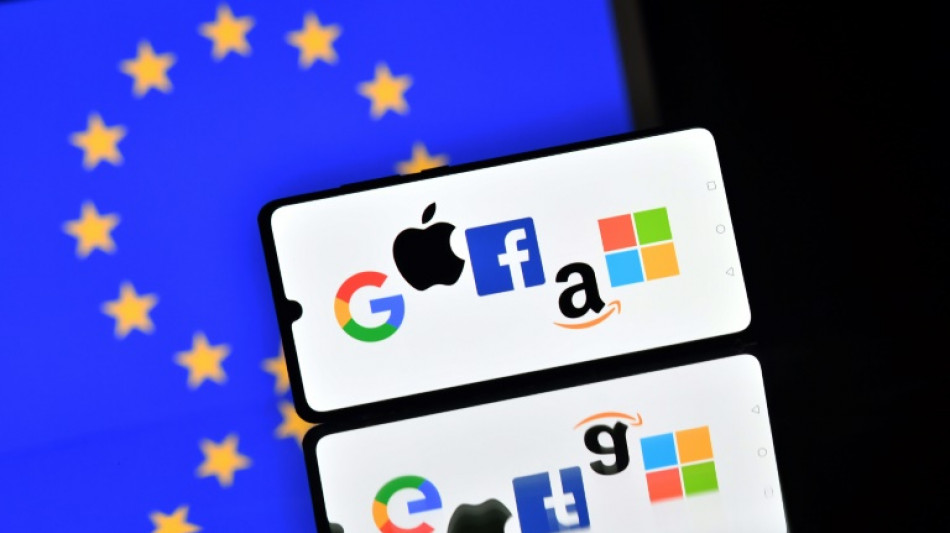
What to know about the EU's landmark digital content act / Photo: JUSTIN TALLIS - AFP/File

 Once a top export, prized Kashmir carpet fades

 Search for 1,000 missing after deadly Nepal-Tibet floods

 Park So-yeon first woman to play for eSports powerhouse South Korea

 Yayoi Kusama: Japan's kaleidoscopic, troubled 'polka dot queen'

 Euro champ Hunt 'on her toes' against world's best in Zurich 100m

 Asian chip firms lifted by Nvidia forecast but broader markets struggle

 Search for missing after Nepal-Tibet floods kill 165

 Qantas says profits slump as fuel costs surge
 Lofty bond yields, Bessent's intervention pose challenge to Fed's Warsh

 The foreigners missing in Nepal's flash floods

 Bond yields are surging: Here's why that could spell trouble

 Fed's Cook rejects Trump mortgage fraud claims

 Police probe 'assault allegations' after Carse's nightclub incident

 How we might hear new Dolly Parton music in the future

 Nvidia doubles revenue, forecasts even more AI spending
 Canada renews push to boycott US products

 Savio scores on debut as Spurs set-up League Cup tie with Liverpool

 Brazil sues Discord over child safety measures, demands $100 mln in damages

 Alberta NDP Urges Smith to Postpone Separation Vote Amid Trade War

 Fenerbahce stun Lyon in Champions League as AEK crush Levski

 Why Global Finance Still Relies on Wall Street Despite Diversification Trends

 Bethlehem Father Seeks Aid for Special Needs Children Amid Health Crisis

 LIV Golf to lay off majority of staff

 How narwhal 'scientists' track Arctic warming

 Iran says US sanctions will achieve nothing

The EU's milestone legislation, known as the Digital Services Act, demands digital giants crack down on illegal and problematic content.
Brussels is bearing its teeth, launching investigations into X, formerly Twitter, as well as Facebook parent Meta and TikTok following Hamas' assault on Israel on October 7 and its aftermath.
The DSA is a mammoth law that will force digital giants to aggressively police content online in the European Union and could see them hit with major fines.
Here are the regulation's key elements:
- Rules for all platforms -
The law kicks in for all platforms from February 17, 2024, but since August it already applies for very large platforms with more than 45 million active monthly users.
Among their obligations, all platforms must quickly remove illegal content or make access to it impossible as soon as they are aware of the issue.
The companies must also rapidly inform the authorities when they suspect a criminal offence that threatens people's lives or the safety of others.
Every year the platform must publish a report that provides details about actions taken on content moderation and how long they took to respond after notification of illegal content. They will also report on the decisions taken in disputes with users.
The law also tells platforms to suspend users who frequently share illegal content such as hate speech or fake ads, while online shopping sites must verify the identities of users and block repeat fraudsters.
There are also tougher rules on targeted advertising, with a ban on such ads for children aged 17 and under.
The EU also wants users to see how their data is used. The law bans targeted advertising based on sensitive data, such as ethnicity, religion or sexual orientation.
The law does not apply to very small companies.
- Extra rules for large platforms -
The EU has named 19 "very large" platforms including Apple, Amazon, Facebook, Google, Instagram, Microsoft, Snapchat, TikTok and clothing retailer Zalando.
Amazon and Zalando have launched legal challenges to their designations.
These large platforms must assess the risks linked to their services with regards to the spread of illegal content and privacy infringements.
And they must also set up structures internally to mitigate such risks, such as improved content moderation.
The platforms must also give regulators' access to their data so officials can see whether they are complying with the rules.
This access will also be shared with approved researchers.
They will be audited once a year by independent organisations -- at their own expense -- to ensure compliance, and also establish an independent internal supervisor that will keep an eye on whether the platforms are in line with the rules.
- EU, national coordination -
Under the law, the EU's 27 member states must assign a competent authority that has the powers to investigate and sanction any violation.
These authorities must work with each other and with the European Commission, the EU's executive arm, to enforce the regulation from February.
If a digital platform provider is located in one member state, that country must enforce the rules except for very large platforms which will come under the commission's supervision.
- Complaints, penalties -
The DSA wants to make it easier for users' complaints to be heard.
Users will be able to lodge a complaint claiming a platform is in violation of the DSA with their competent national authority.
Online shopping sites may be held responsible for any damage from products bought by users that are non-compliant or dangerous.
Violations can be met with fines that could go up to six percent of a company's global turnover, and for repeated non-compliance, the EU can even decide to ban offending platforms from Europe.
V.Dantas--PC