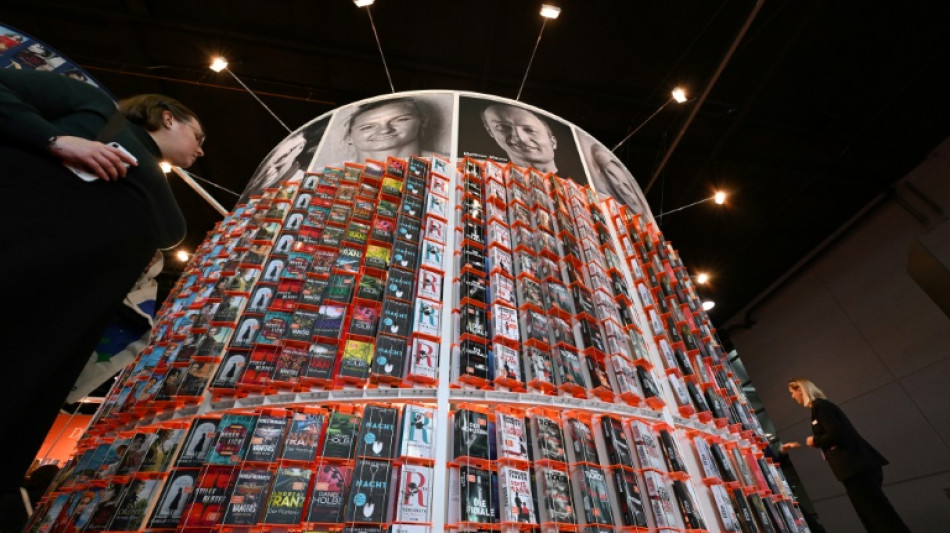
Did a computer write this? Book industry grapples with AI / Photo: Kirill KUDRYAVTSEV - AFP

 Once a top export, prized Kashmir carpet fades

 Search for 1,000 missing after deadly Nepal-Tibet floods

 Park So-yeon first woman to play for eSports powerhouse South Korea

 Yayoi Kusama: Japan's kaleidoscopic, troubled 'polka dot queen'

 Euro champ Hunt 'on her toes' against world's best in Zurich 100m

 Asian chip firms lifted by Nvidia forecast but broader markets struggle

 Search for missing after Nepal-Tibet floods kill 165

 Qantas says profits slump as fuel costs surge
 Lofty bond yields, Bessent's intervention pose challenge to Fed's Warsh

 The foreigners missing in Nepal's flash floods

 Bond yields are surging: Here's why that could spell trouble

 Fed's Cook rejects Trump mortgage fraud claims
 Police probe 'assault allegations' after Carse's nightclub incident

 How we might hear new Dolly Parton music in the future

 Nvidia doubles revenue, forecasts even more AI spending

 Canada renews push to boycott US products
 Savio scores on debut as Spurs set-up League Cup tie with Liverpool

 Brazil sues Discord over child safety measures, demands $100 mln in damages

 Alberta NDP Urges Smith to Postpone Separation Vote Amid Trade War

 Fenerbahce stun Lyon in Champions League as AEK crush Levski

 Why Global Finance Still Relies on Wall Street Despite Diversification Trends
 Bethlehem Father Seeks Aid for Special Needs Children Amid Health Crisis

 LIV Golf to lay off majority of staff

 How narwhal 'scientists' track Arctic warming

 Iran says US sanctions will achieve nothing

From low-quality computer-written books flooding the market to potential copyright violations, publishing is the latest industry to feel the threat from rapid developments in artificial intelligence.
Since the launch last year of ChatGPT, an easy-to-use AI chatbot that can deliver an essay upon request within seconds, there have been growing worries about the impact of generative AI on a range of sectors.
Among book industry players there is "a deep sense of insecurity", said Juergen Boos, director of the Frankfurt Book Fair, the world's biggest, where the topic was in focus last week.
They are asking "what happens to authors' intellectual property? Who does new content actually belong to? How do we bring this into value chains?" he said.
The threat is plain to see -- AI writing programs allow budding authors to produce in a matter of day novels that could in the past have taken months or years to write.
A flood of titles that list ChatGPT as a co-author have been offered for sale through Amazon's e-book self-publishing unit.
Still, critics say the works are of low quality and sense little threat from AI for now.
British author Salman Rushdie told a press conference at the fair that recently someone asked an AI writing tool to produce 300 words in his style.
"And what came out was pure garbage," said the "Midnight's Children" writer, to laughter from the audience.
"Anybody who has ever read 300 words of mine would immediately recognise that it could not possibly be by me."
"So far I'm not that alarmed," he added, during a rare public appearance since a near-fatal stabbing attack last year in the United States.
- 'Still not great' -
Jennifer Becker, a German author and academic, echoed his sentiments, telling a panel discussion that the results when it comes to AI writing fiction "are still not that great".
"There is a lot of potential to use it -- to use it collaboratively.
"But I still don't see the point where we really hand over the writing work to AI completely autonomously. That wouldn't make for an interesting book."
Industry players stress however that in some areas there is more openness to dealing with artificial intelligence.
"It depends a bit on the genre," said Susanne Barwick, deputy legal adviser of the German Publishers and Booksellers Association, who has been in discussion about AI with publishers.
"The field of science and specialist books is already further along and has already dealt with it more."
These areas were "easier than the field of fiction, where I think at the moment people still tend to look a bit more at the risks", she added.
Artificial intelligence's relationship with publishing threatens to throw up a host of legal problems, with one major "grey area" being who owns copyright of AI-generated content, said fair director Boos.
"Then you get into a real mess, and it is a huge theme. There is also really a lot of money involved," he said.
- Legal clashes -
There are already AI-related legal clashes involving top writers.
Last month, "Game of Thrones" author George RR Martin, John Grisham and Jodi Picoult were among several writers who filed a class-action lawsuit against ChatGPT creator OpenAI over alleged violation of copyrights.
Along with the Authors Guild, an organisation representing writers, they accused the California-based company of using their books "without permission" to train ChatGPT's "large language models", algorithms capable of producing human-sounding text responses based on simple queries, according to the lawsuit.
Translation is another thorny area, with some industry players feeling artificial intelligence would miss the nuances and subtleties needed to render complex literature into other languages.
Efforts are being made to make it clearer when AI has been involved in producing a book.
Amazon recently released new guidelines that require authors who want to sell books through its self-publishing unit to tell the company in advance if their work includes material generated using artificial intelligence.
And some recognise the opportunities when it comes to AI and writing -- for example, in producing stereotypical romance novels.
This, Boos joked, could bring "some relief" that "people don't have to deal with that kind of content any more, and it can simply be generated at home on the computer".
V.Dantas--PC