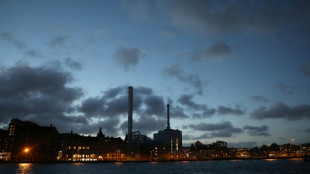
Eurozone business activity going from 'bad to worse' / Photo: David GANNON - AFP/File

 Once a top export, prized Kashmir carpet fades

 Search for 1,000 missing after deadly Nepal-Tibet floods

 Park So-yeon first woman to play for eSports powerhouse South Korea

 Yayoi Kusama: Japan's kaleidoscopic, troubled 'polka dot queen'
 Euro champ Hunt 'on her toes' against world's best in Zurich 100m

 Asian chip firms lifted by Nvidia forecast but broader markets struggle
 Search for missing after Nepal-Tibet floods kill 165

 Qantas says profits slump as fuel costs surge
 Lofty bond yields, Bessent's intervention pose challenge to Fed's Warsh

 The foreigners missing in Nepal's flash floods
 Bond yields are surging: Here's why that could spell trouble

 Fed's Cook rejects Trump mortgage fraud claims
 Police probe 'assault allegations' after Carse's nightclub incident

 How we might hear new Dolly Parton music in the future

 Nvidia doubles revenue, forecasts even more AI spending
 Canada renews push to boycott US products

 Savio scores on debut as Spurs set-up League Cup tie with Liverpool

 Brazil sues Discord over child safety measures, demands $100 mln in damages

 Alberta NDP Urges Smith to Postpone Separation Vote Amid Trade War

 Fenerbahce stun Lyon in Champions League as AEK crush Levski

 Why Global Finance Still Relies on Wall Street Despite Diversification Trends
 Bethlehem Father Seeks Aid for Special Needs Children Amid Health Crisis
 LIV Golf to lay off majority of staff

 How narwhal 'scientists' track Arctic warming

 Iran says US sanctions will achieve nothing

Eurozone business activity slumped at a faster pace in October, resulting in job losses, a closely watched Purchasing Managers' Index (PMI) survey put out by S&P Global showed Tuesday.
The PMI score for October slumped to 46.5, lower than the revised 47.2 given for September.
A figure under 50 indicates a contraction of business activity, while one over 50 suggests growth.
"In the eurozone, things are moving from bad to worse," said Cyrus de la Rubia, chief economist at the Hamburg Commercial Bank which partners with S&P for the PMI.
"We wouldn't be caught off guard to see a mild recession in the eurozone in the second half of this year," he said.
The lacklustre reading will add to pressure on the European Central Bank to pause its succession of interest rate hikes when its governing council next meets in December.
Although eurozone inflation is still far above the ECB's two-percent target -- driven up since last year by Russia's invasion of Ukraine -- it is slowing, and economic headwinds are growing.
The PMI score has now dropped for five successive months, and was declining at the fastest pace since November 2020.
The data showed private-sector activity in the eurozone was shrinking at the fastest rate in a decade if figures from pandemic-affected months were stripped out. New orders were plummeting.
"Companies cut employment as a result, representing the first drop in headcounts since the lockdowns of early 2021," S&P Global said in a statement giving the PMI survey result.
Jobs in the manufacturing sector were being shed at the fastest rate since August 2020, and hiring in the services sector was close to a standstill.
- France, Germany slumping -
The year-ahead outlook of purchasing managers questioned "remained among the weakest seen over the past year," even if it there was a "marginal" uptick for October.
Even though the eurozone's number-two economy France saw a slower services sector decline, partly offsetting a sharper manufacturing slide, PMI sentiment was slumping faster than in number-one economy Germany.
"France and Germany have now respectively seen five and four months of falling output, while the rest of the eurozone as a whole has seen three straight monthly declines," S&P Global said.
The ECB has been tightening the monetary screws a turn at every one of its last 10 meetings, and the bank's key deposit rate now sits at an unprecedented four percent.
The conflict in the Middle East has added to uncertainty for economic forecasts, however, with markets watching for signs it might send oil prices even higher.
ECB President Christine Lagarde has acknowledged the "pain" felt by households as a result of the aggressive rate hikes, but has cautioned against relenting too soon.
Analysts said the ECB was likely to pause its rate rises for now, but keep monetary policy tight for some time going forward.
Consumer prices in the 20-nation currency bloc rose at an annual rate of 4.3 percent in September, its lowest rate in almost two years.
The International Monetary Fund revised its forecast for Germany downwards earlier this month, predicting Europe's biggest economy would shrink by 0.5 percent in 2023, while the eurozone as a whole would limp to 0.7-percent growth.
G.M.Castelo--PC