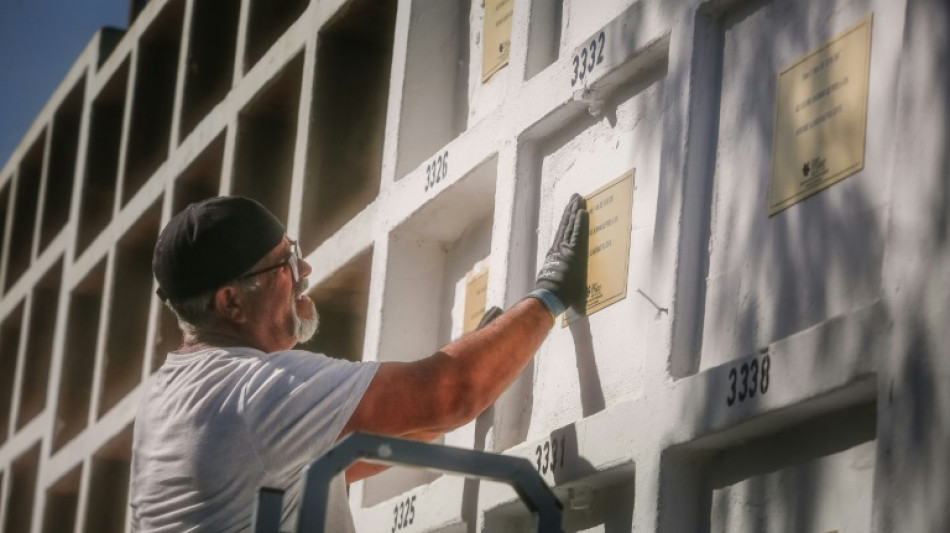
Migrants find final resting spot on Spain's Canary islands / Photo: DESIREE MARTIN - AFP

 Once a top export, prized Kashmir carpet fades

 Search for 1,000 missing after deadly Nepal-Tibet floods
 Park So-yeon first woman to play for eSports powerhouse South Korea
 Yayoi Kusama: Japan's kaleidoscopic, troubled 'polka dot queen'

 Euro champ Hunt 'on her toes' against world's best in Zurich 100m
 Asian chip firms lifted by Nvidia forecast but broader markets struggle

 Search for missing after Nepal-Tibet floods kill 165

 Qantas says profits slump as fuel costs surge

 Lofty bond yields, Bessent's intervention pose challenge to Fed's Warsh
 The foreigners missing in Nepal's flash floods

 Bond yields are surging: Here's why that could spell trouble
 Fed's Cook rejects Trump mortgage fraud claims

 Police probe 'assault allegations' after Carse's nightclub incident
 How we might hear new Dolly Parton music in the future

 Nvidia doubles revenue, forecasts even more AI spending

 Canada renews push to boycott US products

 Savio scores on debut as Spurs set-up League Cup tie with Liverpool
 Brazil sues Discord over child safety measures, demands $100 mln in damages

 Alberta NDP Urges Smith to Postpone Separation Vote Amid Trade War

 Fenerbahce stun Lyon in Champions League as AEK crush Levski

 Why Global Finance Still Relies on Wall Street Despite Diversification Trends

 Bethlehem Father Seeks Aid for Special Needs Children Amid Health Crisis

 LIV Golf to lay off majority of staff
 How narwhal 'scientists' track Arctic warming
 Iran says US sanctions will achieve nothing

At the cemetery in the town of Aguimes, on the Spanish island of Gran Canaria, plaques marked the burial vaults holding the remains of 15 migrants found dead on board a boat.
Located in the Atlantic off the northwest coast of Africa, Spain's Canary Islands have become a key entry point for migrants seeking a better life in Europe, but strong currents make the route one of the deadliest in the world.
Many bodies that are found dead at sea are hard to identify and so cannot be returned to their families, leaving it up to local Spanish officials to find a final resting place for most of them.
"Here lies a brother who lost his life trying to reach our shores," the 15 plaques read.
Bartolome Gomez, the cemetery's gravedigger, said he picked the inscription along with a local priest so people would know who was buried there "even if we don't know who they are".
"They found the boat in the open sea. They were all dead. Of hunger, of thirst," added Gomez, 61, who was still moved by the tragedy three years after it happened.
The perilous route to the Canary Islands has become particularly frequented since controls tightened in the calmer Mediterranean Sea.
Migrants travel in overloaded wooden boats, which are often unseaworthy and do not carry enough drinking water and food.
More than 7,800 people died or went missing at sea en route to the seven-island archipelago between 2018 and 2022, according to Spanish NGO Caminando Fronteras, which helps migrant boats in distress and the families of those who have gone missing.
Bodies that wash ashore or are found by fishermen or the coast guard at sea are hard to identify, complicating their return to their families and leaving it up to local officials to find a final burial spot.
Forensic doctors collect and store DNA samples, take pictures of any identifying markers such as scars and tattoos and study teeth to try to determine who the migrants are.
"In 90 percent of cases, the bodies remain unidentified and no one asks for them," said Maria Jose Meilan, director of the morgue in Las Palmas, the main city of Gran Canaria.
- 'Miss you so much' -
Burials of migrants found dead at sea are the responsibility of the municipality of the port where the remains are taken, she added, a duty they sometimes struggle to carry out.
The mayor of Mogan, in southwestern Gran Canaria, said last month she did not want to pay for any more migrant burials, saying the central government should instead foot the bill.
Mogan includes the port of Arguineguin, where the Spanish coast guard usually takes migrant ships rescued at sea.
The Las Palmas morgue was forced to store the bodies of over 50 migrants in 2020 for several months until cemeteries were assigned for them, Meilan said, describing it as a "chaotic situation".
At the sprawling San Lazaro cemetery at Las Palmas, a plaque placed on a mound of earth read: "Migrant boat number 4. 25/09/2022".
A little further away was the final resting place of Mohamed, a six-year-old boy who was found dead in a boat in October 2021.
"Your mum, sister and cousin love you and miss you so much," read a laminated sheet of paper.
- 'Very dangerous' -
Other migrants got a much more basic burial spot.
The remains of 30 migrants were buried in a common grave at a cemetery in Mogan decorated with just a few cacti. There was no plaque.
The remains of 16 other migrants were held in burial niches, above-ground vaults, the mayor's office said.
On a stretch of land at the port of Arinaga, on Gran Canaria's eastern coast, colourful wooden boats used by migrants to reach the island piled up.
Inside were belongings hastily abandoned by migrants when they were rescued at sea -- a single flip-flop or trainer, rucksacks and a baby bottle.
Muller Emmanuel, a 27-year-old Ghanaian, recently arrived in Gran Canaria with 55 other migrants by boat from Morocco.
Their vessel started to take on water during the crossing, but they all made it.
His friend Jo, who attempted the crossing two weeks earlier, was apparently not so lucky -- several people on his boat died and he has not been heard from since.
"It's very dangerous. I would not advise anyone to come and take this trip," Emmanuel told AFP.
E.Paulino--PC