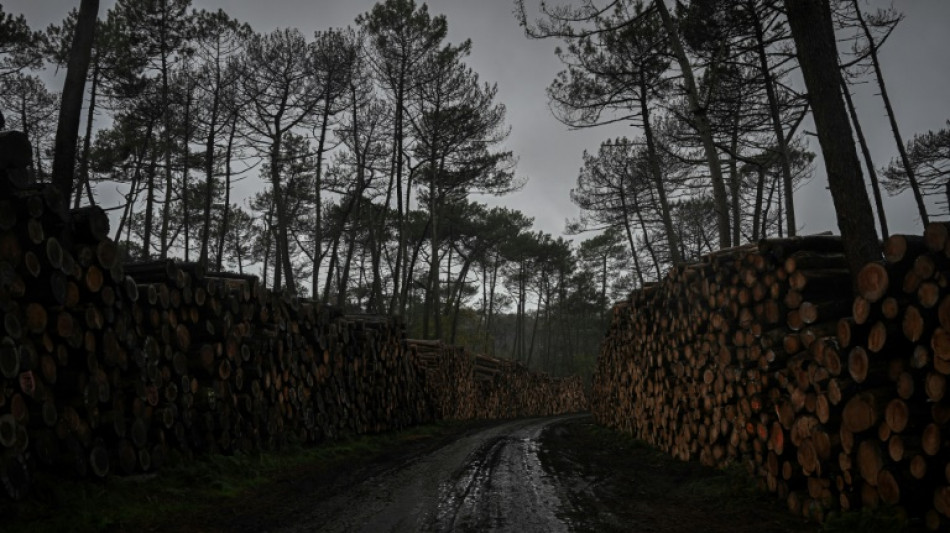
'Time bomb': Tree-killing bugs threaten France's lush forests / Photo: Philippe LOPEZ - AFP

 UEFA set to withdraw FIFA boycott threat ahead of Champions League draw

 Sumo moves to beat Japan summer heat as temperatures rise

 'Be more honest': Markets crave clarity from cryptic Fed chair

 Climate change leaves its mark on America's largest reservoir

 CIA director warned Russia not to attack NATO members: US media

 Search for missing after Nepal-Tibet floods kills at least 160

 Meta, US states agree $18 bn settlement in landmark teen safety case

 What scientists know so far about Nepal's deadly floods

 US general visits Colombia to discuss war on drugs

 Meta settlement puts social media industry on notice: 'There will be more'

 NFL owners approve record Seahawks sale

 Nigerian armed groups net nearly $6 mn in ransoms: study

 Savio scores on debut as Spurs advance in League Cup

 Mbappe hits treble as Real Madrid thrash Real Sociedad

 At Dollywood, superfans honor the late singer and local hero

 Stocks mixed as oil drops, US inflation stays high

 Bolivia's Paz appoints new economy minister amid bailout talks

 US designates UK-based Palestine Action as foreign 'terrorist group'

 'Rocky Horror Picture Show' star Tim Curry dead at 80

 American Moll wins women's pole vault at Zurich city event

 As Canada takes on US tariffs, what's behind the David and Goliath fight?

 UEFA 'likely' to drop threat to boycott FIFA tournaments: source

 US disrupts platforms allegedly used by Chinese hackers

 The foreign tourists missing in Nepal's flash floods

 Hundreds missing after Nepal-Tibet flood kills 98

Last year, ferocious wildfires destroyed thousands of hectares of one of France's most picturesque forests.
Now French authorities are battling an invasion of beetles that are devouring the weakened pines of La Teste-de-Buch, in the southwestern region of Gironde.
"The year 2023 is as cruel and dramatic as the wildfires," said Matthieu Cabaussel, one of the trustees managing the private forest of La Teste-de-Buch. "It's a double punishment."
The stenographer bark beetle, a brown, airborne insect measuring half-a-centimetre, primarily attacks pines damaged by fire or storm.
The parasite lays its eggs in the bark, and when these hatch, the larvae tunnel down into the trunk of the tree until it dies.
Where 250-year-old maritime pines once stood, machines now hum as workers fell, prune, saw and evacuate trees infested with parasites.
Along track 214, which crosses the forest of La Teste-de-Buch, thousands of logs pile up, the symbol of a new environmental threat in a region where wildfires destroyed around 30,000 hectares (74,100 acres) of forest last year.
- 'Disastrous management' -
Experts say that tree felling is necessary to fight the outbreaks of bark beetles, which also affect forests in the east of France, as well as in Eastern Europe.
"Cutting affected trees is the only way to fight this," Francis Maugard, natural risks manager at the National Forests Office (ONF), a government agency, told AFP.
Maugard said pheromone traps were used to measure the extent of infestation.
Close to the famous Dune of Pilat, Europe's tallest sand dune, ONF immediately launched a campaign of tree-felling in the national forest of La Teste, half of which had gone up in flames.
Around 80,000 cubic metres of wood have been removed, the equivalent of 20 years of harvest.
But in the private forest, where the nearly 3,800 hectares fell victim to the wildfires, officials were not so quick to act and trees only began to be cut in January.
For Herve Jactel of the French National Institute for Agriculture, Food, and Environment (INRAE), such an approach amounted to "disastrous management."
Jactel, research director at the institute's BioGeCo laboratory, also criticised the storage of infested wood in the forest.
"It was the ideal breeding environment," he said, noting that bark beetles have also reproduced faster due to the high summer temperatures.
"This is a real time bomb," he said. "If we do nothing, spring 2024 will be a thousand times more dangerous."
Cabaussel, who helps manage the private forest of La Teste-de-Buch, admitted a number of "difficulties", including the hot weather and sluggish demand that has slowed down the evacuation of the affected trees.
- 'We are afraid' -
In late October, some 270,000 tonnes of wood have been evacuated from the private forest and at least twice as much remained to be cut.
Cabaussel hopes to take all the necessary measures, including the felling of the trees during the winter months, when the parasites are inactive, to "save the neighbouring forests."
The bark beetle has already infiltrated La Teste's urban areas, forcing people to cut down pine trees in their gardens.
"There is a risk of population explosion," said Francois Hervieu, Regional Directorate for Food, Agriculture and Forestry (DRAAF), but added that the threat was manageable.
"We are in a situation which requires the greatest vigilance to evacuate the trees in due time."
ADDUFU, a local association of inhabitants holding a medieval right to collect wood in the forest, has called for the creation of dedicated wood evacuation and storage sites.
"There is still a huge amount of wood to be taken out and we are afraid," said Philippe Fur, vice president at ADDUFU. He feared that the problem would only worsen in the future.
"The disaster that we've suffered is serious because we will not see an old forest in our lifetime again," Cabaussel said.
"But the forest ecosystems will recover very well."
In the decimated woods of La Teste-de-Buch, nature is already reclaiming its rights -- small pine saplings have popped up amid the charred tree stumps and ferns.
V.F.Barreira--PC