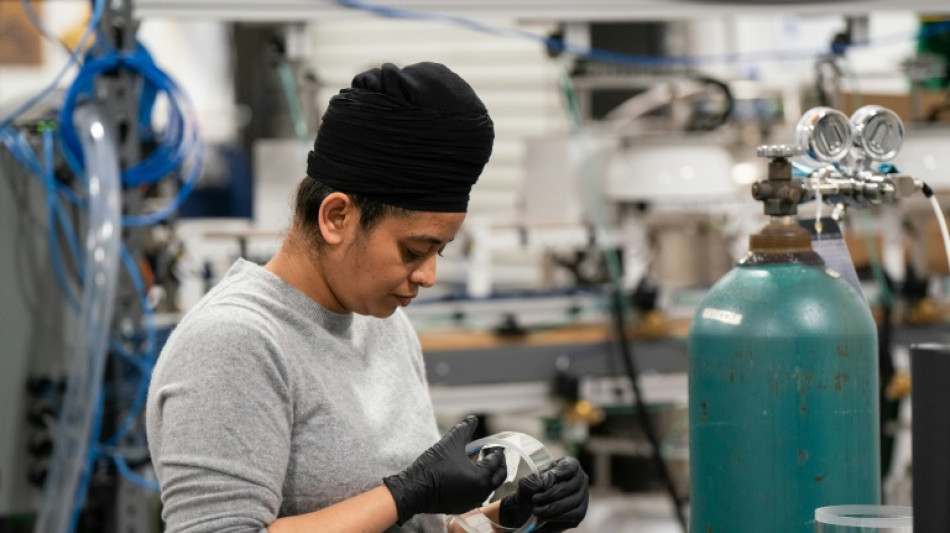
California startup to 'sponge' CO2 from the atmosphere / Photo: Loren Elliott - AFP

 UEFA set to withdraw FIFA boycott threat ahead of Champions League draw
 Sumo moves to beat Japan summer heat as temperatures rise

 'Be more honest': Markets crave clarity from cryptic Fed chair

 Climate change leaves its mark on America's largest reservoir
 CIA director warned Russia not to attack NATO members: US media

 Search for missing after Nepal-Tibet floods kills at least 160

 Meta, US states agree $18 bn settlement in landmark teen safety case

 What scientists know so far about Nepal's deadly floods

 US general visits Colombia to discuss war on drugs

 Meta settlement puts social media industry on notice: 'There will be more'

 NFL owners approve record Seahawks sale

 Nigerian armed groups net nearly $6 mn in ransoms: study

 Savio scores on debut as Spurs advance in League Cup

 Mbappe hits treble as Real Madrid thrash Real Sociedad

 At Dollywood, superfans honor the late singer and local hero

 Stocks mixed as oil drops, US inflation stays high

 Bolivia's Paz appoints new economy minister amid bailout talks

 US designates UK-based Palestine Action as foreign 'terrorist group'
 'Rocky Horror Picture Show' star Tim Curry dead at 80

 American Moll wins women's pole vault at Zurich city event

 As Canada takes on US tariffs, what's behind the David and Goliath fight?

 UEFA 'likely' to drop threat to boycott FIFA tournaments: source

 US disrupts platforms allegedly used by Chinese hackers

 The foreign tourists missing in Nepal's flash floods

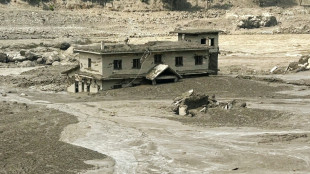 Hundreds missing after Nepal-Tibet flood kills 98
Scrubbing carbon dioxide from the air is imperative if humanity is to limit global warming, experts say, and a California startup says it can do just that, using limestone as a carbon-sucking sponge.
San Francisco-based Heirloom Carbon has become a hot name in the nascent capture technology sector, even sealing a deal with Microsoft to help the Windows-maker meet its zero-carbon ambitions.
Governments are embracing similar innovations to meet their climate goals as CO2 emissions remain too high to mitigate the greenhouse effect that causes the devastation of climate change.
Capturing CO2 directly out of the atmosphere is the "time machine" that will take us back to cleaner air, according to Heirloom cofounder and CEO Shashank Samala.
"If you actually want to reverse climate change and go back to where things were, carbon removal is the closest thing we have actually removing legacy emissions from the air," he said.
Carbon capture will be a central topic of discussions at the COP28 climate talks, which take place in Dubai from November 30 to December 12.
Many see it as a necessity to get closer to a zero-emission world while others fear it is being hailed as an easy ticket to avoid making the sacrifices needed to slow climate change.
The UN Panel on Climate Change (IPCC), which steers the COP meetings, considers the deployment of carbon capture and storage systems to be unavoidable if we are to limit global warming to 1.5 degrees Celsius above pre-industrial levels.
- 'Wring the sponge' -
Heirloom has set itself the goal of ridding the atmosphere of one billion tonnes of CO2 per year by 2035 -- without incentivising companies to keep burning fossil fuels.
That will help put a dent in the between the 10 and 20 billion tonnes of carbon that the US National Academy of Sciences says has to be eliminated every year between now and the end of the century.
"Heirloom uses limestone which is a naturally occurring mineral and we give it superpowers and we turn it into a sponge that can suck up CO2 from the atmosphere," said cofounder and head of research Noah McQueen.
"We then wring out that sponge and we permanently store that CO2 underground," he added.
Cofounder Samala remembers the cyclones, droughts and crushing heatwaves of his childhood in India all too well.
"I remember my mom putting a wet towel on a fan and using that as our air conditioner," he said.
"Climate change has unfair impacts on vulnerable people."
Samala briefly worked at the fin-tech company Square after his US engineering studies and then founded an electronics company.
"But the calling for climate was always there," he said, with year after year of California wildfires and disappearing coral reefs pushing him toward a career change.
Going through the 2018 IPCC report, Samala narrowed in on carbon capture, a field then in dire need of innovation and investment.
- No 'miracles' -
Direct Air Capture (DAC) techniques, such as those developed by Heirloom and Swiss pioneer Climeworks, differ from systems where carbon is captured at source (CCS), such as factory chimneys.
Heirloom opted for limestone because it's available in large quantities, and says there's no shortage of storage space.
"In the United States alone, there's enough to store all of the emissions that we've emitted since the industrial revolution," said McQueen.
Will Knapp, cofounder of the CCS startup Cocoon, believes it is much easier to capture CO2 directly from places it is emitted, such as factories or steel plants, than from the general atmosphere.
Metal-making furnaces can blast out CO2 concentrations of 10 to 30 percent, while the concentration of CO2 in the air we breathe is at just 0.4 percent, according to Knapp.
Capturing it from the general atmosphere would be "like finding a needle in a haystack," he said.
"There's no silver bullet to solving climate change, (but) we don't need miracles, we just need bullets," he added.
Heirloom's Samala holds his company to strict commitments, such as not reselling the CO2 to businesses that would ultimately return it to the atmosphere.
He also condemns "greenwashing," where some industries, in particular the oil and gas lobby, use vague promises of carbon removal "as a way to distract us."
"For us to go against the status quo is incredibly difficult, but that is what we need to do," Samala said.
A.Magalhes--PC