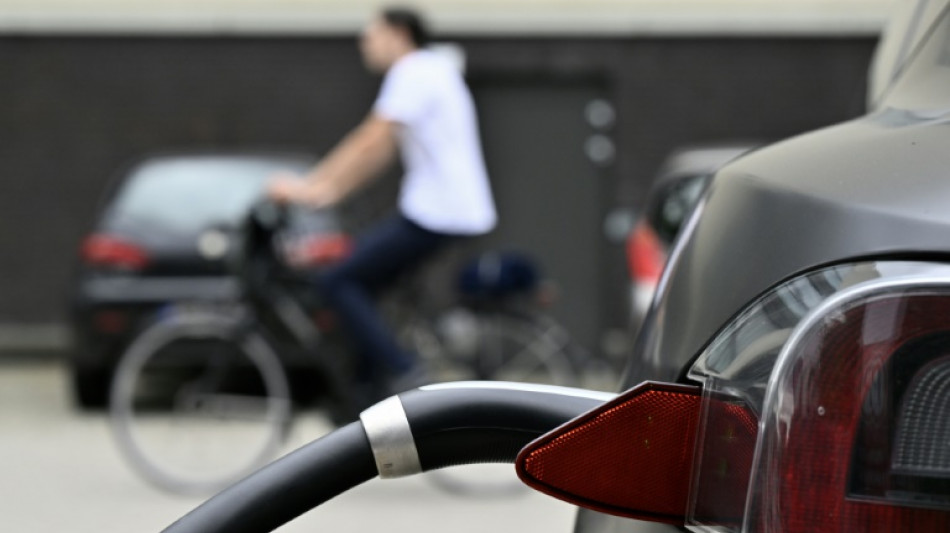
Charging ahead: Dutch eye boost to 'fast charger' EV network / Photo: JOHN THYS - AFP

 UEFA set to withdraw FIFA boycott threat ahead of Champions League draw
 Sumo moves to beat Japan summer heat as temperatures rise
 'Be more honest': Markets crave clarity from cryptic Fed chair
 Climate change leaves its mark on America's largest reservoir
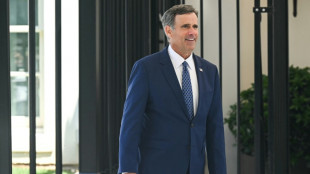 CIA director warned Russia not to attack NATO members: US media
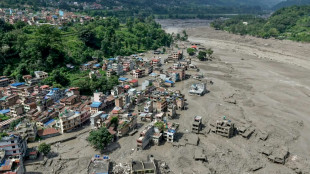 Search for missing after Nepal-Tibet floods kills at least 160
 Meta, US states agree $18 bn settlement in landmark teen safety case

 What scientists know so far about Nepal's deadly floods

 US general visits Colombia to discuss war on drugs

 Meta settlement puts social media industry on notice: 'There will be more'
 NFL owners approve record Seahawks sale

 Nigerian armed groups net nearly $6 mn in ransoms: study

 Savio scores on debut as Spurs advance in League Cup
 Mbappe hits treble as Real Madrid thrash Real Sociedad

 At Dollywood, superfans honor the late singer and local hero
 Stocks mixed as oil drops, US inflation stays high

 Bolivia's Paz appoints new economy minister amid bailout talks
 US designates UK-based Palestine Action as foreign 'terrorist group'
 'Rocky Horror Picture Show' star Tim Curry dead at 80

 American Moll wins women's pole vault at Zurich city event

 As Canada takes on US tariffs, what's behind the David and Goliath fight?

 UEFA 'likely' to drop threat to boycott FIFA tournaments: source

 US disrupts platforms allegedly used by Chinese hackers
 The foreign tourists missing in Nepal's flash floods

 Hundreds missing after Nepal-Tibet flood kills 98
At a service station near Amsterdam's Schiphol Airport, a steady stream of motorists charge up their electric vehicles at "ultra-fast" power points. The whole process takes less than 20 minutes.
"It's really great in the Netherlands. When you leave the Netherlands, the network is a lot thinner," Jeroen Vever, a 37-year-old software developer fuelling up his EV, told AFP by the charging "plug".
Famed globally for an obsession with bikes and especially vulnerable to climate change due to its low-lying location, the Netherlands is proud of its "World Champion" status for EV charging points, with the EU's densest network.
The small country has 145,000 public charging points -- one third of the whole European total -- with streets in major Dutch cities lined with grey metal power points seemingly posted every few metres.
In addition to this are hundreds of thousands of private chargers, much less powerful and therefore slower to "fill up" vehicles.
But only around 6,000 of these are "fast" or "ultra-fast" chargers.
While an impressive total in absolute terms, this leaves the Netherlands proportionally behind the Baltic states or countries in Central and Eastern Europe, which started later but jumped directly to fast chargers, according to the ChargeUp Europe association.
The Netherlands is scrambling to maintain its lead, but there are concerns the electric grid may not cope with a rapid expansion of the energy-gobbling fast chargers.
Electrifying car transport, well advanced in Europe and China, is one of the key pillars of a transition to a carbon-free world and will be a critical topic at the Dubai COP28 summit.
But as the Netherlands shows, EV sales go hand in hand with an efficient charging network.
"It's chicken and egg," said Michiel Langezaal, CEO and co-founder of Dutch firm Fastned, which installs ultra-fast points along European motorways.
"If there's an ample and sufficient charging infrastructure, that helps people shift to sustainable mobility."
The Dutch government wants all new cars to be electric by 2030 but even the current dense charging network would not be able to service such a fleet.
The answer: "It will be necessary to build more fast-charging stations", according to Langezaal.
With the current number of electric vehicles, a total network of around 700 fast-charging stations -- roughly one every 40 kilometres -- is sufficient, Langezaal told AFP.
- 'Fully charged' -
How has the Netherlands managed to roll out such a strong network? According to Auke Hoekstra, a sustainable mobility expert, the Dutch tradition of political consensus played a big part.
The central government worked closely with local officials, network operators, and private firms to create a single charging system, he told AFP.
The absence of a powerful home-grown car manufacturer also helped, he added, saying this often puts a brake on progressive policies in other countries.
The development of fast chargers is key, as the "slow" charging systems can take several hours -- often overnight while the driver sleeps.
"Usually, I just charge up at home in the evening. The next day, the car is fully charged," said Marrit Zylstra, a 33-year-old IT consultant powering up at the Schiphol charging centre.
Another explanation for the rapid rise of the charging network was government bonuses and tax breaks, said Hoekstra.
But it's not all plain sailing in the Netherlands, where one third of the land is below sea level but which is one of Europe's worst polluters.
Many of the tax breaks for electric vehicles will disappear in 2025 and Hoekstra warned about losing the early Dutch advantage.
"The Netherlands is always very good at making something a success and then stopping doing it once it's become too much of a success. We did it in the past in windmills," he told AFP.
While 26 percent of new cars in the Netherlands were electric in 2022, they still make up only five percent of the total cars on the road in the country.
Private cars account for nearly 10 percent of the total greenhouse gas emissions in the Netherlands.
Rising electricity costs and the end of tax advantages mean EV driving is entering "a very different era", said Harry Chua, a restaurant manager charging up on the motorway.
"Electricity is going up, we'll have to pay road taxes. So, I don't know whether driving an electric vehicle is advantageous. We'll see in the future," the 43-year-old told AFP.
But electric or not, some things never change.
"I sat in a traffic jam for two hours and I was late for work," he said, admitting that he was going too fast.
"I got stopped by the police. They gave me a warning."
E.Borba--PC