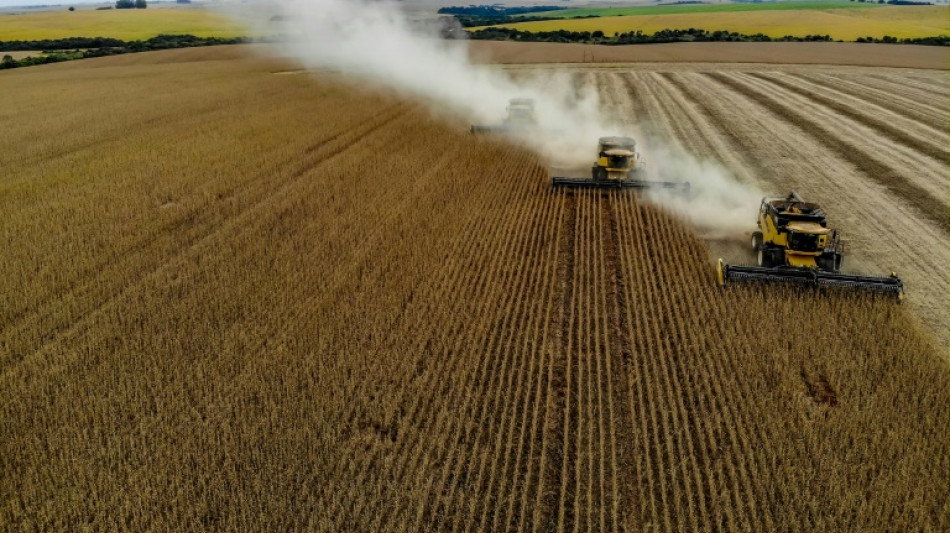
Brazil's booming ag sector draws cash and controversy / Photo: SILVIO AVILA - AFP

 UEFA set to withdraw FIFA boycott threat ahead of Champions League draw
 Sumo moves to beat Japan summer heat as temperatures rise
 'Be more honest': Markets crave clarity from cryptic Fed chair

 Climate change leaves its mark on America's largest reservoir
 CIA director warned Russia not to attack NATO members: US media

 Search for missing after Nepal-Tibet floods kills at least 160
 Meta, US states agree $18 bn settlement in landmark teen safety case

 What scientists know so far about Nepal's deadly floods

 US general visits Colombia to discuss war on drugs

 Meta settlement puts social media industry on notice: 'There will be more'

 NFL owners approve record Seahawks sale

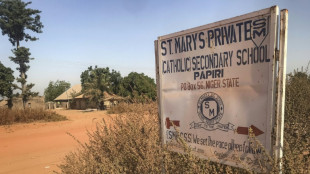 Nigerian armed groups net nearly $6 mn in ransoms: study

 Savio scores on debut as Spurs advance in League Cup

 Mbappe hits treble as Real Madrid thrash Real Sociedad

 At Dollywood, superfans honor the late singer and local hero

 Stocks mixed as oil drops, US inflation stays high

 Bolivia's Paz appoints new economy minister amid bailout talks

 US designates UK-based Palestine Action as foreign 'terrorist group'

 'Rocky Horror Picture Show' star Tim Curry dead at 80

 American Moll wins women's pole vault at Zurich city event

 As Canada takes on US tariffs, what's behind the David and Goliath fight?

 UEFA 'likely' to drop threat to boycott FIFA tournaments: source

 US disrupts platforms allegedly used by Chinese hackers

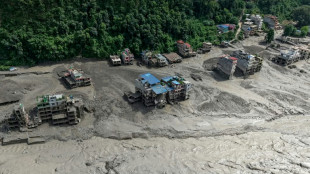 The foreign tourists missing in Nepal's flash floods

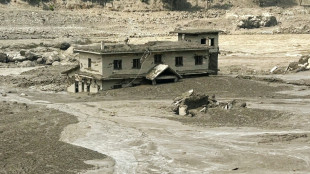 Hundreds missing after Nepal-Tibet flood kills 98

With its massive output of soybeans, beef, cotton and now corn, Brazil has become one of the world's top agricultural powers. But its agribusiness industry also faces criticism, especially over destruction of the Amazon rainforest.
Here is an overview of the South American ag giant, which, more than a decade after passing the United States as the world's biggest soy and beef exporter, is set to overtake US corn exports this year and is now eying the cotton crown.
- Big and growing -
Brazil's agriculture ministry triumphantly announced recently the sector's output will hit a record 1.15 trillion reais ($230 billion) this year.
The country -- the world's fifth-largest by surface area -- is the top producer and exporter of sugar, coffee and soy.
It is also the world's top supplier of chicken and beef, and second in cotton, after the United States.
Agribusiness accounts for nearly one-fourth of Brazil's economy, and half its exports in the first half of the year.
- Roots of the boom -
Brazil's emergence as an agricultural giant goes back to Portuguese colonial times. Fortunes were made here on a succession of commodities: sugarcane, then cotton, rubber and finally coffee, which reigned supreme for more than a century.
But the turning point came in the 1960s and 70s, when Brazil's then military regime ushered in the so-called "green revolution" and encouraged the expansion of agriculture to the Amazon and Cerrado savanna.
Fueled by Chinese demand, Brazil would go on to become the dominant producer of soy, a widely used ingredient in animal feed worldwide.
"Research on genetic improvements, techniques to correct soil acidity and fertilizers" -- plus pesticide development -- have allowed Brazil to expand soy, corn and cotton production into tropical regions, state agricultural research company Embrapa told AFP.
Brazil is able to harvest two and sometimes three crops a year, thanks to its climate and the development of zero till planting and genetically modified (GMO) crops -- which today account for 80 to 90 percent of the country's soy, corn and cotton output.
Production of all three has tripled in the past two decades.
- Price of success -
But the boom has come with controversy.
The agribusiness industry has helped fuel deforestation in the Amazon, which President Luiz Inacio Lula da Silva has vowed to halt.
Polemics over high rates of deforestation, pesticides and GMO use have hurt Brazil's brand in some places, including the European Union, which has held off ratifying a free-trade deal with South American bloc Mercosur over environmental issues.
The agro sector's image has also paid a price internationally for its close association with controversial far-right ex-president Jair Bolsonaro, who was in office from 2019 to 2022.
- Under pressure -
Lula will have to come to terms with the powerful agribusiness lobby if he wants to keep his promise to stop Amazon deforestation by 2030, after a surge in destruction under Bolsonaro.
The veteran leftist, who needs the sector's help to keep the economy growing, is looking to open new markets for Brazilian producers via trade deals, notably with top buyer China.
For its part, the ag sector is keen to polish its image, with international clients increasingly demanding deforestation-free products.
"Meat companies are working particularly hard to make their supply chains traceable, which is fundamental for export value," said Luiz Carlos Correa Carvalho, president of the Brazilian Agribusiness Association.
Grain producers meanwhile tout the recent adoption of a sustainable farming deal aimed at protecting the Cerrado.
Environmentalists say that is not enough.
"Real progress would be zero deforestation," said Cristiane Mazzetti of Greenpeace Brazil, who called for new production models that protect biodiversity.
The issue is urgent, especially since climate change is already starting to hit agricultural output.
"We have to evolve toward a more sustainable model," said Britaldo Soares Filho, a researcher on environmental modeling at the University of Minas Gerais.
"When agribusiness harms the environment, it's shooting itself in the foot."
Nogueira--PC