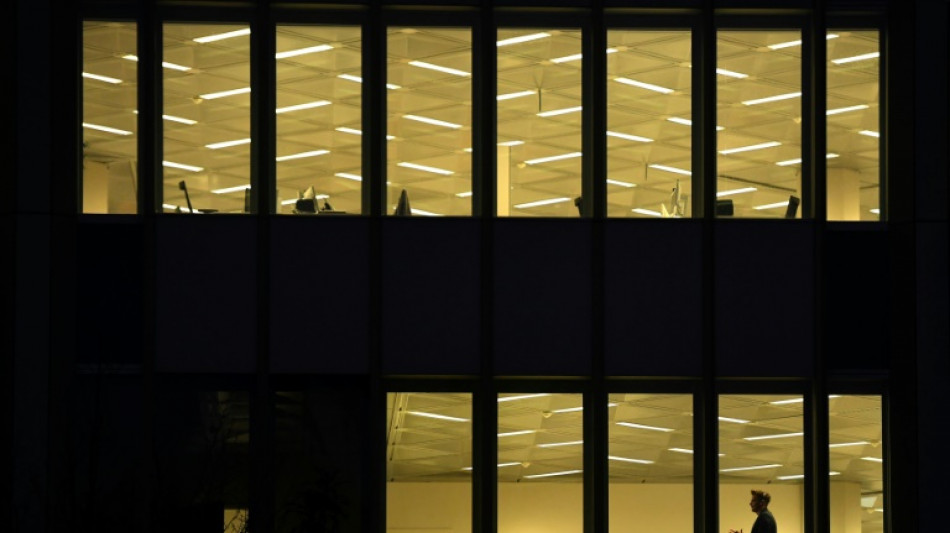
Europe's economic powerhouse tests a shorter working week / Photo: Ina FASSBENDER - AFP

 Fed's Cook rejects Trump mortgage fraud claims
 Police probe 'assault allegations' after Carse's nightclub incident

 How we might hear new Dolly Parton music in the future

 Nvidia doubles revenue, forecasts even more AI spending

 Canada renews push to boycott US products

 Savio scores on debut as Spurs set-up League Cup tie with Liverpool

 Brazil sues Discord over child safety measures, demands $100 mln in damages

 Alberta NDP Urges Smith to Postpone Separation Vote Amid Trade War

 Fenerbahce stun Lyon in Champions League as AEK crush Levski

 Why Global Finance Still Relies on Wall Street Despite Diversification Trends

 Bethlehem Father Seeks Aid for Special Needs Children Amid Health Crisis

 LIV Golf to lay off majority of staff

 How narwhal 'scientists' track Arctic warming

 Iran says US sanctions will achieve nothing

 Essential Dolly: five key Parton songs

 Veteran promoter Warren says it's Joshua's job to agree Fury fight

 Ex-champ Wawrinka gets last-minute wildcard to US Open

 Brennan blasts to Vuelta stage five victory, Pogacar holds lead

 What could change for US teens on Instagram and Facebook

 Meta, US states agree $16.7 bn settlement in landmark teen safety case
 'Point of no return' if Israel-Hamas truce fails: US envoy to Gaza board

 Barcelona holding out hope for Alvarez as Atletico resist sale

 Werro basks in new status, shelves world record talk

 Bill Gates warns world unprepared for AI upheaval

 Prince Harry and family arrive back in Britain: UK media

Maximilian Hermann's weekend starts on Friday morning, when he puts his motorcycle helmet on and takes his bike out for a ride to the southern German Alps.
Like all his colleagues, the 29-year-old project manager shifted to a four-day week at the beginning of the year and is making the most of it.
His new, shorter working hours are part of a trend that is gaining traction in Germany, where companies are looking to balance between worker shortages and the need to stay competitive.
Among the pioneers of the four-day week is Hermann's employer KlimaShop, a purveyor of heat pumps and air-conditioning systems based near Augsburg in southern Germany.
Instead of working 40 hours a week across five days, Hermann now spends a total of 38 hours at work over four working days.
Otherwise put, each of KlimaShop's 30 employees works an hour-and-a-half more for each day they are in the office, while having an extra day to themselves each week.
Hermann's colleague Michael Pankoke sees the shift switch as "big progress".
"You work much more intensely, everything you do is more precise," the 58-year-old customer advisor told AFP.
- Test run -
Management consultancy Intraprenoer is leading the first large-scale experiment with the shorter schedule in Germany together with the organisation 4 Day Week Global, which has already run similar trials in other countries, such as the United Kingdom.
Starting in 2024, up to 50 companies of varying size are set to test the new hours, with the aim of avoiding a drop-off in productivity.
Intraprenoer, which already "abolished Friday" for its workers in 2016, said it has 33 interested candidates for the trial.
But an increasing number of businesses in Europe's largest economy have already taken the leap.
Wolfgang Schmidt, the founder of a manufacturing business near Hamburg, in the north, said he flipped his staff onto a four-day week at the end of 2022 to save his employees, some of whom commute long distances, "fuel and money".
In nearby Wedel, the town administration has introduced a four-day week to attract more "competent and motivated" workers.
During the annual round of wage negotiations in the steel industry, starting in November, Germany's biggest union IG Metall will call for the introduction of a four-day week with hours reduced from 35 to 32, for the same pay.
Beyond a better work-life balance and increased productivity, the move would reduce "one of the highest rates of part-time employees of Europe", said Sophie Jaenicke, working time lead at IG Metall.
According to a study by the Hans-Boeckler foundation, fully 81 percent of Germans would support a shift to a four-day week.
- Lukewarm -
While in Belgium workers have had the right to ask for a four-day week with the same number of hours since the end of 2022, in Germany, workers and employers agree their own work times up to a maximum 48 hours a week.
Enthusiasm for the idea of a shorter week is lukewarm among many managers and economists, however. A 20 percent reduction in working hours would have "a disastrous economic impact", according to economist Holger Schaefer.
While "limiting unproductive activities and condensing work" is still feasible in the office, all the options for increasing productivity in industry have already been exhausted, said Schaefer from the IW economic institute in Cologne.
With the labour supply already stretched by the exit of the baby-boomer generation from the work force, cutting hours would lead "inevitably to a reduction in the amount of goods and services produced", he warned.
A shorter week was, in short, an "unrealistic dream", said Michael Huether, also of the IW economic institute in Cologne. Instead the solution to labour shortages would be longer, not shorter hours, he said.
P.Serra--PC