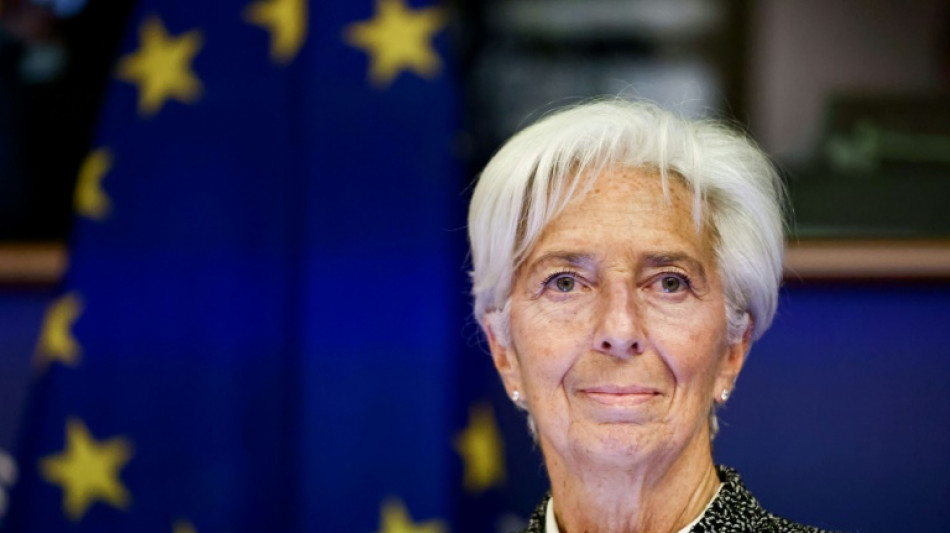
At halfway point, next challenges loom for ECB's Lagarde / Photo: Kenzo TRIBOUILLARD - AFP/File

 Fed's Cook rejects Trump mortgage fraud claims
 Police probe 'assault allegations' after Carse's nightclub incident

 How we might hear new Dolly Parton music in the future
 Nvidia doubles revenue, forecasts even more AI spending
 Canada renews push to boycott US products
 Savio scores on debut as Spurs set-up League Cup tie with Liverpool

 Brazil sues Discord over child safety measures, demands $100 mln in damages

 Alberta NDP Urges Smith to Postpone Separation Vote Amid Trade War

 Fenerbahce stun Lyon in Champions League as AEK crush Levski

 Why Global Finance Still Relies on Wall Street Despite Diversification Trends
 Bethlehem Father Seeks Aid for Special Needs Children Amid Health Crisis
 LIV Golf to lay off majority of staff
 How narwhal 'scientists' track Arctic warming
 Iran says US sanctions will achieve nothing
 Essential Dolly: five key Parton songs

 Veteran promoter Warren says it's Joshua's job to agree Fury fight
 Ex-champ Wawrinka gets last-minute wildcard to US Open
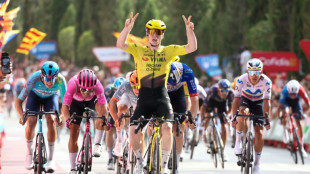 Brennan blasts to Vuelta stage five victory, Pogacar holds lead
 What could change for US teens on Instagram and Facebook
 Meta, US states agree $16.7 bn settlement in landmark teen safety case
 'Point of no return' if Israel-Hamas truce fails: US envoy to Gaza board
 Barcelona holding out hope for Alvarez as Atletico resist sale

 Werro basks in new status, shelves world record talk
 Bill Gates warns world unprepared for AI upheaval
 Prince Harry and family arrive back in Britain: UK media

Halfway through an eight-year stint as head of the European Central Bank, Christine Lagarde has cause to cheer as inflation finally slows after an unprecedented streak of interest rate hikes.
But the conundrum of how to further tame prices without crashing the eurozone economy looks set to dominate the second part of her term.
Eurozone inflation dropped to a surprise two-year low of 2.9 percent in October, inching closer to the ECB's two-percent target and down from more than 10 percent a year ago after Russia's war in Ukraine sent energy costs soaring.
The slowdown was mainly due to falling energy prices, yet the news will likely bolster the ECB's case that it was right to hold rates steady last week after 10 successive increases.
But Lagarde and her team aren't out of the woods yet -- and new risks are piling up.
The ECB is currently in the delicate process of shrinking its vast bond portfolio after years of hoovering up government and corporate debt, pressing another lever to bring down inflation.
Meanwhile geopolitical instability, particularly the potential fallout from the Israel-Hamas war, could trigger "another sharp rise in gas and oil prices that would push inflation upwards", Eric Dor, director of economic studies at IESEG business school in France, told AFP.
How would ECB policymakers respond "at a time when the eurozone economy is already very fragile?" he asked.
- 'Very difficult' -
The 20-nation currency club's economy shrank by 0.1 percent in the third quarter as consumers and businesses reeled from higher borrowing costs.
Should further shocks arise, Dor said Lagarde could be left facing the dilemma of either adopting a "wait-and-see approach" -- knowing that the ECB already received criticism for reacting slower than other central banks when prices started climbing -- or raising rates further.
Doing so would be "at the risk of causing a sharp recession, a property crash and a wave of defaults on private and public debt", he added.
Analysts also see fundamental challenges on the horizon that could shake up monetary policy.
Fritzi Koehler-Geib, chief economist at German public lender KfW, said the economy was headed for "profound structural changes" as a result of the climate crisis, a shortage of skilled workers, weak productivity growth and mounting geopolitical conflicts.
The coming shifts could "make it very difficult" for the ECB to maintain its two-percent inflation goal in the future, Dor added.
- 'Bolder' -
Ever since she took on the job in November 2019, Lagarde's "diplomatic skills" have proved "very useful" in smoothing over tensions after the ECB's 25-member governing council was left deeply divided at the end of predecessor Mario Draghi's term, Dor said.
The outbreak of the pandemic united ECB policymakers around the need to keep credit flowing to businesses and households and limit the economic damage from Covid-related shutdowns.
The result was a massive bond-buying scheme dubbed the Pandemic Emergency Purchase Programme (PEPP), hashed out at Lagarde's kitchen table in Frankfurt.
Lagarde, a former French finance minister and head of the International Monetary Fund, steered the ECB "safely through stormy times in the first half of her term", said Koehler-Geib, praising the quick decision to launch PEPP.
But the post-pandemic recovery fuelled inflation in the autumn of 2021 as supply chain disruptions led to numerous shortages, and the ECB's response was, in hindsight, perhaps "a little too late", she added.
Lagarde initially insisted the surge in consumer price growth would be temporary, and stuck to the ECB's line that rates would stay low until a pre-pandemic asset purchasing scheme had ended in mid-2022.
That stance became harder to hold after Russia's war in Ukraine sparked an energy crisis that pushed eurozone inflation to record highs.
Lagarde recently told the Financial Times she regretted having felt "bound by our forward guidance".
"I should have been bolder," she said.
The ECB's dramatic gear change came in July 2022, when it kicked off the fastest rate-hiking cycle since the introduction of the euro, which "credibly demonstrated" a determination to restoring price stability, Koehler-Geib said.
While Lagarde has acknowledged the "pain" heaped on companies and citizens as they contend with more expensive loans and mortgages, she has said rates would be kept high for long enough to return inflation to target.
Any talk of when the ECB might start cutting rates was "totally premature", Lagarde reiterated last week.
T.Resende--PC