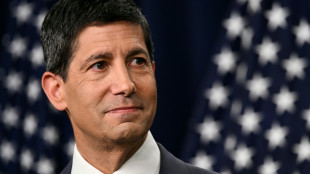
'Brazilian Warren Buffett' rises from poverty to stock stardom / Photo: Nelson ALMEIDA - AFP

 Fed's Cook rejects Trump mortgage fraud claims

 Police probe 'assault allegations' after Carse's nightclub incident

 How we might hear new Dolly Parton music in the future

 Nvidia doubles revenue, forecasts even more AI spending

 Canada renews push to boycott US products

 Savio scores on debut as Spurs set-up League Cup tie with Liverpool

 Brazil sues Discord over child safety measures, demands $100 mln in damages

 Alberta NDP Urges Smith to Postpone Separation Vote Amid Trade War

 Fenerbahce stun Lyon in Champions League as AEK crush Levski

 Why Global Finance Still Relies on Wall Street Despite Diversification Trends

 Bethlehem Father Seeks Aid for Special Needs Children Amid Health Crisis

 LIV Golf to lay off majority of staff

 How narwhal 'scientists' track Arctic warming

 Iran says US sanctions will achieve nothing

 Essential Dolly: five key Parton songs

 Veteran promoter Warren says it's Joshua's job to agree Fury fight

 Ex-champ Wawrinka gets last-minute wildcard to US Open

 Brennan blasts to Vuelta stage five victory, Pogacar holds lead

 What could change for US teens on Instagram and Facebook

 Meta, US states agree $16.7 bn settlement in landmark teen safety case

 'Point of no return' if Israel-Hamas truce fails: US envoy to Gaza board

 Barcelona holding out hope for Alvarez as Atletico resist sale

 Werro basks in new status, shelves world record talk

 Bill Gates warns world unprepared for AI upheaval

 Prince Harry and family arrive back in Britain: UK media

A former shoeshine boy now worth hundreds of millions of dollars, Luiz Barsi has been called the "Brazilian Warren Buffet" for his ultrasharp investing acumen.
But getting rich was never his goal, says the Sao Paulo tycoon.
Above all, he says, "I didn't want to be poor again."
At 84 years old, Barsi could easily stay on a private island counting his fortune -- estimated at four billion reais ($800 million) by Forbes magazine.
Instead, he still goes to work every day, both out of "addiction" and because "I can't let the wheel stop turning," the white-haired octogenarian tells AFP at his offices in central Sao Paulo.
"If the wheel stops, I go back to being who I was," says Barsi, one of the biggest individual investors on the Sao Paulo stock exchange, the largest in Latin America.
Barsi was born and raised in the Brazilian economic capital -- but in very different surroundings.
His father died when he was one, leaving him and his mother to fend for themselves as best they could, living in shared low-income housing in the working-class neighborhood of Bras.
"Going back there was a constant reminder I desperately needed to improve my life," he wrote in his autobiography, published last year.
- Dividend dynamo -
Besides shining shoes, Barsi used to sell candy at the movies and work as an office boy -- all while keeping up his studies, finally earning degrees in law plus economics and accounting.
Starting out from nothing, he began trading stocks in the late 1960s.
Separated from his first wife and with four kids to raise -- he later had a fifth with his second wife -- he started looking for "new ways to make money without a lot to invest," even as he kept up his day job as an auditor, he says.
The investment philosophy he developed has fueled the comparisons between him and Buffett, the 93-year-old US magnate famed for his frugality and eagle-eyed investing.
Good investors must "control their ego" and stick to a no-frills lifestyle, says Barsi, sporting a simple polo shirt that belies his status as one of the wealthiest people in Brazil.
He says his success came from "discipline" and "making few mistakes."
And it took time.
"Nobody gets rich overnight," he says, contrasting himself with other investors on the Sao Paulo stock exchange.
"Most of them are speculators -- they've turned the stock market into a casino."
He is equally dismissive of trends such as crypto-currency -- a "fantasy," he says.
Barsi's method is to buy large amounts of shares when prices are low, favoring "perennial" sectors, such as energy, banking and paper products.
One thing above all is key: dividends.
Barsi, who calls himself a "mini-owner" of the companies he invests in, says stocks should guarantee a monthly payout.
He currently makes around $200,000 a day in dividends, according to his daughter Louise, who cofounded an investment education program in 2019 that teaches the "Barsi strategy" to people aspiring to follow in his footsteps.
- Money, not politics -
Barsi's methods have largely withstood Brazil's various busts over the years.
"My success was trusting in markets, not governments," he says, adding he turned down offers to get involved in politics.
"I like money, not titles."
He is critical of President Luiz Inacio Lula da Silva, saying the veteran leftist's government "doesn't invest in generating wealth... it just distributes money it doesn't have."
But far-right ex-president Jair Bolsonaro, whom Lula beat in a divisive election last year, was "not much better," he says.
Barsi lashes out at legislation currently before Congress that would tax offshore firms and investment funds for the "super-rich."
Plans for a dividend tax are also in the works.
"We already pay too many taxes in Brazil," says Barsi.
"Tax any more, and what little (investment) we have will vanish."
P.Queiroz--PC