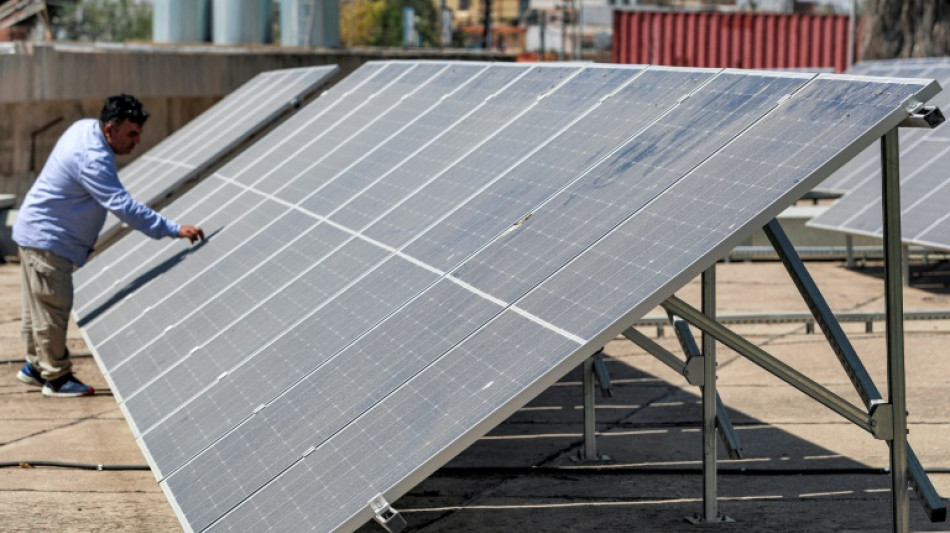
Iraq inches toward solar-powered future / Photo: Ahmad AL-RUBAYE - AFP

 Fed's Cook rejects Trump mortgage fraud claims
 Police probe 'assault allegations' after Carse's nightclub incident
 How we might hear new Dolly Parton music in the future

 Nvidia doubles revenue, forecasts even more AI spending

 Canada renews push to boycott US products
 Savio scores on debut as Spurs set-up League Cup tie with Liverpool
 Brazil sues Discord over child safety measures, demands $100 mln in damages

 Alberta NDP Urges Smith to Postpone Separation Vote Amid Trade War

 Fenerbahce stun Lyon in Champions League as AEK crush Levski

 Why Global Finance Still Relies on Wall Street Despite Diversification Trends
 Bethlehem Father Seeks Aid for Special Needs Children Amid Health Crisis
 LIV Golf to lay off majority of staff
 How narwhal 'scientists' track Arctic warming

 Iran says US sanctions will achieve nothing

 Essential Dolly: five key Parton songs
 Veteran promoter Warren says it's Joshua's job to agree Fury fight

 Ex-champ Wawrinka gets last-minute wildcard to US Open
 Brennan blasts to Vuelta stage five victory, Pogacar holds lead
 What could change for US teens on Instagram and Facebook
 Meta, US states agree $16.7 bn settlement in landmark teen safety case
 'Point of no return' if Israel-Hamas truce fails: US envoy to Gaza board

 Barcelona holding out hope for Alvarez as Atletico resist sale

 Werro basks in new status, shelves world record talk

 Bill Gates warns world unprepared for AI upheaval
 Prince Harry and family arrive back in Britain: UK media

In a small village in the mountains of Iraqi Kurdistan, solar panels adorn most homes, part of a small but growing effort to harness the sun's energy in Iraq, where electricity is scarce.
"Solar covers all our needs: the refrigerator, television, air cooler, washing machine, vacuum cleaner," said Daniar Abdallah, 33, a resident of Hazar Merd who converted to solar and hasn't looked back.
"It has helped us a lot," said the father of two, who spent $2,800 in 2018 to install photovoltaic panels for his family home.
Despite its vast oil wealth, Iraq struggles to provide enough electricity to its 43 million people after decades of conflict and sanctions, as well as rampant corruption and crumbling infrastructure.
And even though it is blessed with more sunshine than most other countries, it has proved difficult to wean Iraq's economy off fossil fuels - one of the themes of the upcoming COP28 climate talks in Dubai.
Although it receives a third of its energy needs from neighbouring Iran, there are still daily power cuts, which worsen in the hot summer months when temperatures approach 50 degrees Celsius (120 Fahrenheit).
The tranquil silence of Hazar Merd is striking in a country where the roar of large neighbourhood generators used to provide back-up power is ever-present.
"Before, we had a generator that broke down all the time" to overcome power cuts which can sometimes last 12 or 13 hours a day, said Abdallah, who works as a soldier for local Kurdish forces.
Several friends have swiftly followed his example and now 17 out of the 25 homes in his village boast solar panels.
- Fossil fuels dominate -
Nationwide, however, the use of solar power remains scarce.
In nearby Sulaymaniyah, the second-largest city in northern Iraq's autonomous Kurdish region, only 500 out of the 600,000 households are equipped with solar panels, said Sirwan Mahmud, a spokesman for the province's electricity department.
Solar power had seen "rapid progression", he said, after the region's parliament adopted incentives in 2021 to compensate households for any excess electricity that they generate.
The region aims to build three commercial solar power plants with a total capacity of 75 megawatts (MW), he added.
But that would only represent a small boost to the 24,000 MW that Iraqi power plants produce.
To end power outages, the country would need to produce at least 32,000 MW.
Despite its huge potential, renewable energy remains under-used in Iraq, even though it experiences more than 3,000 hours of sunlight across the 8,760 hours in a year.
"The worst solar site in Iraq has resources that are almost two-thirds higher than the best site in Germany," said Ali al-Saffar, climate director at the New York-based Rockefeller Foundation.
A recent World Bank report highlighted that more than 98 percent of Iraq's electricity is still generated from fossil fuels.
Authorities say they aim to harness green energy to meet a third of the country's needs by 2030. But despite several major projects being announced with great fanfare, that has yet to materialise.
TotalEnergies says it hopes to deliver "the first phase" of a 1,000 MW solar plant within two years.
In 2021, Baghdad signed an agreement with the Emirati company Masdar to build five solar plants with a combined capacity of 1,000 MW.
- 'Lack of solar culture' -
To encourage renewable energy, Iraq's Central Bank in 2022 announced the allocation of $750 million in almost zero-interest loans for individuals and private companies adopting solar power.
But the initiative is "stalling due to a lack of cooperation from banks", according to Mohamed al-Duleimi, an expert in renewable energies.
Iraq lacks a "solar culture", said Ali al-Ameri, the executive director of Solar Energy Universe, which installs solar infrastructure.
This year, however, more people are turning to solar, he said, with his company installing photovoltaic panels at about a dozen sites.
"Prices start at $4,500 and can go up to $6,000," he said.
Among his clients are academics and doctors, but also humanitarian agencies and farmers.
Since 2020, he has installed panels on 70 buildings, mainly houses, in Baghdad, the neighbouring province of Anbar and the south.
Despite the slow progress, Iraq's solar potential could be an "opportunity to resolve once and for all its chronic electricity shortages," he added.
V.F.Barreira--PC