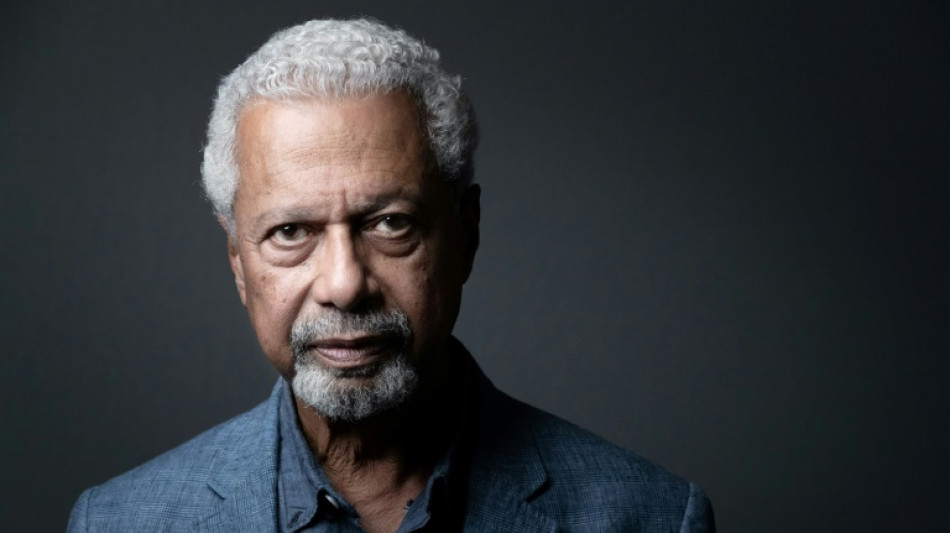
Nobel-winner Gurnah: UK imperial literature was openly racist / Photo: JOEL SAGET - AFP/File

 Fed's Cook rejects Trump mortgage fraud claims

 Police probe 'assault allegations' after Carse's nightclub incident

 How we might hear new Dolly Parton music in the future

 Nvidia doubles revenue, forecasts even more AI spending

 Canada renews push to boycott US products

 Savio scores on debut as Spurs set-up League Cup tie with Liverpool

 Brazil sues Discord over child safety measures, demands $100 mln in damages

 Alberta NDP Urges Smith to Postpone Separation Vote Amid Trade War

 Fenerbahce stun Lyon in Champions League as AEK crush Levski

 Why Global Finance Still Relies on Wall Street Despite Diversification Trends

 Bethlehem Father Seeks Aid for Special Needs Children Amid Health Crisis

 LIV Golf to lay off majority of staff

 How narwhal 'scientists' track Arctic warming

 Iran says US sanctions will achieve nothing

 Essential Dolly: five key Parton songs

 Veteran promoter Warren says it's Joshua's job to agree Fury fight

 Ex-champ Wawrinka gets last-minute wildcard to US Open

 Brennan blasts to Vuelta stage five victory, Pogacar holds lead

 What could change for US teens on Instagram and Facebook

 Meta, US states agree $16.7 bn settlement in landmark teen safety case

 'Point of no return' if Israel-Hamas truce fails: US envoy to Gaza board

 Barcelona holding out hope for Alvarez as Atletico resist sale

 Werro basks in new status, shelves world record talk

 Bill Gates warns world unprepared for AI upheaval

 Prince Harry and family arrive back in Britain: UK media

Nobel-winning writer Abdulrazak Gurnah says removing offensive words from the likes of Agatha Christie is "futile", but says Britain did produce openly racist literature during the last century of its empire.
The British-Tanzanian author won the 2021 Nobel Prize for books such as "Paradise" and "Memory of Departure" exploring Europe's colonial legacy.
He is also a professor of English and post-colonial literature at Britain's University of Kent.
Asked by AFP about the recent trend of publishers rewriting books by Christie, Roald Dahl and James Bond author Ian Fleming to remove racist and other possibly offensive words, Gurnah was ambivalent.
"Certainly as a scholar, I think it's a futile thing to do," he said.
"I suppose one of the reasons why they're doing it is that the publisher wants to make their product more respectable."
Ultimately, he said, "I think there are bigger issues in the world to worry about."
While the current culture wars focus on tweaks to celebrity writers and hysteria over "cancel culture", Gurnah is more interested in the much more extreme racism that appeared in British literature when its empire was under threat.
"There is a certain period during imperialism when the language used to describe the colonised became harsher and harsher," he said.
He cited a study linking this shift to the mutiny in India in 1857, an uprising that showed Britain it was unwanted and vulnerable, and which sparked a brutal crackdown on dissent.
"There's a kind of out-of-control rage with which the British responded," Gurnah said.
"This is also a turning point in the way the language changes... There is a period from the early and mid-19th century, right through the middle of the 20th century, when there was no self-consciousness about being racist, and using racist language," he added.
Gurnah's response has not been to call for revisions to the past -- though he admits it can be "very hard" to read the racist literature of this period.
Rather he looks to augment our understanding of this period with his work.
He spoke to AFP in Paris for the launch of the French translation of "Afterlives".
It tells the story of a young boy stolen from his parents by German colonial troops in East Africa.
"When an account is incomplete, because it is only seeing one side, you can add to that... that is my idea," said Gurnah.
E.Raimundo--PC