China owed more than $1 trillion in Belt and Road debt: report / Photo: Pedro PARDO - AFP

 What scientists know so far about Nepal's deadly floods

 US general visits Colombia to discuss war on drugs

 Meta settlement puts social media industry on notice: 'There will be more'
 NFL owners approve record Seahawks sale

 Nigerian armed groups net nearly $6 mn in ransoms: study

 Savio scores on debut as Spurs advance in League Cup

 Mbappe hits treble as Real Madrid thrash Real Sociedad

 At Dollywood, superfans honor the late singer and local hero

 Stocks mixed as oil drops, US inflation stays high

 Bolivia's Paz appoints new economy minister amid bailout talks

 US designates UK-based Palestine Action as foreign 'terrorist group'

 'Rocky Horror Picture Show' star Tim Curry dead at 80
 American Moll wins women's pole vault at Zurich city event

 As Canada takes on US tariffs, what's behind the David and Goliath fight?

 UEFA 'likely' to drop threat to boycott FIFA tournaments: source

 US disrupts platforms allegedly used by Chinese hackers

 The foreign tourists missing in Nepal's flash floods

 Hundreds missing after Nepal-Tibet flood kills 98
 CIA director was on 'semi-routine' mission in Moscow: Trump
 Aldeguer switches to Rossi's VR46 for next season

 Rent TRON Energy and Reduce USDT Fees : TronBid Expands Marketplace

 Pakistan captain Babar Azam returns against England '90 percent fit'
 Stocks mixed as oil drops, inflation stays high

 Improving standards transform pole vault as spectacle, says Duplantis

 India close in on win despite Sri Lanka fightback in second Test
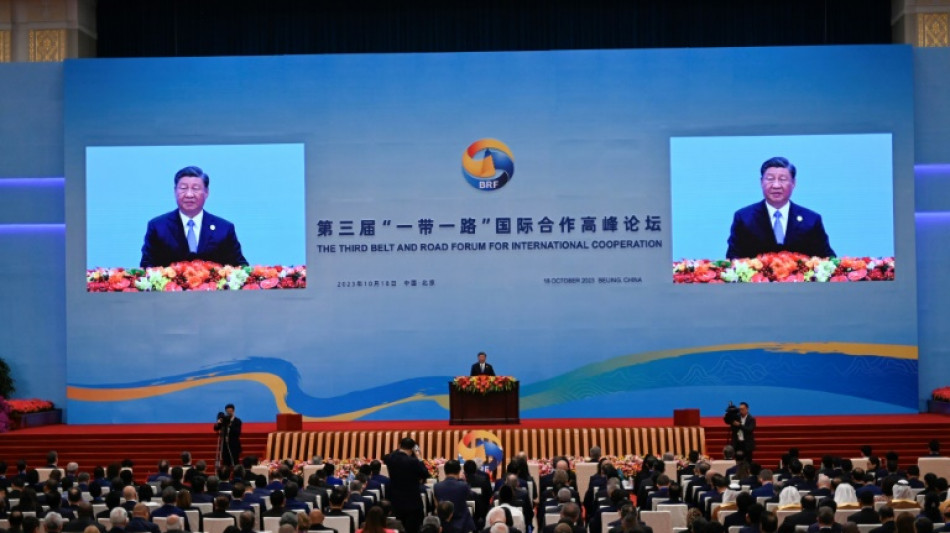
China is owed more than a trillion dollars through its Belt and Road project, making it the biggest debt collector in the world, a report said this week, with an estimated 80 percent of the loans supporting countries in financial distress.
Beijing says upwards of 150 countries stretching from Uruguay to Sri Lanka have signed up to the BRI, a vast global infrastructure push unveiled by President Xi Jinping a decade ago.
The first decade of the initiative saw China distribute huge loans to fund the construction of bridges, ports and highways in low and middle-income countries.
But much more than half of those loans have now entered their principal repayment period, said a report released Monday by AidData, a research institute tracking development finance at Virginia's College of William and Mary.
That figure is set to hit 75 percent by the end of the decade, it added.
Crunching data compiled on Chinese financing of almost 21,000 projects across 165 countries, AidData said Beijing had now committed aid and credit "hovering around $80 billion a year" to low and middle-income nations.
The United States, in contrast, has provided $60 billion to such countries a year.
"Beijing is navigating an unfamiliar and uncomfortable role -- as the world's largest official debt collector," the report said.
"Total outstanding debt -- including principal but excluding interest -- from borrowers in the developing world to China is at least $1.1 trillion," AidData said.
AidData, it added, "estimates that 80 percent of China's overseas lending portfolio in the developing world is currently supporting countries in financial distress".
Proponents of the BRI praise it for bringing resources and economic growth to the Global South.
But critics have long pointed to opaque pricing for projects built by Chinese companies, with countries including Malaysia and Myanmar renegotiating deals to bring down costs.
And AidData said China has in recent years suffered reputational damage among developing countries, with its approval rating falling from 56 percent in 2019 to 40 percent in 2021.
But China is "learning from its mistakes and becoming an increasingly adept crisis manager", the study said.
Beijing is seeking to de-risk the BRI by bringing its lending practices more in line with international standards, it stressed.
But also among those methods are "increasingly stringent safeguards to shield itself from the risk of not being repaid", it said.
That includes allowing key BRI lenders to pay themselves principal and interest due by "unilaterally sweeping" borrowers' foreign currency reserves held in escrow.
"These cash seizures are mostly being executed in secret and outside the immediate reach of domestic oversight institutions... in low- and middle-income countries," it said.
"The ability to access cash collateral without borrower consent has become a particularly important safeguard in China's bilateral lending portfolio."
At a major summit in Beijing last month marking the project's tenth anniversary, Xi said China would inject more than $100 billion of new funds into the BRI.
But a joint report this year by the World Bank and other institutions, including AidData, said Beijing had been forced to hand out billions of dollars in bailout loans to BRI countries in recent years.
The initiative has also drawn scrutiny for its massive carbon footprint and the environmental degradation caused by massive infrastructure projects.
R.Veloso--PC