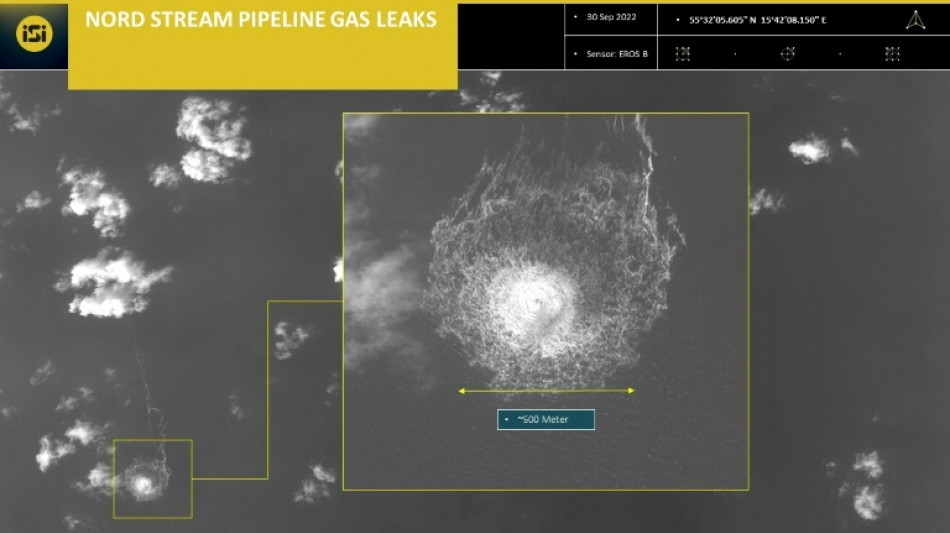
Methane leaks from Nord Stream pipeline blasts revised up: studies / Photo: - - ImageSat International (ISI)/AFP

 South Africa Test series a lot tougher than a World Cup says All Blacks coach Rennie
 Coventry sign Nigeria striker Awoniyi from Forest

 TripleDart tops $7 million ARR with AI-led growth, reports 50 per cent EBIT margin

 Bipartisan backlash as Trump scales back US-South Korea drills
 'Never seen one like it': German pensioners flee wildfire

 Ipswich sign Enciso and Ouattara in double raid on Strasbourg
 UN laments 'unacceptable' toll of 350 aid workers killed in 2025

 Former child star actress Hayden Panettiere dead at 36

 Pakistan captain Babar Azam doubtful for England opener

 Pentagon inks Tomahawk deal amid reports of missile shortfall
 Rain halts India push after Dinusha century lifts Sri Lanka

 Dinusha hits century as Sri Lanka post 284 in first India Test

 Stocks steady as investors weigh US rate path
 Taiwan's leader says government to propose record defence spending for 2027
 Cambridge head slams 'feeding frenzy' over dead academic

 Ebola outbreak now DR Congo's deadliest ever

 Germany's coalition split over putting climate in constitution

 Ukraine badminton star: 'How can you feel normal when bombs are falling?'
 Rain brings respite as Belgium wrestles massive wildfire
 Most stocks rise as US data ease rate fears but fuel economic worries

 India take control of Galle Test as Sri Lanka slump to 99-5
 Australia's mushroom murderer appeals conviction

 The Nigerian fishing community being eaten up by the Atlantic

 Kushner to meet Netanyahu after talks with Hamas on Gaza plan
 Photos, memories all that remain for Colombia's bereaved after quake

A series of underwater explosions that ruptured the Nord Stream gas pipelines in 2022 caused the largest known methane leak on record from a single incident, according to new research published on Wednesday.
Scientists estimate the rupture of the major pipeline for transporting Russian gas to Europe released approximately 465,000 tonnes of methane into the atmosphere -- well above earlier estimates, but just a fraction of total global emissions.
The exact cause of the blasts in September 2022, just months after Russia's invasion of Ukraine, is still unknown, though Moscow and Kyiv have traded blame over this and other damage of energy infrastructure.
In three new studies on the Nord Stream leak -- one in Nature and two in a separate journal Nature Communications -- researchers said its potential impact on the environment and climate remained unclear.
But the leak "represents the largest recorded amount of methane released from a single transient event", wrote Stephen Harris and others in Nature.
Though significant, this was equivalent that year to 0.1 percent of human-caused emissions of methane, a powerful greenhouse gas many times more effective at trapping heat in the short term than carbon dioxide.
Methane is emitted naturally from wetlands and rivers but also cows, rice fields and landfills.
A leading source of human-caused emissions is oil and gas projects, and fixing leaky pipelines and other infrastructure is considered a particularly cost-effective way to quickly slow global warming.
"While extraordinary in its magnitude, the Nord Stream explosions remind us of the immediate climate opportunity represented by reducing methane emissions across the oil and gas industry," said Manfredi Caltagirone, head of the UN Environment Programme's International Methane Emissions Observatory (IMEO), which supported the research.
- Unclear impact -
After the explosions beneath the Baltic Sea damaged the Nord Stream pipelines, gas began bubbling up at four rupture points, creating enormous foamy patches on the surface.
There was an "immediate desire" among scientists to determine the size of such a clearly significant leak, said Harris from IMEO.
This was challenging because it was difficult to know how much methane was absorbed in the ocean and how much leaked into the atmosphere.
Early estimates for the Nord Stream leak ranged from 70,000 tonnes to 300,000 tonnes.
For the research in Nature, scientists used atmospheric data, satellite images, marine observations and aerial measurements to model how much methane might have escaped the ocean.
It "far exceeds" any other leak of its kind and was equivalent to 30 percent of Germany's annual methane emissions, wrote Friedemann Reum from the German Aerospace Centre in Nature Communications.
Another paper in the same journal looked at the impact of the leaks on protected marine areas in the Baltic.
Martin Mohrmann from Sweden's Voice of the Ocean Foundation and colleagues suggested 14 percent of the region experienced methane concentrations five times average levels.
More than 150 countries have signed a pledge to slash methane emissions, but atmospheric concentrations of this potent greenhouse gas still hit record highs in 2024.
The International Energy Agency has noted that normal oil and gas operations around the world release the same amount of methane as the Nord Stream explosion every single day.
B.Godinho--PC