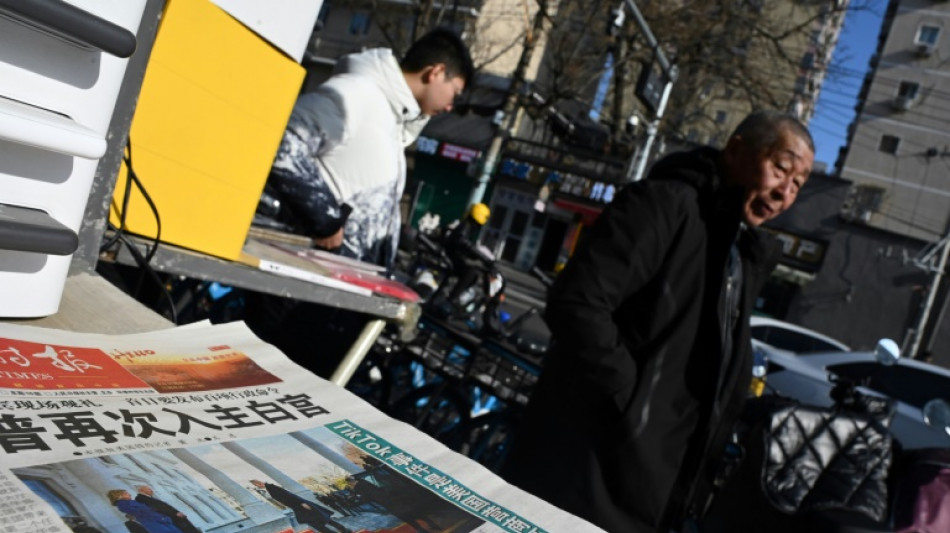
How things stand in China-US trade tensions with Trump 2.0 / Photo: GREG BAKER - AFP

 Stocks lower as Hormuz concerns and high oil prices persist

 Crowds turn out for 'Total Eclipse' singer Bonnie Tyler's funeral

 Mali jails junta-critic broadcaster, influencer for seven years

 'Nowhere to run': Indonesian quake survivors plead for help
 Belgium fire makes 'limited' spread overnight, more help on way

 Vingegaard brings curtain down on season

 Dickwella, Dinusha hit fifties as Sri Lanka fight back

 Bangladesh Test cricket reboot delivers in style with historic win

 Virgin moves closer to launching Eurostar rival in 2030

 Indian marble waste dump becomes unlikely tourist attraction

 Coach says Australia 'let standards slip' in shock Bangladesh loss

 Hawaii recovery efforts begin as Lala downgraded, moves west

 Food safety crackdown snares Mumbai's famed restaurants

 Trump says US scaling back military drills with Seoul hours before start

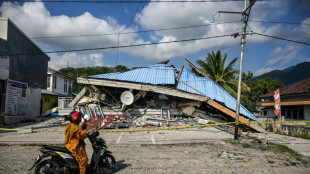 Nearly 13,000 displaced after deadly Indonesian quake

 Axe hangs over Australian batters after Darwin 'disaster'

 Is this cave in Turkey where Homer wrote 'The Odyssey'?
 Winning back walls from gangs, artists fill El Salvador's towns with color

 Opening arguments expected in Tupac murder trial

 As machinery removes rubble, hopes for survivors from Colombian quake dwindle
 Trump says US scaling back military drills with South Korea

 Zambia's Hichilema takes early lead in reelection bid
 Sabalenka squeezes out a win on sixth match point in Cincinnati

 Duplantis dominant, Hunt hits four and Asher-Smith makes history

 Spanish soldier dies in Aragon wildfire

Donald Trump is back in the White House, promising to use the United States's vast economic weight to hit back at China for its alleged unfair trade practices and role in the deadly American fentanyl crisis.
This week, the mercurial magnate said 10 percent tariffs on all Chinese imports could kick in on February 1 -- and on the campaign trail touted a levy as high as 60 percent.
China has warned that there are "no winners" in a trade war and vowed to defend its economic interests.
Here's where the China-US trade relationship stands:
- How much trade is at stake? -
Trade between China and the United States -- the world's two largest economies -- is vast, totalling more than $530 billion in the first eleven months of 2024, according to Washington.
Over that same period, sales of Chinese goods to the United States totalled more than $400 billion, second only to Mexico.
According to the Peterson Institute of International Economics (PIIE), China is the dominant supplier of goods from electronics and electrical machinery, to textiles and clothing.
But a yawning trade imbalance -- $270.4 billion for January to November last year -- has long raised hackles in Washington.
As has China's vast state support for its industry, sparking accusations of dumping, as well as its perceived mistreatment of US firms operating in its territory.
But China's economy remains heavily reliant on exports to drive growth despite official efforts to raise domestic consumption -- making its leaders reluctant to change the status quo.
- What happened during Trump's first term? -
Trump stormed into the White House in 2016 vowing to get even with China, launching a trade war that slapped significant tariffs on hundreds of billions of dollars of Chinese goods.
China responded with retaliatory tariffs on American products -- particularly affecting US farmers.
Key US demands were greater access to China's markets, broad reform of a business playing field that heavily favours Chinese firms, and a loosening of heavy state control by Beijing.
After long, fraught negotiations the two sides agreed what became known as the "phase one" trade deal -- a ceasefire in the nearly two-year-old trade war.
Under that agreement, Beijing agreed to import $200 billion worth of US goods, including $32 billion in farm products and seafood.
But in the face of the pandemic and a US recession, analysts say Beijing fell well short of that commitment.
"In the end, China bought only 58 percent of the US exports it had committed to purchase under the agreement, not even enough to reach its import levels from before the trade war," PIIE'S Chad P Brown wrote.
"Put differently, China bought none of the additional $200 billion of exports Trump's deal had promised."
- How did things change under Biden? -
Trump's successor Joe Biden did not roll back increases imposed by his predecessor, but took a more targeted approach when it came to tariff hikes.
Under Biden, Washington expanded efforts to curb exports of state-of-the-art chips to China -- part of a broader effort to prevent sensitive US technologies being used in Beijing's military arsenal.
His administration has also used tariffs to take aim at what it called China's "industrial overcapacity" -- fears the country's industrial subsidies for green energy, cars and batteries could flood global markets with cheap goods.
Last May, Biden ordered $18 billion worth of imports from China be slapped with tariffs, accusing Beijing of "cheating" rather than competing.
Under the hikes, tariffs on EVs quadrupled to 100 percent, while the tariff for semiconductors will surge from 25 percent to 50 percent.
The measures also targeted strategic sectors such as batteries, critical minerals and medical products.
Both sides have also launched investigations into the others' alleged unfair trade practices with probes into dumping and state subsidies.
- What happens next? -
With Biden gone, all eyes are on whether Trump will follow through on these threats -- or if the rhetoric was an opening gambit in negotiations.
Trump has long viewed tariffs as a bargaining tool -- an "all-purpose bludgeon", according to a Wall Street Journal editorial.
He has also tied tariffs to the fate of Chinese-owned social media app TikTok -- warning of retaliation if a deal cannot be struck to sell it.
Many breathed a sigh of relief when a "shock and awe" blitz of executive orders signed on Trump's first day in office did not feature tariffs on Chinese goods.
But Trump did order a sweeping review by top officials into a number of Chinese trade practices -- with reports due by April 1.
"Although no immediate tariff hike is an upside surprise, extended uncertainty may still weigh on confidence," HSBC economists wrote in a note Wednesday.
"That said, the lack of concrete tariffs at this juncture may suggest that Trump is open to further negotiations with China," they added.
C.Amaral--PC