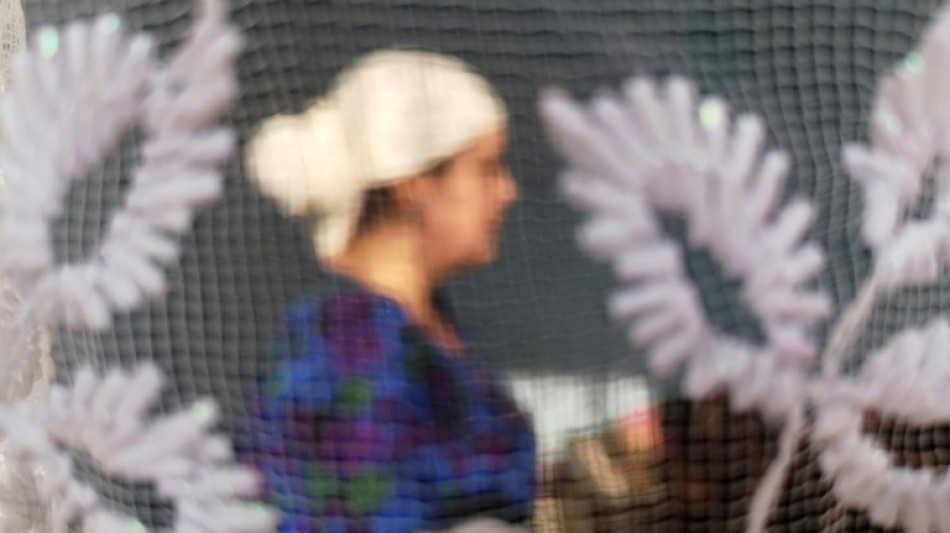
Tajikistan launches crackdown on 'witchcraft' and fortune-telling / Photo: STRINGER - AFP

 Mali jails junta-critic broadcaster, influencer for seven years

 'Nowhere to run': Indonesian quake survivors plead for help
 Belgium fire makes 'limited' spread overnight, more help on way

 Vingegaard brings curtain down on season
 Dickwella, Dinusha hit fifties as Sri Lanka fight back
 Bangladesh Test cricket reboot delivers in style with historic win

 Virgin moves closer to launching Eurostar rival in 2030
 Indian marble waste dump becomes unlikely tourist attraction

 Coach says Australia 'let standards slip' in shock Bangladesh loss

 Hawaii recovery efforts begin as Lala downgraded, moves west

 Food safety crackdown snares Mumbai's famed restaurants
 Trump says US scaling back military drills with Seoul hours before start
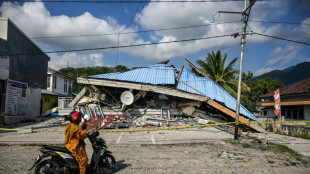 Nearly 13,000 displaced after deadly Indonesian quake
 Axe hangs over Australian batters after Darwin 'disaster'

 Is this cave in Turkey where Homer wrote 'The Odyssey'?

 Winning back walls from gangs, artists fill El Salvador's towns with color

 Opening arguments expected in Tupac murder trial

 As machinery removes rubble, hopes for survivors from Colombian quake dwindle

 Trump says US scaling back military drills with South Korea

 Zambia's Hichilema takes early lead in reelection bid
 Sabalenka squeezes out a win on sixth match point in Cincinnati

 Duplantis dominant, Hunt hits four and Asher-Smith makes history

 Spanish soldier dies in Aragon wildfire

 PSG beaten by Lens in French Champions' Trophy

 Rybakina, Andreeva race into Cincinnati third round

In a block of flats in Tajikistan's capital Dushanbe, a turbaned woman cautiously opened the door of her apartment a chink, letting out a waft of incense.
"I'm not taking on new clients. It could be a set-up," she says, as she closes the door again and locks it.
"I risk a heavy fine. I do not want people outside on my landing," speaking through the door.
A majority Muslim country in Central Asia, mountainous and impoverished Tajikistan has recently launched a crackdown against fortune tellers, clairvoyants, mediums and "witches".
Practitioners of the occult are keeping a low profile to avoid arrest and public shaming because of a government-led campaign against them.
Tajik police have stepped up raids against what they call "parasites engaged in some of the most detestable activities imaginable -- divination and witchcraft".
Other countries in Central Asia are also cracking down on what have become widespread practices with roots in pre-Islamic traditions.
- Thousands of arrests -
The fight against occult practices is part of wider strict controls imposed in the authoritarian country, which is seeking to curb both radical Islam and ancestral beliefs.
"Illegal religious teaching leads to scams, divination and witchcraft. Tajiks! The Prophet categorically forbade going to diviners and sorcerers," President Emomali Rakhmon, who has ruled the country since 1992, said last year.
Rakhmon also last year announced the arrest of 1,500 people "engaged in witchcraft and divination" as well as "more than 5,000 mullahs" who promised healing through prayer.
A repeat offence is now punishable by two years' imprisonment and a fine of 12,800 euros ($13,300) -- the equivalent of six years' average salary for a Tajik.
Witches and fortune tellers have adapted to avoid police raids.
"I no longer receive people in my home. I go to them," Adalat, a 56-year-old fortune teller, said during a session on the outskirts of Dushanbe.
She swung a string of pearls over some instructions scribbled on a piece of paper, mumbling a few words after asking her client some questions.
She said she is particularly skilled at reconciling fighting couples and seeing their future.
"Even as a child, I was tormented by nightmares which made me want to help people. But I only show my gift to people close to me," she said.
The price of consultations can range from a few euros to gold jewels depending on the client requests but Adalat said she "cannot live" off her fortune telling and relies on money sent to her by her son who works in Russia.
- 'Social inequality' -
One of her clients, Gulbakhor, said she had "turned to fortune tellers and healers mainly because of health problems".
"It's cheaper than conventional medicine, which is very expensive," the 42-year-old housewife told AFP.
Since the fall of the Soviet Union and a civil war in the early 1990s, Tajikistan has been plunged into poverty.
According to Mehrigiul Ablezova, a professor of sociology at the American University of Central Asia, "the attraction of witchcraft and fortune-telling may be linked to social inequality and a lack of access to public services".
"In countries where health or welfare systems are limited, people may seek alternative sources of treatment and support," she told AFP.
She said repression alone would not be enough to counteract these "deeply rooted traditions and beliefs in Central Asia that predate the introduction of Islam".
V.Dantas--PC