Rubbish roads: Nepal explores paving with plastic / Photo: Prakash MATHEMA - AFP

 Mali jails junta-critic broadcaster, influencer for seven years
 'Nowhere to run': Indonesian quake survivors plead for help
 Belgium fire makes 'limited' spread overnight, more help on way

 Vingegaard brings curtain down on season
 Dickwella, Dinusha hit fifties as Sri Lanka fight back
 Bangladesh Test cricket reboot delivers in style with historic win

 Virgin moves closer to launching Eurostar rival in 2030
 Indian marble waste dump becomes unlikely tourist attraction
 Coach says Australia 'let standards slip' in shock Bangladesh loss

 Hawaii recovery efforts begin as Lala downgraded, moves west

 Food safety crackdown snares Mumbai's famed restaurants
 Trump says US scaling back military drills with Seoul hours before start
 Nearly 13,000 displaced after deadly Indonesian quake
 Axe hangs over Australian batters after Darwin 'disaster'

 Is this cave in Turkey where Homer wrote 'The Odyssey'?

 Winning back walls from gangs, artists fill El Salvador's towns with color

 Opening arguments expected in Tupac murder trial

 As machinery removes rubble, hopes for survivors from Colombian quake dwindle

 Trump says US scaling back military drills with South Korea

 Zambia's Hichilema takes early lead in reelection bid
 Sabalenka squeezes out a win on sixth match point in Cincinnati

 Duplantis dominant, Hunt hits four and Asher-Smith makes history

 Spanish soldier dies in Aragon wildfire

 PSG beaten by Lens in French Champions' Trophy

 Rybakina, Andreeva race into Cincinnati third round

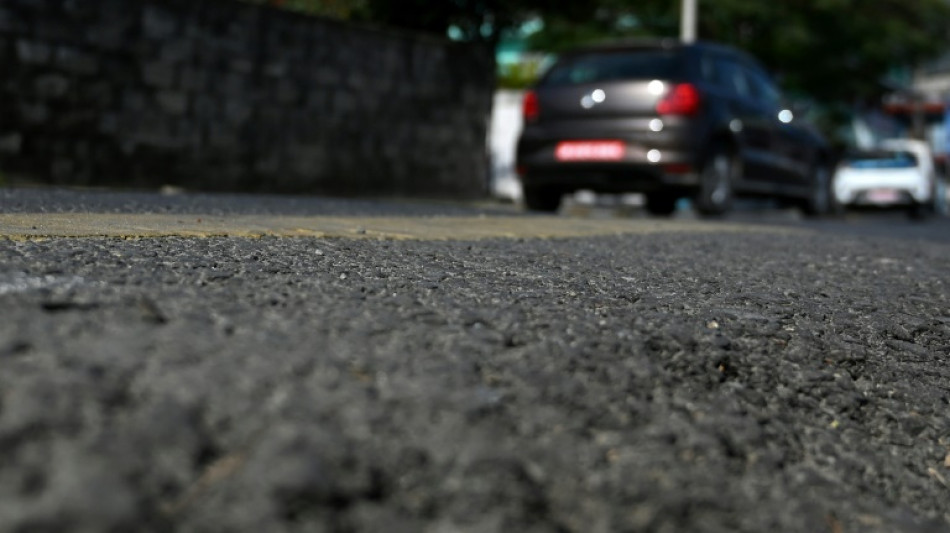
Cars speeding along a smooth, black-coloured street in Nepal's Pokhara are also driving over heaps of discarded plastic, transformed into an ingredient in road construction.
Nepal's urban areas generate about 5,000 tonnes of solid waste per day, according to the World Bank, of which 13 percent is plastic waste dumped in landfills.
While high-value plastics, like bottles, are absorbed by the recycling industry, low-value plastics -- such as multi-layered packaging -- pose a significant challenge because they don't fit into a single recycling category.
For a group of young Nepali entrepreneurs, the vast accumulation of this low-value plastic waste presented an opportunity.
"A plastic road can use even low-value plastics," said Bimal Bastola, founder of Green Road Waste Management, the organisation leading the initiative in Nepal.
"We saw scope for such plastics to be utilised as a raw material, partially substituting bitumen in road construction."
Discarded packages of noodles, biscuits and other snacks move along a conveyor belt at their trash-sorting centre.
The divided plastic is then put into machines to be shredded into fine pieces.
Since the early 2000s, neighbouring India has been leading the world in building a network of plastic roads, even making the usage of plastic waste mandatory in roads near large cities in 2015.
A growing number of countries are experimenting with it, including nearby Bhutan and Bangladesh.
In traditional road construction, bitumen is the binding material, a tarry oil product mixed directly with hot aggregates before paving a road.
The plastic road method, however, first coats the aggregates with shredded plastic before adding bitumen.
"This method reduces the need for fresh raw materials, lowers costs, prevents water infiltration and increases road lifespan," Bastola said.
Studies show that roads paved with plastic waste can be twice as durable as normal roads.
- 'Scale up' -
Globally, only nine percent of plastic waste is recycled, while 19 percent is incinerated, and nearly half ends up in controlled landfills, according to the Organisation for Economic Cooperation and Development (OECD).
Left unchecked, the production of synthetic polymers -- the building blocks of plastics -— is expected to reach about 1.2 billion tonnes annually by 2060.
The plastic that accumulates in the environment is non-biodegradable, takes hundreds of years to decompose and breaks down into tiny microscopic particles.
And while Nepal banned single-use plastic bags thinner than 40 microns, that ban is not strictly implemented.
For Bastola, increasing plastic road construction is key to making the recycling of low-value plastics economically viable.
His organisation says about two tonnes of shredded plastic is used to build a kilometre of road.
So far, the organisation has completed about 10 projects totalling a little over 1.5 kilometres (one mile).
"It is happening at a small scale, we need to scale up," Bastola said. "We have to make government-level projects and we are trying to work closely with the department of roads."
A pilot project is planned this year in the capital Kathmandu at a major intersection.
"Nepal is keen on testing this technology through pilot projects," said Arjun Nepal, an engineer with the Kathmandu road department.
"But to take it forward, we need government-led standards to ensure quality."
The World Bank says life cycle analyses of plastic roads are limited and it is still not clear what environmental impacts -- if any -- recycled plastics may have when used in road construction.
"While initial anecdotes and pilot studies show promise, further research is needed to measure emissions during production, evaluate microplastic release over time and determine how these roads behave once they are decommissioned," said Valerie Hickey, global director of the World Bank's climate change group.
Despite these concerns, environmentalist Bhushan Tuladhar said that plastic roads present an important opportunity for Nepal.
"It is a low-hanging fruit to address two problems simultaneously -- the need for strong roads and the management of plastic waste -- for a developing country like Nepal," he said.
O.Salvador--PC