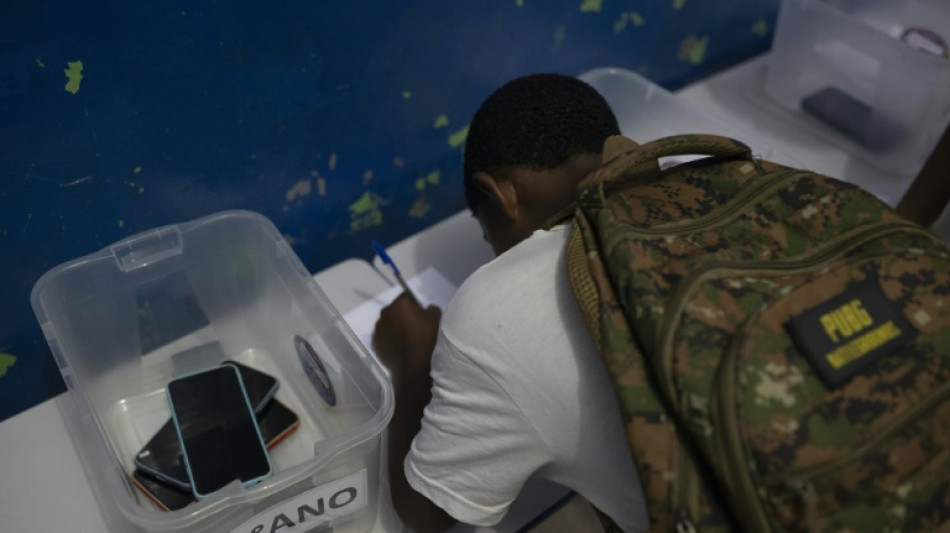
Playgrounds come alive again with Brazil school phone ban / Photo: Pablo PORCIUNCULA - AFP

 Trump says US scaling back military drills with South Korea hours before start

 Jason Arday: UK academic who died amid plagiarism storm
 Sabbath cafe clash lays bare Israel faultlines
 Top-ranked Scheffler powers to PGA St. Jude Championship victory
 Jacquet scores on Liverpool debut in friendly win over Como
 Hawaii's Big Island begins recovery efforts as Hurricane Lala downgrades, moves west

 Spidey swings high for third weekend in N. American box office

 Eagle and late birdie lift Jeeno to LPGA Portland Classic win

 Duplantis masterclass for fourth Euro pole vault title

 Records for Asher-Smith, Hunt as Britain win 4x100m mixed relay

 Barcelona reach deal with Man City to sign Rodri

 Misery for Maresca as Man City make dismal start to life after Guardiola

 Strikes kill 19 in Russia and Ukraine

 Lula and Bolsonaro court women voters as Brazil election campaign kicks off

 Belgium races to tame huge wildfire creeping towards Germany
 Two dead, hundreds evacuated from fires on island near Athens

 Real Madrid crush Schalke in friendly as Diomande debuts

 Calls for UK inquiry into 'hounding' of ex-Cambridge academic

 Strikes kill 16 in Russia and Ukraine

 Marchand tries for European swim gold in unfamiliar event
 India's Padikkal steals the show with 167 in first Sri Lanka Test

 Hollywood duo underline Premier League ambition for Wrexham

 India's Padikkal makes 167 in first Sri Lanka Test
 Hurricane Lala pulls away from Hawaii's Big Island

 Petros, Vainio set new championship records to win Euro marathons

In Rio de Janeiro, children are playing again "like in the old days," and their focus in class has improved after a school cellphone ban pioneered in the city that has now gone national.
Students across the country of more than 200 million people are starting the school year with phones banned from classes and break time after a new law signed by President Luiz Inacio Lula da Silva in January.
Brazil, which has more smartphones than people, joins a growing number of nations using such bans to pry devices from the hands of children hooked on social media.
"It was difficult because we get addicted and ... it ends up causing a certain withdrawal ... but after the habit passes, we interact more," said Kamilly Marques, 14.
A student at the Reverend Martin Luther King public school in Rio de Janeiro, Marques told AFP she didn't even bother bringing her phone to school anymore, a year after the city first implemented the ban.
She is not alone. Only a few students now stop under a large mural of the US civil rights hero to place their devices in plastic boxes before heading to class.
Marques said that while she first thought the ban was "annoying" and "boring", she is happier with her improved grades and social life.
"There was a classmate who was cyberbullied, and we didn't even know, because we were more focused on our phones than on our friends, you know?" she said.
- Addicted and anxious -
UN culture and education body UNESCO said that at the end of 2024, 40 percent of global education systems had some sort of ban on smartphone use in schools, up from 30 percent a year earlier.
Rio's municipal education secretary, Renan Ferreirinha, told AFP that officials had noticed children returning to classrooms after the Covid pandemic "more agitated, more impatient, more addicted to cell phones and much more anxious."
A 2024 survey of parents by digital research company Opinion Box and mobile industry platform Mobile Time showed most Brazilian children got their first cellphone at an average of 10 years old.
While children under the age of three were spending almost an hour and a half a day on smartphones, this rose to almost four hours for those between 13 and 16.
A study carried out by the Rio de Janeiro municipality in September showed improvements in concentration, class participation and student performance since the school ban was implemented.
Ferreirinha, who is also a federal lawmaker, acted as rapporteur for the law which took the ban nationwide.
If moderating cellphone use "is difficult for an adult, imagine what it's like for a child. It doesn't make any sense for a teacher to be trying to teach a class while the child is watching a video on social media or playing a game on their phone," he said.
On a recent school visit, one child told him they were back to playing like kids did "in the old days."
- 'Much happier' -
Fernanda Heitor, 46, the deputy director of the Reverend Martin Luther King school -- which has students aged six to 16 -- said classes had become unsustainable before the ban.
"There was resistance. Even today, some still hide their cell phones when they enter the school," she said.
She described break time previously as "islands" of children sitting glued to their phones.
"They didn't interact, there wasn't much play, they didn't talk. Now they play... It's transformed the school. It's become much happier, much more lively."
Brazil's new law allows cellphone use for educational purposes, emergencies and health purposes.
Fabio Campos, an expert on education and technology, told AFP that while he believed the law was necessary, students should be taught how to use technology responsibly.
"Brazil is a country of inequality. Many students only have access to technology at school. So, if this means that schools will become less technological, it is a failure."
Ferreirinha said parents also need to impose more limits at home.
At the Reverend Martin Luther King school, Pedro Henrique, 11, still brings his smartphone to school every day and uses it a lot at home.
"I miss the cellphone a little," during breaktime, he admits, adding that at the end of the day "I feel happy, because I'll be with my cell phone and using it."
E.Raimundo--PC