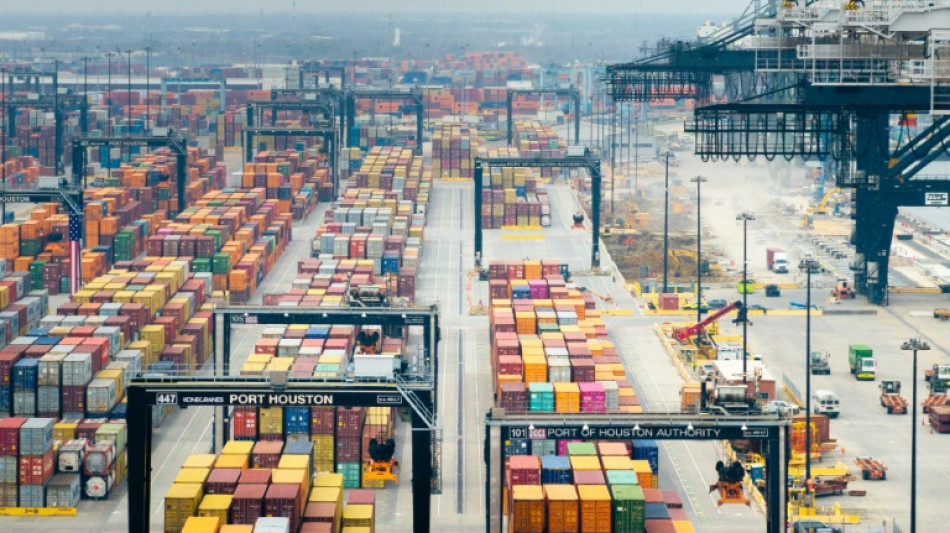
US trade deficits at core of Trump tariff moves / Photo: Brandon Bell - GETTY IMAGES NORTH AMERICA/AFP/File

 Top-ranked Scheffler powers to PGA St. Jude Championship victory

 Jacquet scores on Liverpool debut in friendly win over Como

 Hawaii's Big Island begins recovery efforts as Hurricane Lala downgrades, moves west

 Spidey swings high for third weekend in N. American box office

 Eagle and late birdie lift Jeeno to LPGA Portland Classic win

 Duplantis masterclass for fourth Euro pole vault title

 Records for Asher-Smith, Hunt as Britain win 4x100m mixed relay

 Barcelona reach deal with Man City to sign Rodri

 Misery for Maresca as Man City make dismal start to life after Guardiola

 Strikes kill 19 in Russia and Ukraine

 Lula and Bolsonaro court women voters as Brazil election campaign kicks off

 Belgium races to tame huge wildfire creeping towards Germany

 Two dead, hundreds evacuated from fires on island near Athens

 Real Madrid crush Schalke in friendly as Diomande debuts

 Calls for UK inquiry into 'hounding' of ex-Cambridge academic

 Strikes kill 16 in Russia and Ukraine

 Marchand tries for European swim gold in unfamiliar event

 India's Padikkal steals the show with 167 in first Sri Lanka Test

 Hollywood duo underline Premier League ambition for Wrexham

 India's Padikkal makes 167 in first Sri Lanka Test

 Hurricane Lala pulls away from Hawaii's Big Island

 Petros, Vainio set new championship records to win Euro marathons

 Hurricane Lala brushes past Hawaii's Big Island, bringing heavy rain

 'Something we dreamed of': Bangladesh celebrates historic cricket win

 Rain holds up India on day two of Sri Lanka Test

Imposing punitive tariffs on countries with high trade surpluses with the United States has been at the heart of US President Donald Trump's economic policy.
Trump has lived up to his campaign pledges to resume his hardball trade diplomacy.
But analysts say trade imbalances can sometimes be the result of US policy itself.
- What is a trade deficit? -
A trade deficit occurs when a country's imports exceed its exports to another country. The balance is usually calculated on trade of goods such as cars, electronics, farm products or oil and gas, among other things.
International comparisons usually focus on goods but some analysts say trade in services -- such as financial systems, transports, tourism or communications services -- should also be taken into account to get the full picture.
The United States, for instance, has a large trade deficit with many of its partners when just considering goods, but once services are taken into account the overall imbalance is less.
"Politicians are obsessed with the material nature of physical goods," said Niclas Poitiers, a research fellow at Brussels' think tank Bruegel.
Poitiers noted that countries can't impose tariffs on services, hence Trump's insistence on focusing on goods.
- Who is Trump targeting? -
"We have deficits with almost every country -- not every country, but almost -- and we're going to change it," Trump vowed at the beginning of February, while announcing he would imposed fresh tariffs on Canada, Mexico and China.
The United States posted a goods trade deficit of $295 billion with China in 2024, $63 billion with Canada and $172 billion with Mexico, according to the US Department of Commerce.
While the tariffs on China were implemented, Trump agreed to delay those against Mexico and Canada.
With the European Union, the deficit reached $157 billion in 2023, according to the Eurostat data agency, driven by trade surpluses in Germany, Italy and Ireland.
Japan, South Korea and India are also among the 10 countries with the largest surpluses.
- Is the data reliable? -
The numbers should be dealt with carefully as calculations can vary from one country to the next depending on local accounting norms, the exchange rate used, or to what extent transportation costs are included.
Such inconsistencies mean that some countries can go from having a surplus to having a deficit. France, for instance, had a goods surplus of $14 billion in 2023, according to US statistics, but a deficit of $7 billion according to French customs.
There are differences within the European Union, too, where national figures can differ from those of the European Commission.
This is due the fact that US goods cleared through customs in the Netherlands, Germany or Belgium before being shipped to France, are registered by Eurostat as coming from these countries, French customs have said.
- Where do deficits come from? -
Trump has said that US partners have been taking advantage of the situation, but analysts argue that the reality is more complex with a number of factors playing a part.
"The dollar is at the top of the pile," said Elvire Fabry, a senior researcher in trade geopolitics at the Jacques Delors Institute, in Brussels.
The dollar's status as the world's preeminent reserve currency tends to push its value higher, but this makes American exports more expensive and less competitive for foreign buyers.
Low US savings rates -- at around five percent since the beginning of the 2000s, according to the Federal Reserve Bank of St. Louis -- encourages consumption, including imported goods.
Other factors are at play, such as China maintaining its currency at a low level, making its exports more competitive.
The type of goods manufactured in the United States also matters, said Fabry.
"If the United States can't export more American car brands, it's because they don't suit European consumption," where smaller cars prevail, Fabry said.
More broadly, there are questions on whether economic policy should be based on trade statistics alone.
"Bilateral trade deficits are not really meaningful," said Poitiers, taking the example of the way iPhones are manufactured.
"There are (iPhone) components that are manufactured in South Korea, these components are shipped from South Korea to China, where the stuff is assembled," Poitiers said.
They are then exported from China to the United States, showing up in both countries' bilateral trade, when Apple is an American company, he said.
L.Henrique--PC