Late trains, old bridges, no signal: Germany's infrastructure woes / Photo: THOMAS KIENZLE - AFP

 Sabalenka squeezes out a win on sixth match point in Cincinnati

 Duplantis dominant, Hunt hits four and Asher-Smith makes history

 Spanish soldier dies in Aragon wildfire

 PSG beaten by Lens in French Champions' Trophy

 Rybakina, Andreeva race into Cincinnati third round

 Amy Hunt bags fourth Euro gold as Britain win 4x100m mixed relay

 Spanish soldier dies in Aragon wildfire: regional leader
 Belgium's Pocognoli appointed new Scotland manager

 Marchand storms to second gold of European championships
 Kushner meets with Hamas in push to revive Gaza plan

 Villarreal battle back to earn draw at promoted Racing

 Odegaard says Arsenal 'want to win everything' after Community Shield success

 Arsenal rout Man City in Community Shield masterclass

 Southampton mocked over Spygate during Watford defeat

 Hamas expects meeting with Kushner as US pushes Gaza plan
 Farmers, helicopters help battle record Belgian wildfire

 Air support kicks in as record Belgian wildfire jumps in size
 Firefighters battle second day of blaze on Greek island

 Strikes kill 12 in Russia and Ukraine

 India's Sindhu backs monkey measures as badminton worlds set to open

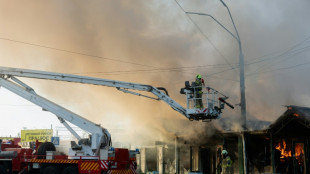 Mass drone attack on Moscow as Russian strikes kill three in Ukraine

 Djokovic feels the heat in Cincinnati defeat, Zverev wins all-nighter
 Pallister stuns Ledecky in Pan Pacs 800m free as two world records carry Douglass to gold
 Rampant Bangladesh make history with first-ever Test win in Australia

 UK's media-savvy PM Burnham shifts messaging to TikTok, podcasts

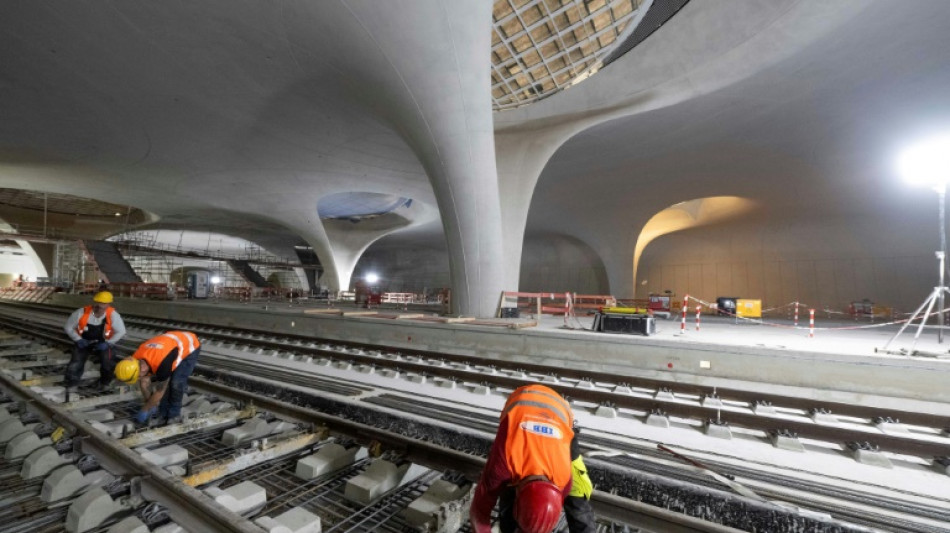
Running late and vastly over budget, a mammoth rail project stands as a monument to what critics say is Germany's glaring failure to tackle long-standing infrastructure woes.
"Stuttgart 21" is envisaged as a major, futuristic rail hub in the southwestern city, a fitting gateway to a region home to the headquarters of corporate heavyweights such as Bosch and Mercedes-Benz.
But 15 years after work began, the project -- which involves replacing the current station with a major underground site -- is not yet complete.
Parts of the city centre remain a vast building site and costs have more than doubled to around 11 billion euros ($11.4 billion).
"Money is just being thrown out of the window," Dieter Reicherter, spokesman for protest group Action Alliance Against Stuttgart 21, told AFP.
"It would be much better if the money had just been used to improve and modernise the existing infrastructure."
Ageing, clapped-out infrastructure and badly planned projects are among some of the most visible problems facing Europe's top economy, whose malaise has become a key issue in the February 23 parliamentary election.
Germany's reputation for efficiency no longer holds true, critics contend -- trains do not run on time, internet and mobile phone coverage is often patchy, and roads and bridges are in a state of disrepair.
- Digital doldrums -
Observers blame years of underinvestment, cumbersome planning and approval procedures and political paralysis caused in recent years by the feuding ruling coalition, whose November collapse precipitated the polls.
A catalogue of problems meant it took 14 years to build a new international airport in the capital Berlin, which finally opened in 2020.
The parlous condition of the railways, run by state-owned operator Deutsche Bahn, is a frequent target of criticism, with passengers complaining of breakdowns, cancelled services and shuttered restaurant carriages.
In 2023 a total of 36 percent of long-distance trains were not punctual, defined as six minutes or more past their scheduled arrival time, according to data from the operator, a rate unthinkable in the past.
The problems sparked international headlines when Germany hosted the Euro 2024 football tournament last summer, with stories of fans facing arduous journeys, frequent delays and being left stranded on platforms.
Elsewhere there are concerns about the state of the country's bridges -- in a 2022 paper, the transport ministry identified 4,000 of them in need of modernisation.
Last September a bridge in Dresden collapsed into the Elbe river in the early hours, causing no injuries but snarling traffic in the eastern city.
It is not just physical infrastructure problems holding the country back, with critics also pointing to a slow rollout of new technologies and digitalisation.
Just 11 percent of Germany's fixed broadband connections are of the faster fiber-optic variety, one of the lowest rates among countries of the Organisation for Economic Co-operation and Development, according to OECD data.
- 'Invest, invest, invest' -
The infrastructure woes have been partly blamed on Germany's constitutionally enshrined "debt brake", which limits annual public deficits to 0.35 percent of GDP, hampering borrowing and keeping spending low.
"The overarching reason is too little investment," ING bank analyst Carsten Brzeski told AFP.
He urged the next government to "invest, invest, invest", and suggested setting up an infrastructure fund and coming up with a 10-year plan.
Both the centre-right CDU, likely to take power after the vote, and Chancellor Olaf Scholz's SPD have voiced openness to easing the debt brake.
Berenberg bank economist Salomon Fiedler said there was a good chance of "helpful reforms" under the country's new leaders.
"I do expect that the next government will try to streamline bureaucratic procedures to speed up investment projects," he told AFP.
But that may be little comfort to residents of Stuttgart whose city centre has faced long-running disruption due to the monster rail project.
"When you come to Stuttgart by train, you have to walk around the construction site," said protest activist Reicherter. "It is like a long-distance hiking trail."
The alliance opposes the project on numerous grounds, including that its main aim is not to improve rail traffic but rather to free up space above ground for new real estate projects.
There is light at the end of the tunnel -- Deutsche Bahn believes the project will be mostly up and running at the end of next year, seven years late.
It insists there will be benefits to travellers, such as significant reductions in journey times and a better link to the airport.
But Reicherter dismisses the claims as "fairy tales", and fears follow-up construction will continue for years to come.
"Unfortunately it never stops," he said.
Ferreira--PC