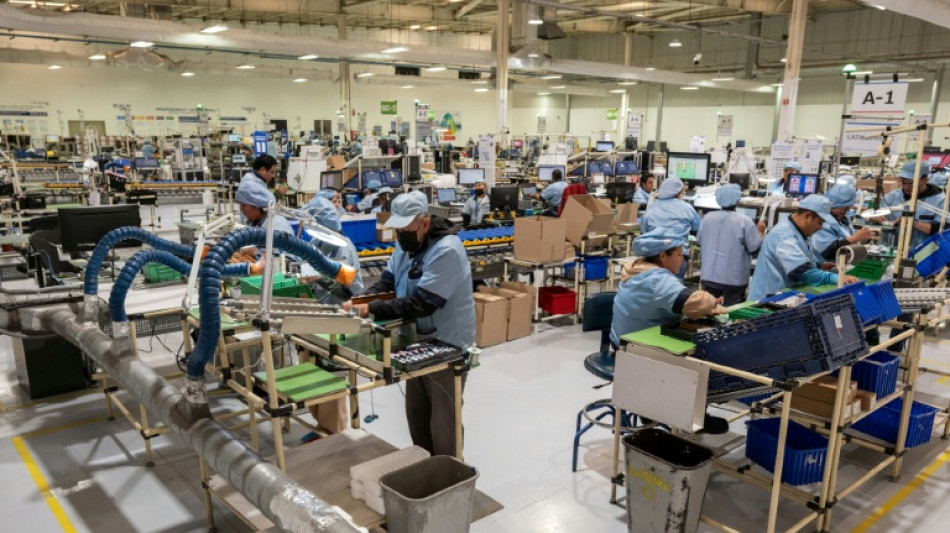
Why Mexican manufacturers seem unfazed by threat of Trump tariffs / Photo: Guillermo Arias - AFP

 Arsenal rout Man City in Community Shield masterclass

 Southampton mocked over Spygate during Watford defeat

 Hamas expects meeting with Kushner as US pushes Gaza plan

 Farmers, helicopters help battle record Belgian wildfire

 Air support kicks in as record Belgian wildfire jumps in size

 Firefighters battle second day of blaze on Greek island

 Strikes kill 12 in Russia and Ukraine

 India's Sindhu backs monkey measures as badminton worlds set to open

 Mass drone attack on Moscow as Russian strikes kill three in Ukraine

 Djokovic feels the heat in Cincinnati defeat, Zverev wins all-nighter

 Pallister stuns Ledecky in Pan Pacs 800m free as two world records carry Douglass to gold

 Rampant Bangladesh make history with first-ever Test win in Australia

 UK's media-savvy PM Burnham shifts messaging to TikTok, podcasts

 Gay badminton star Gilmour urges progress on LGBTQ rights in Asia
 Pallister takes down Ledecky in Pan Pacs 800m freestyle

 Douglass breaks 50m free world record again to claim Pan Pacs gold

 As Opel turns to Chinese partners, its hometown frets about the future

 Mehidy takes three as Bangladesh close on historic win in Australia
 Hope fades for finding surivivors of Colombia quake as rescued woman dies
 Hurricane Lala dumps heavy rain on Hawaii

 Jaded voters, same old choices: Brazil kicks off election campaign

 'Everyone lives in fear': Yemenis worry about return to all-out war

 Cardinals' Baez bashes record three homers in MLB debut

 Djokovic feels the heat in Cincinnati opening defeat

 Hunt bags third Euro gold, Diaz shines in triple jump

If US President Donald Trump is to be taken at his word, Mexican imports to the United States will be hit with 25-percent tariffs on Tuesday.
But exporters in Mexico, the United States' biggest trading partner, remain upbeat about the future of the $840-billion business relationship.
Mexico's economy has gone from strength to strength on the back of the free trade agreements it has enjoyed with the United States and Canada since 1994.
The value of its exports to the United States now far exceeds that of its imports from its northern neighbor -- a major bone of contention for Trump.
On Tuesday, the tariffs he announced on all Mexican imports shortly after taking office are due to go into effect, after being suspended for a month.
Mexican manufacturers, however, are not as worried as you might imagine.
- Been there, done that -
Marco Antonio Lopez has experience when it comes to navigating economic upheaval, from the sudden devaluation of the Mexican peso in 1994 that sent the economy into meltdown to Trump's first presidency, when the Republican threatened to pull the plug on the North America free trade deal.
In the end, the US leader renegotiated parts of the deal, but trade remains mostly tariff-free.
Lopez's company SMK Electronica, based in the city of Tijuana on the border with the United States, manufactures electronic components for the automotive, audiovisual and telecoms industries.
The Tijuana region is home to hundreds of "maquiladoras" -- factories that assemble imported parts into finished products for export, particularly to the United States.
"We have faced many crises. The previous Trump administration was not as drastic, but it was very similar and we learned to adapt," Lopez said.
"The border industry is highly adaptable... and the investment is so great that there is no risk of it disappearing."
The automobile industry is under particular threat from the impending tariffs.
A representative of an auto parts maker with operations in Mexico who did not want to be identified said that US-Mexico trade was too big to fail, but that tariffs could have an impact on production nonetheless.
"Products will become more expensive and there will be a clear loss in competitiveness," the person told AFP.
- Interdependence -
Besides tequila and avocados, Mexico is one of the United States' biggest suppliers of cars, car parts and mechanical and electronic equipment.
Free trade has made North America a seamless manufacturing platform, with products like car key fobs, which are assembled in Mexico, crossing borders on the continent several times during the manufacturing process.
The aerospace industry is another example: Mexican companies manufacture components for US partners such as Boeing and General Electric in the northern city of Monterrey as well as in the central state of Queretaro.
The mere development of a part for an aircraft engine can take between two and three years.
"Changing suppliers in this sector is a rather complicated process," said Erik Palacios, director of the Monterrey aerospace cluster, which groups some 40 companies.
He predicted that US customers "will continue buying at a higher price" until they can develop a local supply chain.
Citing a recent conversation with an executive from US carmaker Ford, Mexican Economy Minister Marcelo Ebrard said that the brand's two most productive plants are in Mexico.
That fact alone, he said, suggested that there were no plans to relocate them north of the border.
- The long-term view -
Companies that AFP spoke to said that decisions to locate manufacturing plants in Mexico were taken years in advance, and would likely outlast Trump's four years in office.
"Decisions in these companies are not made six months or a year in advance. They are made five or ten years ahead of time," SMK Electronica's Lopez said.
German automaker BMW, which has an assembly plant in the Mexican state of San Luis Potosi, subscribes to that view.
"We do not base our long-term strategic decisions on policies or political incentives," a company spokesman told AFP.
The spokesman pointed to the company's announcement in early 2023 of an 800-million-euro ($830 million) investment in the production of lithium batteries in Mexico and the decision to start producing electric vehicles in Mexico in 2027.
That, they said, was proof that BMW was banking on the Latin American country for years to come.
C.Amaral--PC