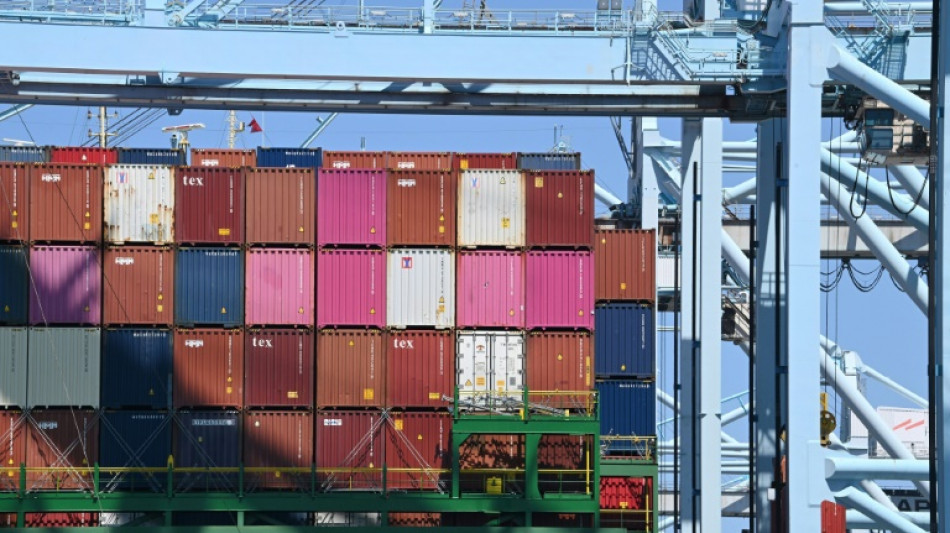
US trade gap shrinks on imports retreat as tariffs fuel worries / Photo: Robyn Beck - AFP/File

 Best Pet Advent Calendars for Christmas 2026: Dog Treats and Cat Toys

 Grattan Institute Releases Blueprint to Target Specialists Over Excessive Fees

 Arizona Science Center Hosts Girls in STEM Astro Adventures for Students

 New Turkish Cafe, Japanese BBQ, and Korean Restaurants Open Across East Bay

 Knowle Move Four Points Clear at Top After Histon Victory

 Physicians Urge Arizona to Ban Medical Gag Clauses and Enable Private Lawsuits

 New Campaign Highlights Knowledge Gaps on Carbon Monoxide Safety Among Americans

The US trade gap narrowed in June, government data showed Tuesday, as imports pulled back more than exports while businesses grappled with President Donald Trump's tariffs on allies and competitors alike.
The overall trade deficit in the world's biggest economy narrowed by 16 percent to $60.2 billion, down from a revised $71.7 billion figure in May, the Department of Commerce said.
The narrowing was more than analysts expected but largely reflected a drop in goods imports -- including consumer goods as Trump's wide-ranging tariffs added to businesses' costs of bringing in foreign products.
In April, Trump imposed a 10-percent duty on most US trading partners and he has also slapped much steeper tariffs on steel, aluminum and autos.
This baseline tariff is set to rise to varying levels for dozens of economies including Japan and the European Union come Thursday.
Given that plans have been set out for higher rates to take effect, policy uncertainty has eased somewhat, said Nationwide financial markets economist Oren Klachkin.
"But businesses hoping tariffs were just threats must now adjust to the reality they are here to stay," he added in a note.
"We think the negative impact of high tariff rates will outweigh any positives from lower policy uncertainty," Klachkin said.
The June deficit narrowed on the back of a fall in imports, by 3.7 percent to $337.5 billion, while exports also dropped by 0.5 percent to $277.3 billion.
The drop in imports came as those of consumer goods decreased $8.4 billion, while those of industrial supplies and materials fell by $2.7 billion. Imports of autos and parts also dropped by $1.3 billion.
The retreat in exports, meanwhile, came as goods exports declined by $1.3 billion, with decreases seen in industrial supplies as well.
The goods deficit with China dropped by $4.6 billion, to $9.4 billion in June.
Washington and Beijing slapped escalating tariffs on each other's products in April, reaching prohibitive triple-digit levels and snarling supply lines between the world's two biggest economies.
But in May, the countries reached a temporary agreement to bring these duties to a lower level until August 12.
X.M.Francisco--PC

