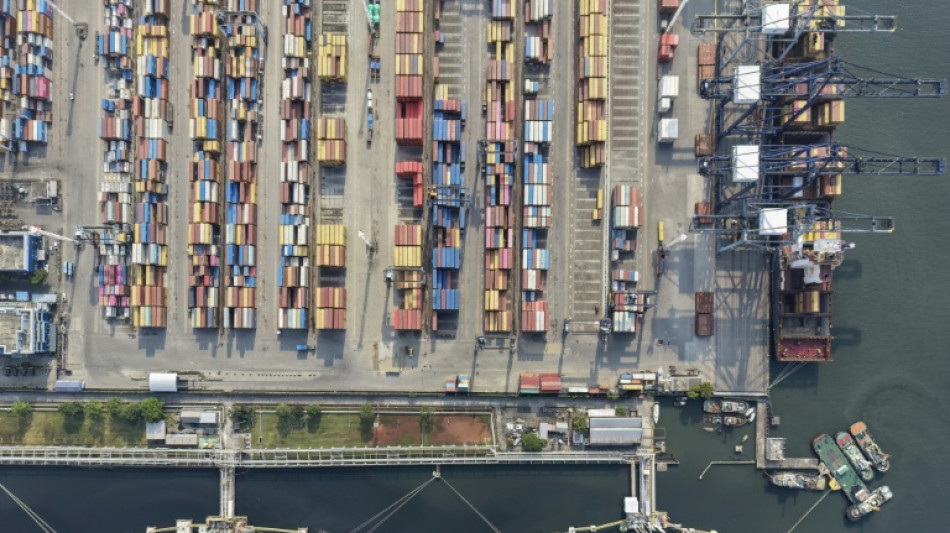
How Middle East war is driving up shipping costs / Photo: BAY ISMOYO - AFP

 Ukraine's Zelensky visits Russian ally Serbia for talks

 Defending champion Shelton storms to Montreal win

 Exodus: West Bank hardships drive out Palestinian Christians

 Travis Head wins Australian cricketer of the year gong

 Colombia's new president vows to 'defeat narco-terrorists'

 Call for Infantino to resign comes amid wave of support

 Trump ally Abelardo de la Espriella sworn in as Colombia president

 FIFA chief Infantino gets backing of South American football

 Amazon behind massive private gas plant for new data centers

 Apple and OpenAI escalate legal battle over devices

 All Blacks strike late to secure opening win against Stormers

 Saudi Arabia, Turkey, Pakistan sign defence pact amid regional war

 Trump renews effort to remove US Fed Governor Lisa Cook

 Abelardo de la Espriella, the flamboyant millionaire taking power in Colombia

 Germany holds security meeting over explosive drone amid Russia protest

 Austrian writer Stefan Zweig, who fled Nazis, honoured in London

 Mexico and Peru reestablish ties after asylum spat

 Dollar drops, stocks climb as weak US jobs data eases rate fears

 Japan defender Tomiyasu joins Crystal Palace

 Celtic boss O'Neill out of hospital after 'small procedure'

 Man City reject Barcelona bid for Rodri - reports

 US unexpectedly loses jobs in blow to Trump ahead of midterms

 Dollar drops, stocks climb after surprise US jobs miss

 Thai students in disbelief after deadly school shooting

 McLaren boss glad of 'harmony' between F1 teammates Norris and Piastri

Iran's closure of the Strait of Hormuz trade route in the Middle East war is driving up the costs of shipping fuel and goods around the world, industry data shows.
Prices have risen because of falling capacity, with ships staying put in the Gulf for fear of attack if they set sail. Other ships are taking long, costly alternative routes to avoid the strait -- while the reduction of oil flows has raised the price of boats' fuel.
"We've had to stop bookings... from and to the upper Gulf region because we can't get the ships in nor out," said Rolf Habben Jansen, chief executive of major container shipping line Hapag-Lloyd last week, estimating the war had driven up costs by "$40, 50 million per week".
"A big chunk of that is bunker fuel prices but also in categories like insurance or container storage and inland transportation we have seen costs go up, and we have six ships that we cannot use today, which reduces the available capacity," he told a news conference.
Here are five data indicators of how the crisis is driving up shipping costs.
- Tanker charters -
The cost of chartering an oil tanker multiplied after US and Israeli forces started striking Iran on February 28, prompting retaliatory strikes across the region.
For a big Suezmax-class crude carrier, the average "earnings" -- a standard indirect indicator of charter costs -- has more than tripled since February 26 to over $330,000 a day, according to maritime research group Clarksons.
For liquefied natural gas carriers on a reference US to Japan route, the measure also tripled in that period to $90,000 a day.
- Oil shipping -
The overall cost of shipping oil shot up after the war broke out, said freight pricing specialist Peter Norfolk at Platts, part of S&P Global Energy.
From $46 per metric tonne at the end of February, the cost of shipping crude from the Gulf to China on a giant VLCC-class tanker nearly tripled in a few days, then eased to stand at around $64 at the end of March, he told AFP on Monday.
"Of course, in reality there is hardly any loading happening at the moment," he noted.
Around a fifth of global crude oil and liquefied natural gas passes through the strait in peacetime.
- Container costs -
The spot reference price to ship a 40-foot container has risen by 20 to 25 percent on the main routes from the Far East to Europe and the US West Coast, according to consultancy Maritime Services International.
The price has reached between $2,200 and $2,700 for a 40-foot container on that Europe route, it said.
"War surcharges have caused rates from the Far East to the Middle East Gulf and Red Sea to spike by nearly 200 percent" from February 20 to March 20, it said in a report.
"Traffic through the SoH (Strait of Hormuz) has been severely constrained, with carriers suspending bookings, rerouting vessels, and discharging cargo at alternative safe regional hubs."
- Ship fuel surge -
The price of the bunker fuel that powers ships nearly doubled after the war broke out, peaking at $1,053 per metric tonne on March 20.
It stood at more than $936 on March 31 -- up from around $540 on the eve of the war, according to market data from financial platform Factset.
- Insurance premiums -
War-risk insurance could run into tens of millions of dollars for a single trip through the Hormuz Strait, with ships and cargoes worth hundreds of millions.
David Smith, head of the marine arm at specialist insurance broker McGill, estimated last week that premiums were swinging "between three and-a-half and 10 percent" of a vessel's value.
X.Matos--PC