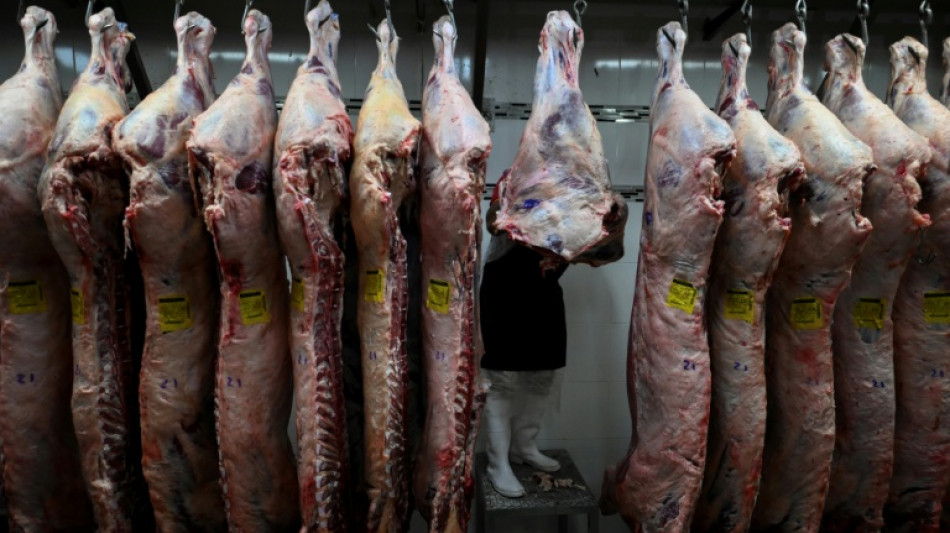
Meat-loving Argentines shun beef as inflation bites / Photo: Luis ROBAYO - AFP

 Asian stocks track Wall St higher after US job losses ease rate fears
 Western Europe experienced hottest June-July on record: EU monitor

 Shelton sweeps Fonseca to reach Montreal quarter-final

 Who are the main contenders in Zambia's presidential vote?

 Rybakina survives scare as Gauff, Osaka race into Toronto quarters

 Thirty years on, a trial finally opens in Tupac Shakur's killing

 Shelton sweeps Fonseca to reach another Montreal quarter-final

 Brennan captures Wyndham crown for second PGA win

 Rybakina, Gauff advance to Toronto quarter-finals

 Rahm three-peats as LIV Golf season champ while Niemann wins at New York

 Vollering wins Tour de France Femmes after war of nerves

 BMW’s next chapter accelerates with New Class rollout

 Five dead in new Russia, Ukraine strikes

 PSG sign France full-back Digne from Villa

 Sinner withdraws from Cincinnati Open with knee injury

 Fernandez's 'perfect' race earns him British MotoGP Grand Prix win

 Iran Guards say won't reopen Hormuz without US meeting Tehran's demands

 Hogh's hat-trick inspires Celtic to 5-1 victory over Kilmarnock

 London grants first licences for supervised Uber robotaxis

 Erasmus hopeful Kolisi hamstring injury not 'too bad'

 Luxury car buyers trade prestige for mainstream value

 Students, teachers mourn girl killed in Thailand school shooting

 Jacobson to lead New Zealand for first time against Sharks

 Typhoon Dolphin makes landfall in China after flight cancellations, evacuations

 South Korea FA apologises after sex scandal adds to controversies

As New Year's festivities draw near, meat-loving Argentines are readying their famous "asado" grills -- traditionally laden with steaks, ribs and sausages.
This year, however, menus will feature much more chicken, pork and even vegetables as inflation puts beef beyond the reach of many and societal values change.
Argentines have for years vied with their neighbors in Uruguay for the title of world's top beef eaters.
But in 2024, Argentina recorded an historic low of 47 kilograms (103 pounds) of red meat consumed per person on average, according to the IPCVA beef promotion institute.
Despite a slight rebound to an estimated 50 kg eaten per person in 2025, consumption was half the nearly 100 kg of beef Argentines were devouring at the end of the 1950s.
Pork and chicken, both cheaper than beef, both grew in popularity in 2025, and the UVA vegan union says more than one in 10 Argentines are now non-meat eaters.
"There are more of us all the time. These days, everyone knows a vegetarian or a vegan in their family," UVA president Manuel Alfredo Marti told AFP.
- 'How I love it!' -
At a popular meat festival in San Isidro, north of the capital Buenos Aires, avowed carnivores spoke of a combination of push and pull factors they blamed for beef's flagging popularity.
There were economic reasons -- with inflation far outstripping salary growth in Argentina -- but also increased awareness of the health risks of eating too much meat, concerns for animal welfare, and worry for the future of the planet.
At the "Locos por el asado" (Crazy for the Grill) fair, retiree Gustavo Clapsos, 55, said he eats meat "less frequently now than before, for health and cost reasons."
So did Dora Acevedo, 59, who moved among the beef flanks dripping over embers while an expert griller gives lessons in meat salting, cooking and carving to a crowd bathed in smoke and the aroma of cooking meat.
"Everything plays a role: the economic side, health... we’ve started eating more vegetables. At least in my diet, that was my change: starting to eat more vegetables," said Acevedo.
In Argentina this year, monthly inflation has fluctuated between 1.5 and 3.7 percent, while the annual rate stands at about 30 percent.
Beef inflation has been higher than that for other food categories.
"As I’ve gotten older, I vary more; I know that less red meat is better for my health," said another meat fair visitor, 73-year-old Graciela Ramos.
"But how I love it! Even more so in good company. I have memories of asados, of big family tables ever since I was little."
- 'Being Argentine' -
According to historian Felipe Pigna, beef consumption in Argentina at the beginning of the 19th century reached a staggering 170 kg per person per year.
"At noon, at night, the rich, the poor, everyone ate it... It was abundant, very cheap, practically the natural daily menu," he told AFP.
It was a time when the cattle Spanish settlers had brought with them in the 16th century was everywhere: propagating freely and exponentially across Argentina's vast pampas grasslands.
By the mid-19th century, cows numbered about 20 million head.
Then the advent of curing and refrigerated shipping transformed the destiny of Argentine beef, turning it into a commodity in high demand globally.
"Meat has always been, and remains, a lead character in Argentina’s story, an essential part of 'being Argentine'," said Pigna.
Even as plant-based restaurants spring up everywhere and vegan products take up ever more space on supermarket shelves, the domestic market still accounts for 70 percent of Argentine beef sales, according to IPCVA president George Breitschmitt.
Despite a sharp fall in consumption, "we’re still at 50 kilos per person per year, while in Europe the average is between 10 and 20 kilos, and in Asia about three to five kilos per person per year," he said.
The Argentine beef sector is also heartened by growth in international demand, said Breitschmitt, particularly in Asia and China -- which receives 70 percent of the South American country's beef exports.
J.Pereira--PC