China's economy beats forecasts, but war darkens outlook / Photo: - - CN-STR/AFP

 Defending champion Shelton storms to Montreal win

 Exodus: West Bank hardships drive out Palestinian Christians

 Travis Head wins Australian cricketer of the year gong

 Colombia's new president vows to 'defeat narco-terrorists'

 Call for Infantino to resign comes amid wave of support

 Trump ally Abelardo de la Espriella sworn in as Colombia president

 FIFA chief Infantino gets backing of South American football

 Amazon behind massive private gas plant for new data centers

 Apple and OpenAI escalate legal battle over devices

 All Blacks strike late to secure opening win against Stormers
 Saudi Arabia, Turkey, Pakistan sign defence pact amid regional war

 Trump renews effort to remove US Fed Governor Lisa Cook

 Abelardo de la Espriella, the flamboyant millionaire taking power in Colombia

 Germany holds security meeting over explosive drone amid Russia protest

 Austrian writer Stefan Zweig, who fled Nazis, honoured in London

 Mexico and Peru reestablish ties after asylum spat

 Dollar drops, stocks climb as weak US jobs data eases rate fears

 Japan defender Tomiyasu joins Crystal Palace

 Celtic boss O'Neill out of hospital after 'small procedure'

 Man City reject Barcelona bid for Rodri - reports

 US unexpectedly loses jobs in blow to Trump ahead of midterms

 Dollar drops, stocks climb after surprise US jobs miss

 Thai students in disbelief after deadly school shooting

 McLaren boss glad of 'harmony' between F1 teammates Norris and Piastri

 Saudi Arabia, Turkey and Pakistan sign defence pact amid regional war

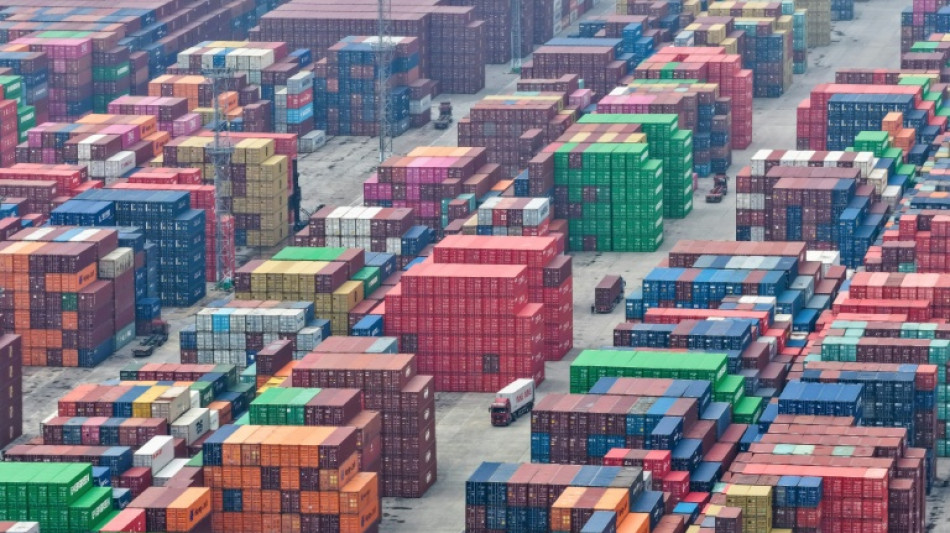
China's economy expanded more than expected in the first three months of the year, with official data Thursday indicating resilience in the face of a Middle East crisis that threatens to hit global growth.
The figures came despite a surge in world energy prices caused by the US-Israel war on Iran, which has stymied shipping through the crucial Strait of Hormuz, through which a fifth of the world's oil and natural gas passes.
Analysts say China's diversified energy supply shields it from immediate shocks, though a potential global downturn caused by the war could weaken demand for its exports, which have been propping up the country's economy.
Gross domestic product in the world's second-largest economy expanded 5.0 percent year-on-year in January-March, according to the National Bureau of Statistics (NBS).
The reading was slightly higher than an AFP forecast of 4.8 percent based on a survey of economists.
During the first quarter, China's economy "achieved a strong start to the year, further demonstrating its resilience and vitality", the NBS said in a statement announcing the data.
The reading came days after the International Monetary Fund cut its 2026 global growth projection, warning that the world economy could be "thrown off course" by the Middle East war.
It also reduced its forecast for China to 4.4 percent growth, from a previous estimate of 4.5 percent.
"The global economy is facing this next test of resilience as signs of unevenness lie beneath the surface," it said, noting that China's "domestic activity -- especially in the housing sector -- lags behind exports".
Beijing has set a 2026 target of 4.5-5.0 percent growth -- the lowest in decades.
A years-long crisis in the property sector and a persistent slump in domestic spending have left leaders reliant on exports to meet growth targets.
- Trade headwinds -
Outbound shipments have boomed, exemplified by the country's whopping $1.2 trillion trade surplus last year.
But data this week showed export growth slowed sharply in March, indicating that war in the Middle East was already taking a toll.
Thursday's NBS data also showed retail sales grew 1.7 percent on-year in March, well short of a Bloomberg forecast of 2.4 percent.
Industrial production rose 5.7 percent, the NBS said, beating a Bloomberg estimate of 5.3 percent but well down from the 6.3 percent seen in January and February combined.
The first-quarter acceleration in growth was fuelled by exports, Zichun Huang of Capital Economics wrote in a note.
"We think growth will soften a bit over the rest of the year," she said.
"While the Chinese economy is holding up well, it is becoming ever more dependent on external demand," she said, noting that the Iran war "is likely to add to this trend".
A major international trade fair kicked off this week in Guangzhou -- a metropolis in China's southern manufacturing heartland -- where attendees told AFP the war is impacting their business.
Chinese exporters and Middle Eastern buyers at the opening day of the Canton Fair on Wednesday gloomily told AFP the Iran war had pummelled orders and led to price hikes.
Wang Jun, the deputy head of China's customs administration, this week acknowledged "many uncertainties and instabilities in the external environment".
"The impact of international geopolitical conflicts on global industrial and supply chains is still evolving in a complex manner," he said.
R.Veloso--PC