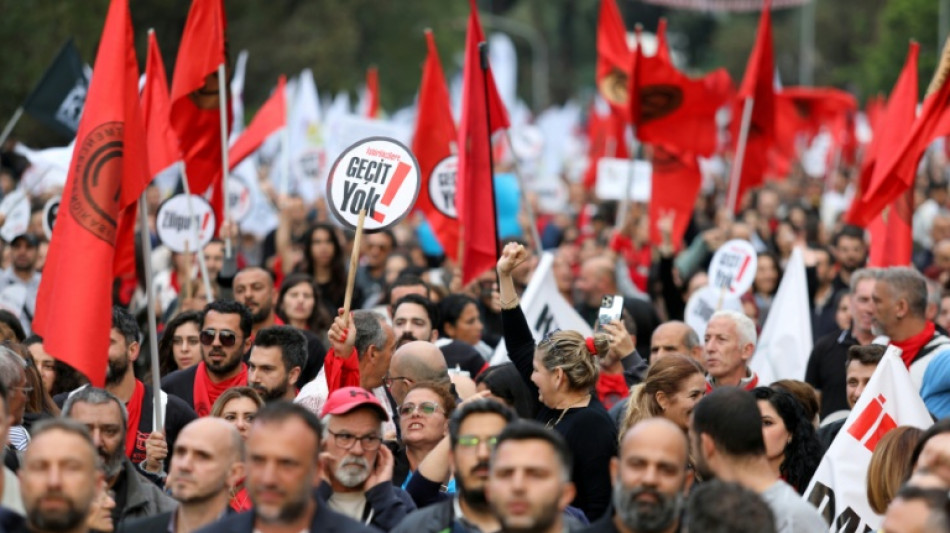
Turkish Cypriots protest new rule allowing hijab in school / Photo: Birol BEBEK - AFP

 Kennedy Center: future unclear for iconic Washington arts hub

 Trump claims 'infinite' Greenland security deal with Denmark

 Helicopters battle wildfire threatening Ecuador's capital

 Brentford batter Chelsea to undo Alonso's promising start

 Kane hits Bundesliga century as Bayern rout Union

 Trump says CNN, MS NOW, Politico banned from White House

 Hushing and hedging: US companies retreat on climate

 Springboks to face Fiji before 2027 Rugby World Cup

 Nigeria miners struggled to breathe in cell before 37 died: survivors

 McIlroy on the charge at PGA Championship as Reed withdraws

 McIlroy on the charge at PGA Championship

 Crisis-wracked Volkswagen warns of 10-bn-euro hit to profits

 Costa Rica's Grynspan tops third informal poll for UN chief: diplomat

 Stock markets retreat after central bank rate hikes

 Russia labels director of Cannes Grand Prix winner a 'foreign agent'

 Macron warns of Russian 'hybrid' threat after meeting presidential hopefuls

 UN holds third informal poll for new chief

 Kulusevski return can spark Spurs: De Zerbi

 Shakira to cap off world tour with Madrid 12-gig run

 Isolated Syrian-Druze city blames Damascus for shortages

 Isolated Syrian-Druze city shortages

 Dutch drop Depay for Germany match in Xavi's first pick

 Ronaldo named in Portugal squad for Nations League

 Stock markets diverge after central bank rate hikes

 Anti-Assad music star makes triumphant return to Syria
Several thousand Turkish Cypriots marched on Friday to protest a new regulation allowing pupils to wear Islamic headscarves in secondary schools, a move critics say threatens the community's secular traditions.
The rule, introduced in March in the breakaway Turkish Republic of Northern Cyprus -- recognised only by Turkey -- amended the school disciplinary code to explicitly permit headscarves in high schools. Middle schools were left to adopt the rule at their own discretion.
"This is a religious symbol. A child under the age of 18 cannot make this decision with their own free will, in my opinion," said Dila Ensari, 15, who attended the rally with her mother, a public school teacher.
The government's decision followed an incident in which an eighth-grade girl in Nicosia was reportedly barred from school because she was wearing a hijab. In a video that quickly went viral, the student, dressed in a blue headscarf, and her father are seen outside the school gates arguing with staff, while other students file in.
The backlash to the regulation was swift. Educators, trade unions and opposition leaders condemned the move as an erosion of long-held secular traditions and a politicisation of the education system.
"They say they want to legitimise hijabs at school, but we know this won't stop here," said Sara, a 30-year-old teacher who declined to give her full name for fear of repercussions.
"We are for secular education. If one of my students wants to wear a hijab after 18, I'll be here protesting for her right to do so."
Burak Mavis, head of the Cyprus Turkish Teachers' Trade Union, echoed that concern.
"Granting exceptions to religious symbols in public schools is a practice that is contrary to secularism and also threatens the development of children," he told AFP before the rally.
Turkish Cypriot leader Ersin Tatar defended the new regulation, saying it protects students from discrimination.
"In this country, there are those who have religious beliefs and those who do not. There are those who go to mosques and those who do not. These are personal choices," he told a morning talk show last month.
Although overwhelmingly Muslim, Turkish Cypriots largely identify as secular.
Hijabs are rarely worn, many consume alcohol and more devout individuals tend to observe their religious practices in private.
"Most Turkish Cypriots don't practise religion publicly, and if they do, they want to keep it in the private sphere. There's never been a push to bring religious symbols into public life," said Umut Bozkurt, a political scientist at Eastern Mediterranean University.
Many residents draw a clear distinction between themselves and migrants from mainland Turkey -- who by some estimates now outnumber the Turkish Cypriot population -- and are often seen as more religious and conservative.
- 'Different culture' -
For many, the headscarf regulation is seen as the latest example of Ankara's growing influence in the north.
"They see it as a threat to their relative autonomy from Turkey," Bozkurt said.
Turkey still maintains a substantial military presence in northern Cyprus decades after its 1974 invasion and exercises huge influence over the breakaway administration.
"We love Turkey, (but) our culture is different," said Ahmet Serdaroglu, head of the Kamu-Is trade union.
"I am Muslim — praise be to God... but I don't have to cover my baby's head" to prove it.
Under the amended policy, headscarves must be of one colour and consistent with school uniforms. Officials say the regulation is about fairness, not religious imposition.
In secondary schools in the two-thirds of Cyprus controlled by the internationally recognised government, pupils may wear headscarves and other religious attire, although few Turkish Cypriots are enrolled in them.
The island has been divided along broadly communal lines since soon after Ankara occupied its northern third in 1974 in response to an Athens-engineered Greek Cypriot coup seeking union with Greece.
The debate mirrors past struggles in Turkey, where a 2013 decision to lift a longstanding ban on Islamic headscarves in public high schools was seen by secularists as a turning point.
Now, many Turkish Cypriots fear they are on the same path.
A.F.Rosado--PC