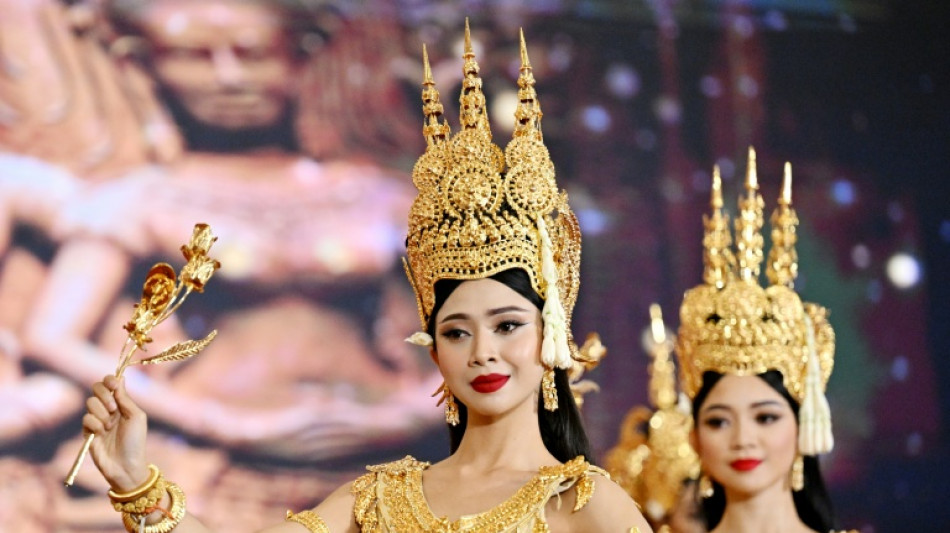
Difficult dance: Cambodian tradition under threat / Photo: TANG CHHIN Sothy - AFP

 Kennedy Center: future unclear for iconic Washington arts hub

 Trump claims 'infinite' Greenland security deal with Denmark

 Helicopters battle wildfire threatening Ecuador's capital

 Brentford batter Chelsea to undo Alonso's promising start

 Kane hits Bundesliga century as Bayern rout Union

 Trump says CNN, MS NOW, Politico banned from White House

 Hushing and hedging: US companies retreat on climate

 Springboks to face Fiji before 2027 Rugby World Cup

 Nigeria miners struggled to breathe in cell before 37 died: survivors

 McIlroy on the charge at PGA Championship as Reed withdraws

 McIlroy on the charge at PGA Championship

 Crisis-wracked Volkswagen warns of 10-bn-euro hit to profits

 Costa Rica's Grynspan tops third informal poll for UN chief: diplomat

 Stock markets retreat after central bank rate hikes

 Russia labels director of Cannes Grand Prix winner a 'foreign agent'

 Macron warns of Russian 'hybrid' threat after meeting presidential hopefuls

 UN holds third informal poll for new chief

 Kulusevski return can spark Spurs: De Zerbi

 Shakira to cap off world tour with Madrid 12-gig run

 Isolated Syrian-Druze city blames Damascus for shortages

 Isolated Syrian-Druze city shortages

 Dutch drop Depay for Germany match in Xavi's first pick

 Ronaldo named in Portugal squad for Nations League

 Stock markets diverge after central bank rate hikes

 Anti-Assad music star makes triumphant return to Syria
Cambodian master classical dancer Penh Yom walks between her teenage students, painstakingly adjusting a bent-back finger here and the tilt of a head there, as she passes on a centuries-old art form.
Khmer classical dance, performed to traditional music, is renowned for its graceful hand gestures and stunning costumes, and has a 1,000-year history.
But after barely surviving Cambodia's genocidal Khmer Rouge regime in the 1970s, it is now under threat from a changing media and entertainment landscape, limited funding and economic challenges.
Enrolment in the Secondary School of Fine Arts in Phnom Penh is falling, and many entrants do not complete the gruelling nine-year curriculum.
The art form was nearly destroyed when the Khmer Rouge killed almost all the master dancers and musicians, among nearly two million who were murdered or died of starvation, illness or overwork during the regime's less than four years in power.
Then-leader Pol Pot's ultra-Maoist fanatics considered dancers among the enemies of the people, both educated and representative of a feudal past they wanted to eradicate entirely.
As artists, they were specifically targeted for identification and elimination.
Penh Yom, 78, survived by hiding her profession, and after the Khmer Rouge-run Democratic Kampuchea fell in 1979, she regrouped with a small troupe of dancers to revive the form.
Her own training began in the Royal Palace when she was eight.
"Now I am worried that it will disappear," she said. "We keep urging them to train hard and to help us preserve this art."
"Like 'you the grandchildren and me the grandmother try hard together'."
Dancer Yang Sopheaktra, 21, graduated from the Phnom Penh school three years ago and recalled that the training was "really difficult".
"We need patience, for example, when we bend our fingers, we have to count up to 100," she said.
"We have to remember many styles of the dance. So students with less talent would drop out easily. Sometimes, I was so tired and wanted to drop it."
Her father is also a dancer, but was against her following in his footsteps. "He wanted me to learn whatever is not related to the arts."
But she persevered: "I want to help preserve this art form with new ideas."
- 'From hair to toe' -
Also known as Cambodia's royal ballet, classical dance performances were originally mounted for court occasions such as coronations or marriages.
It was first introduced to an international audience in colonial power France in 1906.
UNESCO proclaimed it an intangible cultural heritage in 2003 and says it takes dancers "years of intensive training" to master its gestures and poses, which "evoke the gamut of human emotions, from fear and rage to love and joy".
But it risks "becoming a mere tourist attraction", it adds.
The Secondary School of Fine Arts has more than 90 classical dance teachers and is the primary training centre for the next generation.
Pupils attend dance classes in the mornings and follow the standard school curriculum in the afternoons.
Tuition is free, but it has slashed the accommodation available to students, and trainers expect many to drop out in the face of educational demands and financial pressures on their families.
This year, 39 eight-year-olds registered, little more than half the usual number.
A few weeks into the course, the new entrants bent their hands, legs and bodies as trainer Hang Sophea sought to instil the basics.
"I have to watch them from hair to toe so that in the future they could be our heirs," she said.
Some would soon start dropping out and at most 15 would become dancers, she predicted.
"As teachers, we are worried... Now it is the modern era and everything is in a smartphone," Hang Sophea added.
"We always remind them not to forget our identity."
But some use social media to promote their art.
Tola Thina, 18, is in her final year at the school and often posts her performances on Facebook, where she has more than 20,000 followers.
"This culture is really beautiful and I love it," she said. "I want to be a traditional dancer and preserve it."
P.Queiroz--PC