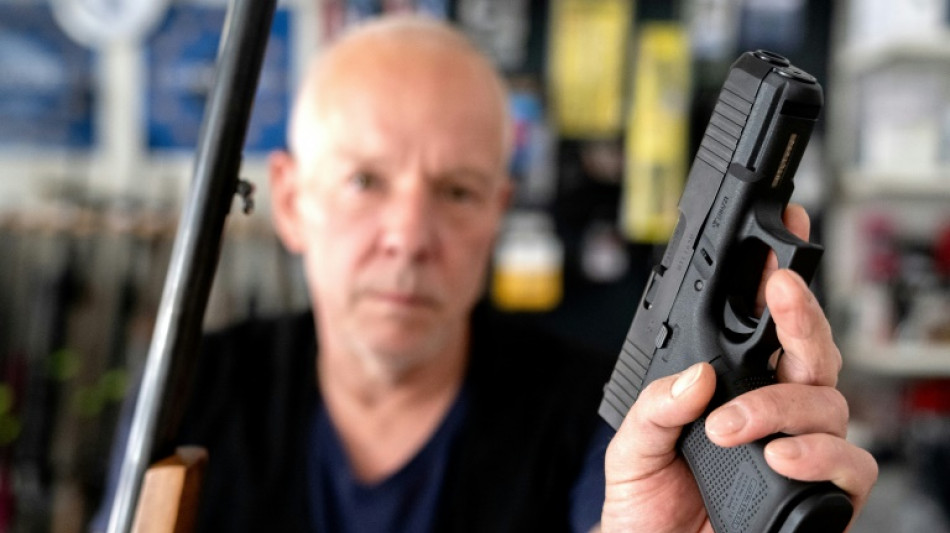
Deadly school shooting fuels debate on Austria's gun laws / Photo: Joe Klamar - AFP

 Kennedy Center: future unclear for iconic Washington arts hub

 Trump claims 'infinite' Greenland security deal with Denmark

 Helicopters battle wildfire threatening Ecuador's capital

 Brentford batter Chelsea to undo Alonso's promising start

 Kane hits Bundesliga century as Bayern rout Union

 Trump says CNN, MS NOW, Politico banned from White House

 Hushing and hedging: US companies retreat on climate

 Springboks to face Fiji before 2027 Rugby World Cup

 Nigeria miners struggled to breathe in cell before 37 died: survivors

 McIlroy on the charge at PGA Championship as Reed withdraws

 McIlroy on the charge at PGA Championship

 Crisis-wracked Volkswagen warns of 10-bn-euro hit to profits

 Costa Rica's Grynspan tops third informal poll for UN chief: diplomat

 Stock markets retreat after central bank rate hikes

 Russia labels director of Cannes Grand Prix winner a 'foreign agent'

 Macron warns of Russian 'hybrid' threat after meeting presidential hopefuls

 UN holds third informal poll for new chief

 Kulusevski return can spark Spurs: De Zerbi

 Shakira to cap off world tour with Madrid 12-gig run

 Isolated Syrian-Druze city blames Damascus for shortages

 Isolated Syrian-Druze city shortages

 Dutch drop Depay for Germany match in Xavi's first pick

 Ronaldo named in Portugal squad for Nations League

 Stock markets diverge after central bank rate hikes

 Anti-Assad music star makes triumphant return to Syria
With Austria still reeling from this week's deadly school shooting that killed 10 people, a debate is now raging over the Alpine country's gun laws.
The unprecedented case of deadly gun violence stunned the country of almost 9.2 million people, which ranks among the 10 safest in the world, according to the Global Peace Index.
While politicians have called for tighter restrictions on private gun ownership in the wake of the shooting in Graz, interest in firearms and demand for weapons training courses has surged.
"You can't imagine how many people have signed up for shooting courses" since Tuesday's attack, Viennese gun dealer Markus Schwaiger, who also offers training courses at shooting ranges, told AFP.
"People are worried that gun laws are about to get tightened" in the coming months, he added.
Austria has a relatively high number of weapons in circulation, with more than 1.5 million registered to about 370,000 owners.
- 'Strong gun culture' -
According to industry expert Aaron Karp, Austria has a "strong gun culture" centred around "hunting and sports shooting, especially in the countryside", which is rich with game.
The Alpine nation is also one of the European countries with the largest number of small arms in circulation per capita, said Karp, one of the authors of the Small Arms Survey, which compiles data on gun ownership.
Famous for the Glock pistol, invented by Austrian engineer Gaston Glock, gun ownership is deeply rooted in the country -- and has been on a steady rise in recent decades: only about 900,000 weapons were registered in Austria in 2015, according to official figures.
For Schwaiger, "rising populism" has also played its part, with right-wing politicians tapping into people's anxieties over crises, arguing that the world has become a more dangerous place.
"For twenty years, right-wing populism has been scaring people" and "every crisis causes sales to skyrocket," he told AFP.
The shooting at a secondary school in the southern city of Graz by a 21-year-old former pupil was the deadliest postwar mass shooting in Austria.
But a study published online in 2020 in the European Psychiatry journal suggests that the number of violent deaths in Austria has been increasing in lockstep with the number of weapons.
In order to join the European Union in 1995, Austria had to regulate the sale of firearms, which temporarily led to a drop in violent deaths -- until the financial crisis of 2008 hit.
According to the study, the positive effect of the reform has been "offset by the global economic slowdown", which increased anxiety among the public and thus the tendency to purchase weapons.
"After such an act of madness... there must be consequences and changes," Interior Minister Gerhard Karner said on Friday.
Under the current legislation, anyone without a criminal record and over the age of 21 can buy handguns after undergoing an assessment and registering their weapon.
- 'Unfit' -
"The standards for psychological testing" to grant gun licences in Austria are "very good", said Karp, but proper implementation appears to be the bottleneck.
The gunman, who killed nine pupils and a teacher in Graz, was rejected from Austria's mandatory military service after failing the psychological tests and being deemed "unfit". He was nonetheless able to receive a gun licence and purchase the shotgun and pistol that he used in the attack.
"He obviously found a gun dealer and a psychologist who didn't look too closely," Schwaiger lamented. "There is still too much leeway."
Such shortcomings have been dominating and fuelling the most recent debate on Austria's gun laws, with the opposition Green Party tabling a bill to tighten legislation in May.
Austrian authorities have said they plan to consult other European countries like France, Sweden and the Czech Republic, which have experienced mass shootings in the past.
"But there are cultural differences and each country must chart its own course," Karp said.
A.Magalhes--PC