Scientists find microplastics in blood for first time

 Drones hit Moscow as Russians go to the polls

 New England boss Fleming says 'wrong' to ask Stokes to end retirement

 Germans vote in elections threatening fresh blow to Merz

 US fears rapid escalation in Mideast after Houthis attack Riyadh

 Japan triathlete Hojo wins first gold of Asian Games

 IOC president impressed by 'beautiful' Asian Games wooden huts

 First Asian Games gold goes to Japan as China's 13-year-old Yu lights up pool

 Data centre command hub keeps AI up and running

 Pope Leo in France: the issues on the table

 Packing for a pope: behind the scenes on foreign trips

 Republicans find transgender issues a powerful political weapon in midterm campaigning

 German state elections threaten new shock waves for Merz

 Chile's Bachelet quits race to be next UN chief

 Raphinha treble fires perfect Barca to win at Sevilla

 Thiam makes winning heptathlon return at Decastar meet

 Czechs beat USA to qualify for Davis Cup finals

 Dortmund sink Stuttgart to climb to Bundesliga summit

 Trump says will not tolerate attempts to slow AI growth

 'It has to stop': runners protest women's murders in S.Africa district

 Fire erupts near Riyadh airport as Houthis claim strikes

 Cuba works to restore power after another blackout

 England thrash Sri Lanka again to return to top of T20 rankings

 Arsenal thrashed by Brighton, sorry Spurs lose again

 South Korea, Austria qualify for Davis Cup finals

 Seare shocks Ingebrigtsen to win world 5km gold

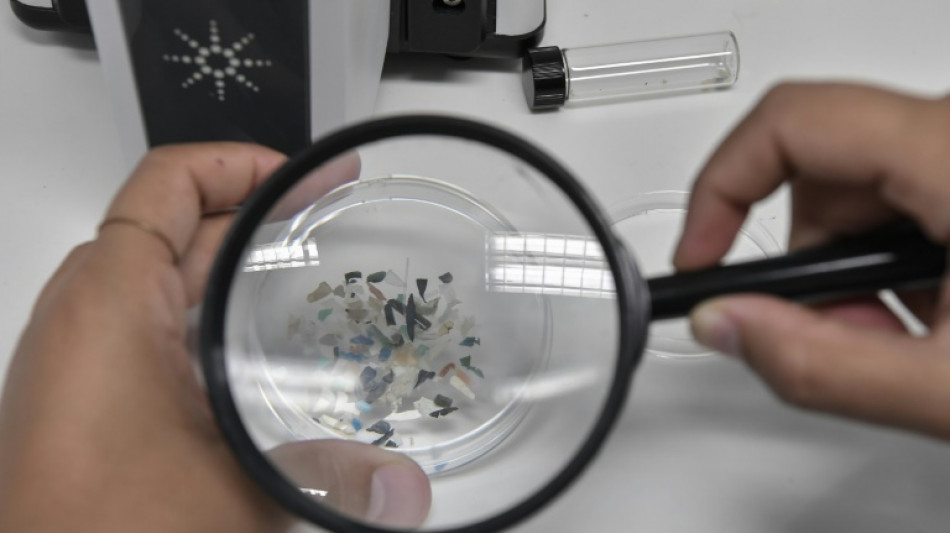
Scientists have discovered microplastics in human blood for the first time, warning that the ubiquitous particles could also be making their way into organs.
The tiny pieces of mostly invisible plastic have already been found almost everywhere else on Earth, from the deepest oceans to the highest mountains as well as in the air, soil and food chain.
A Dutch study published in the Environment International journal on Thursday examined blood samples from 22 anonymous, healthy volunteers and found microplastics in nearly 80 percent of them.
Half of the blood samples showed traces of PET plastic, widely used to make drink bottles, while more than a third had polystyrene, used for disposable food containers and many other products.
"This is the first time we have actually been able to detect and quantify" such microplastics in human blood, said Dick Vethaak, an ecotoxicologist at Vrije Universiteit Amsterdam.
"This is proof that we have plastics in our body -- and we shouldn't," he told AFP, calling for further research to investigate how it could be impacting health.
"Where is it going in your body? Can it be eliminated? Excreted? Or is it retained in certain organs, accumulating maybe, or is it even able to pass the blood-brain barrier?"
The study said the microplastics could have entered the body by many routes: via air, water or food, but also in products such as particular toothpastes, lip glosses and tattoo ink.
"It is scientifically plausible that plastic particles may be transported to organs via the bloodstream," the study added.
Vethaak also said there could be other kinds of microplastics in blood his study did not pick up -- for example, it could not detect particles larger than the diameter of the needle used to take the sample.
The study was funded by the Netherlands Organisation for Health Research and Development as well as Common Seas, a UK-based group aimed at reducing plastic pollution.
Alice Horton, anthropogenic contaminants scientist at Britain's National Oceanography Centre, said the study "unequivocally" proved there was microplastics in blood.
"This study contributes to the evidence that plastic particles have not just pervaded throughout the environment, but are pervading our bodies too," she told the Science Media Centre.
Fay Couceiro, reader in biogeochemistry and environmental pollution at the University of Portsmouth, said that despite the small sample size and lack of data on the exposure level of participants, she felt the study was "robust and will stand up to scrutiny".
She also called for further research.
"After all blood links all the organs of our body and if plastic is there, it could be anywhere in us."
F.Carias--PC