Performing medical miracles in impoverished Venezuela

 Germans vote in elections threatening fresh blow to Merz

 US fears rapid escalation in Mideast after Houthis attack Riyadh

 Japan triathlete Hojo wins first gold of Asian Games

 IOC president impressed by 'beautiful' Asian Games wooden huts

 First Asian Games gold goes to Japan as China's 13-year-old Yu lights up pool

 Data centre command hub keeps AI up and running

 Pope Leo in France: the issues on the table

 Packing for a pope: behind the scenes on foreign trips

 Republicans find transgender issues a powerful political weapon in midterm campaigning

 German state elections threaten new shock waves for Merz

 Chile's Bachelet quits race to be next UN chief

 Raphinha treble fires perfect Barca to win at Sevilla

 Thiam makes winning heptathlon return at Decastar meet

 Czechs beat USA to qualify for Davis Cup finals

 Dortmund sink Stuttgart to climb to Bundesliga summit

 Trump says will not tolerate attempts to slow AI growth

 'It has to stop': runners protest women's murders in S.Africa district

 Fire erupts near Riyadh airport as Houthis claim strikes

 Cuba works to restore power after another blackout

 England thrash Sri Lanka again to return to top of T20 rankings

 Arsenal thrashed by Brighton, sorry Spurs lose again

 South Korea, Austria qualify for Davis Cup finals

 Seare shocks Ingebrigtsen to win world 5km gold

 Brigitte Bardot widower slams sale of star's belongings

 Aston Villa compound Tottenham's misery despite late rally
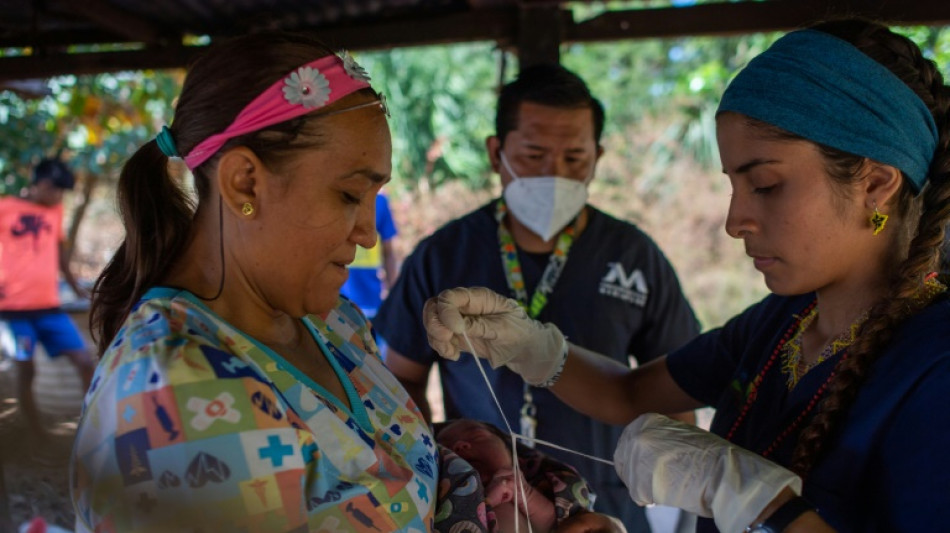
Venezuelan indigenous teenager Lidiana Requena lies on an old, dirty hammock under an awning, her sunken eyes gazing at her newborn baby in the arms of the village nurse.
Unable to reach a rural medical center miles away from the Amazonian village of Chaviripa in Venezuela's southwestern Bolivar state in time, she gave birth on the ground.
The 270 Chaviripa villagers -- including 180 members of the Enepa ethnicity -- live in extreme poverty, marked by a severe lack of medical facilities.
Nurse Carmen Olivo, 40, is used to making do with limited resources and has delivered dozens of babies.
"I barely have a pair of gloves. I don't even have a pair of scissors, I cut the (umbilical) cord with a knife," she said.
"Both the mother and baby could get infected. These aren't the conditions to give birth... There's nothing hygienic, there's no clean water, there's nothing," she added.
"These people are far from everything. They don't even have the resources to leave."
- 'Not a hospital' -
When Requena's contractions began at dawn, Olivo had sent word for a car to take her the nine miles (15 kilometers) to a Maniapure Foundation center that provides health services to rural communities.
But with no telephone or radio in Chaviripa, Olivo had to send a messenger to ask for the car -- which didn't arrive until after the birth.
At the La Milagrosa donation-funded center, Requena was examined by Natalia Vivas, a 24-year-old medical intern studying at the Central University in Caracas.
Speaking to her patient in a mixture of Spanish and the Enepa language, Vivas stitched up the tears caused by the birth.
"It is important to communicate, to tell them it is going to hurt a bit. The women often don't speak Spanish," she said.
Renowned cardiologist Dr. Tomas Sanabria co-founded the foundation with a Swiss-Venezuelan couple 25 years ago.
He said La Milagrosa now "attends to the largest number of patients in the area, but it is not a hospital."
The 74-year-old started coming to the region to camp in the 1960s as student.
"From the first visits we realized the Enepa and Creoles had many needs. They asked us for consultations."
In 1995, he secured funding from an NGO to install a doctor in the area.
"A salary for a rural doctor, a car to move around, a radio. That's all I asked for," he said.
"From the start we understood the importance of being able to communicate: telemedicine."
From only a radio to internet today, Sanabria said medical workers can resolve 90 to 95 percent of issues without a face-to-face visit.
"It is healthcare for everyone at minimal cost."
Once a year the foundation arranges for a group of around 30 specialists to visit the area.
They treat up to 1,800 patients in a matter of days.
- Symbolic contribution -
Every day, 50 to 100 patients visit the center. Some walk hours to get there.
Cristobal Quilelli cycled three hours with his wife and four-year-old daughter -- who was suffering from a fever and cough -- perched on his bicycle.
Occasionally a bus full of people arrives after an hours-long journey.
Domingo Antonio, 69, and Felix Gutierrez, 73, traveled the day before and slept at the center overnight to consult a doctor the next morning.
One had kidney, heart and prostate problems, the other was suffering from joint pains.
At the center's pharmacy, Alvaro Leal gave them free medicines.
"We ask for a symbolic contribution for each consultancy but we don't turn anyone away," said Leal.
France, one of the center's main benefactors, donates 600,000 euros ($674,000) a year to help protect "indigenous populations."
"We have to protect their languages, their customs and... their health," said French ambassador Romain Nadal.
Around 32 percent of patients at the La Milagrosa center are indigenous, said Sanabria.
Over time, the foundation has extended its reach beyond the center, providing medicines, medical supplies, training and internet access to rural pharmacies.
"Here, I cried, I suffered," said Marlene Campos, a nurse in La Urbana, a village on the shores of the Orinoco river.
Thanks to the foundation she can now treat many patients she used to send to a hospital several hours drive away.
"When I arrived, I wanted to leave. Now I feel useful, I've asked to stay another year."
P.L.Madureira--PC