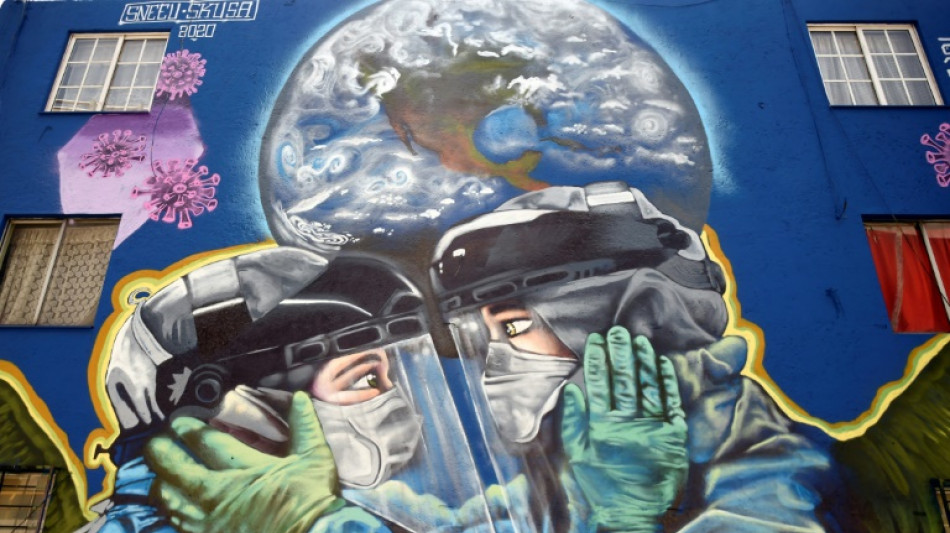
WHO countries reach landmark agreement on tackling future pandemics / Photo: ALFREDO ESTRELLA - AFP

 Drones hit Moscow as Russians go to the polls

 New England boss Fleming says 'wrong' to ask Stokes to end retirement

 Germans vote in elections threatening fresh blow to Merz

 US fears rapid escalation in Mideast after Houthis attack Riyadh

 Japan triathlete Hojo wins first gold of Asian Games

 IOC president impressed by 'beautiful' Asian Games wooden huts

 First Asian Games gold goes to Japan as China's 13-year-old Yu lights up pool

 Data centre command hub keeps AI up and running

 Pope Leo in France: the issues on the table

 Packing for a pope: behind the scenes on foreign trips

 Republicans find transgender issues a powerful political weapon in midterm campaigning

 German state elections threaten new shock waves for Merz

 Chile's Bachelet quits race to be next UN chief

 Raphinha treble fires perfect Barca to win at Sevilla

 Thiam makes winning heptathlon return at Decastar meet

 Czechs beat USA to qualify for Davis Cup finals

 Dortmund sink Stuttgart to climb to Bundesliga summit

 Trump says will not tolerate attempts to slow AI growth

 'It has to stop': runners protest women's murders in S.Africa district

 Fire erupts near Riyadh airport as Houthis claim strikes

 Cuba works to restore power after another blackout

 England thrash Sri Lanka again to return to top of T20 rankings

 Arsenal thrashed by Brighton, sorry Spurs lose again

 South Korea, Austria qualify for Davis Cup finals

 Seare shocks Ingebrigtsen to win world 5km gold

Years of negotiations culminated early Wednesday with countries agreeing the text of a landmark accord on how to tackle future pandemics, aimed at avoiding a repeat of the mistakes made during the Covid-19 crisis.
After more than three years of talks and one last marathon session, weary delegates at the World Health Organization's headquarters sealed the deal at around 2:00 am (0000 GMT) Wednesday.
"Tonight marks a significant milestone in our shared journey towards a safer world," WHO chief Tedros Adhanom Ghebreyesus said.
"The nations of the world made history in Geneva today."
Five years after Covid-19 killed millions of people and devastated economies, a growing sense of urgency hung over the talks, with new health threats lurking, ranging from H5N1 bird flu to measles, mpox and Ebola.
The final stretch of negotiations also took place with cuts to US foreign aid spending and threatened tariffs on pharmaceuticals casting a shadow over the talks.
- 'It's adopted' -
Right until the last minute, disagreement had lingered over a few thorny issues.
Negotiators stumbled over the agreement's Article 11, which deals with transferring technology for pandemic health products towards developing nations.
During the Covid-19 pandemic, poorer states accused rich countries of hoarding vaccines and tests.
Countries with large pharmaceutical industries have strenuously opposed the idea of mandatory tech transfers, insisting they must be voluntary.
But it appeared the obstacle could be overcome by adding that any transfer needed to be "mutually agreed".
The core the agreement is a proposed Pathogen Access and Benefit-Sharing System (PABS), aimed at allowing the swift sharing of pathogen data with pharmaceutical companies, enabling them to quickly start working on pandemic-fighting products.
In the end, the 32-page agreement was entirely highlighted in green, indicating it had been fully approved by WHO member states.
"It's adopted," negotiations co-chair Anne-Claire Amprou announced, to thundering applause.
"In drafting this historic agreement, the countries of the world have demonstrated their shared commitment to preventing and protecting everyone, everywhere, from future pandemic threats."
The finalised text will now be presented for sign-off at the WHO's annual assembly next month.
- 'More equity' -
As intense talks in corridors and closed rooms drew towards an end late on Tuesday, Tedros joined the negotiations, telling reporters he thought the current draft was "balanced", and that a deal would bring "more equity".
While taking measures to coordinate pandemic prevention, preparedness and response could be costly, "the cost of inaction is much bigger", he insisted.
"Virus is the worst enemy. (It) could be worse than a war."
The United States, which has thrown the global health system into crisis by slashing foreign aid spending, was not present.
US President Donald Trump ordered a withdrawal from the United Nations' health agency and from the pandemic agreement talks after taking office in January.
However, the US absence, and Trump's threat to slap steep tariffs on pharmaceutical products, still hung over the talks, making manufacturers and governments more jittery.
But in the end, countries reached consensus.
Many saw the approval of the text as a victory for global cooperation.
"At a time when multilateralism is under threat, WHO member states have joined together to say that we will defeat the next pandemic threat in the only way possible: by working together," said former New Zealand prime minister Helen Clark, co-chair of the Independent Panel for Pandemic Preparedness and Response.
As the congratulatory speeches continued on towards daybreak, Eswatini's representative stressed that "whilst we celebrate this moment, we need not rest on our laurels".
"The real work begins now."
G.Machado--PC