New hope for patients with less common breast cancer / Photo: ANNE-CHRISTINE POUJOULAT - AFP/File

 Drones hit Moscow as Russians go to the polls

 New England boss Fleming says 'wrong' to ask Stokes to end retirement

 Germans vote in elections threatening fresh blow to Merz

 US fears rapid escalation in Mideast after Houthis attack Riyadh

 Japan triathlete Hojo wins first gold of Asian Games

 IOC president impressed by 'beautiful' Asian Games wooden huts

 First Asian Games gold goes to Japan as China's 13-year-old Yu lights up pool

 Data centre command hub keeps AI up and running

 Pope Leo in France: the issues on the table

 Packing for a pope: behind the scenes on foreign trips

 Republicans find transgender issues a powerful political weapon in midterm campaigning

 German state elections threaten new shock waves for Merz

 Chile's Bachelet quits race to be next UN chief

 Raphinha treble fires perfect Barca to win at Sevilla

 Thiam makes winning heptathlon return at Decastar meet

 Czechs beat USA to qualify for Davis Cup finals

 Dortmund sink Stuttgart to climb to Bundesliga summit

 Trump says will not tolerate attempts to slow AI growth

 'It has to stop': runners protest women's murders in S.Africa district

 Fire erupts near Riyadh airport as Houthis claim strikes

 Cuba works to restore power after another blackout

 England thrash Sri Lanka again to return to top of T20 rankings

 Arsenal thrashed by Brighton, sorry Spurs lose again

 South Korea, Austria qualify for Davis Cup finals

 Seare shocks Ingebrigtsen to win world 5km gold

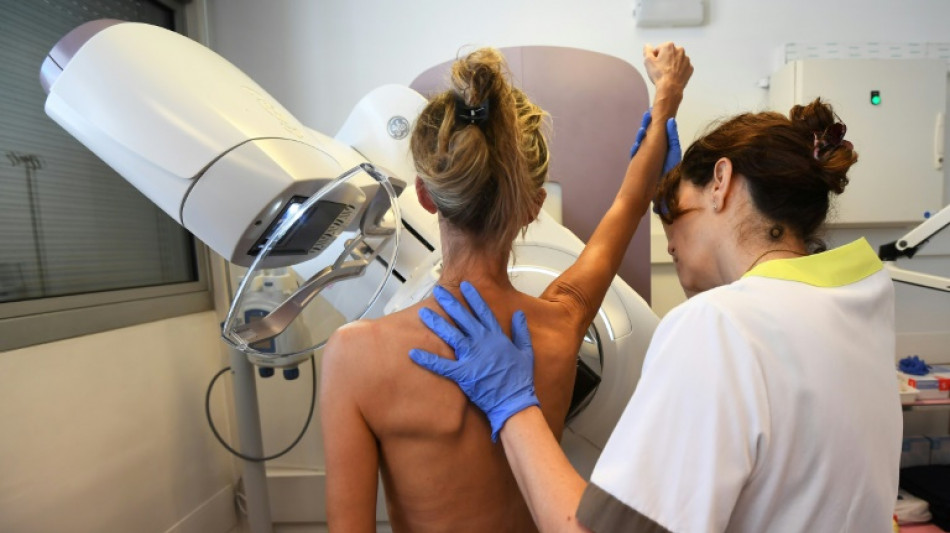
A new treatment nearly halves the risk of disease progression or death from a less common form of breast cancer that hasn't seen major drug advances in over a decade, researchers reported Monday.
Results from the study, presented at the annual meeting of the American Society for Clinical Oncology, are expected to be submitted to regulators and could soon establish a new first-line therapy for people with HER2-positive metastatic breast cancer -- the advanced stage of a form that comprises 15–20 percent of all breast cancer cases.
HER2-positive cancers are fueled by an overactive HER2 gene, which makes too much of a protein called human epidermal growth factor receptor 2 that helps cancer cells grow and spread.
Patients with HER2-positive breast cancer that has spread to other parts of the body live around five years.
"Seeing such a striking improvement was really impressive to us -- we were taking a standard and almost doubling how long patients could have their cancer controlled for," oncologist Sara Tolaney, chief of the breast oncology division at Dana-Farber Cancer Institute, told AFP.
The current standard of care, known as THP, combines chemotherapy with two antibodies that block growth signals from the HER2 protein. The new approach uses a drug called trastuzumab deruxtecan (T-DXd), an antibody attached to a chemotherapy drug.
- 'Smart bomb' -
This "smart bomb" strategy allows the drug to target cancer cells directly. "You can bind to the cancer cell and dump all that chemo right into the cancer cells," explained Tolaney.
"Some people call them smart bombs because they're delivering chemo in a targeted fashion -- which is how I think we're able to really increase efficacy so much."
Common side effects included nausea, diarrhea and a low white blood cell count, with a less common effect involving lung scarring.
T-DXd is already approved as a "second-line" option -- used when first-line treatments stop working. But in the new trial, it was given earlier, paired with another antibody, pertuzumab.
In a global trial led by Tolaney, just under 400 patients were randomly assigned to receive T-DXd in combination with pertuzumab, thought to enhance its effects.
A similar number received the standard THP regimen. A third group, who received T-DXd without pertuzumab, was also enrolled -- but those results haven't yet been reported.
- 44 percent risk reduction -
At a follow-up of 2.5 years, the T-DXd and pertuzumab combination reduced the risk of disease progression or death by 44 percent compared to standard care.
Fifteen percent of patients in the T-DXd group saw their cancer disappear entirely, compared to 8.5 percent in the THP group.
Because this was an interim analysis, the median progression-free survival -- meaning the point at which half the patients had seen their cancer return or worsen -- was 40.7 months with the new treatment, compared to 26.9 months with the standard, and could rise further as more data come in.
Tolaney said the results would be submitted to regulators around the world, including the US Food and Drug Administration, and that future work would focus on optimizing how long patients remain on the treatment, particularly those showing complete remission.
"This represents a new first-line standard treatment option for HER2-positive metastatic breast cancer," said Dr. Rebecca Dent, a breast cancer specialist at the National Cancer Center Singapore who was not involved in the study
G.Machado--PC