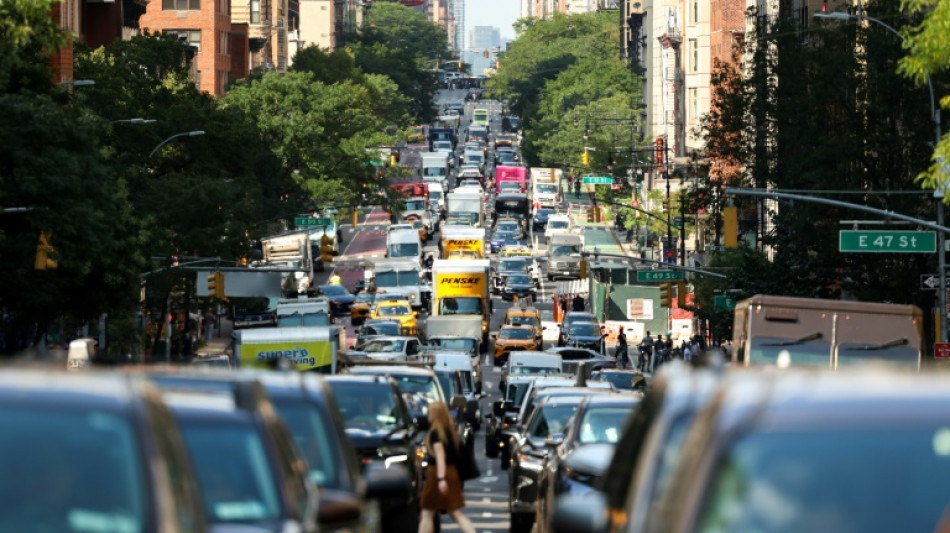
Sounds serious: NYC noise pollution takes a toll / Photo: CHARLY TRIBALLEAU - AFP/File

 Drones hit Moscow as Russians go to the polls

 New England boss Fleming says 'wrong' to ask Stokes to end retirement

 Germans vote in elections threatening fresh blow to Merz

 US fears rapid escalation in Mideast after Houthis attack Riyadh

 Japan triathlete Hojo wins first gold of Asian Games

 IOC president impressed by 'beautiful' Asian Games wooden huts

 First Asian Games gold goes to Japan as China's 13-year-old Yu lights up pool

 Data centre command hub keeps AI up and running

 Pope Leo in France: the issues on the table

 Packing for a pope: behind the scenes on foreign trips

 Republicans find transgender issues a powerful political weapon in midterm campaigning

 German state elections threaten new shock waves for Merz

 Chile's Bachelet quits race to be next UN chief

 Raphinha treble fires perfect Barca to win at Sevilla

 Thiam makes winning heptathlon return at Decastar meet

 Czechs beat USA to qualify for Davis Cup finals

 Dortmund sink Stuttgart to climb to Bundesliga summit

 Trump says will not tolerate attempts to slow AI growth

 'It has to stop': runners protest women's murders in S.Africa district

 Fire erupts near Riyadh airport as Houthis claim strikes

 Cuba works to restore power after another blackout

 England thrash Sri Lanka again to return to top of T20 rankings

 Arsenal thrashed by Brighton, sorry Spurs lose again

 South Korea, Austria qualify for Davis Cup finals

 Seare shocks Ingebrigtsen to win world 5km gold

Tim Mulligan moved to central Manhattan so he could be closer to work and avoid a daily ordeal on the rattling, screeching subway, just one part of the urban noisescape that tests New Yorkers every day.
"Even with your earbuds in, turned all the way up, you can't hear anything for the whole commute, and you're ruining your ears at that level," said Mulligan, a US Marines veteran who lives with PTSD.
At his home close to New York's tourist hub Times Square, Mulligan has sealed his windows with high-density soundproof foam, draped them with double thick curtains and invested in earplugs to sleep.
On the street he has resorted to noise-cancelling headphones, and he prefers bikes to the subway for getting around.
New Yorkers and visitors to the megacity of 8.5 million people are bombarded with blaring sirens, loud locals, raucous bars and car horns almost constantly.
A city-wide hotline received 750,000 noise complaints in 2024, the most commonly complained about quality of life issue.
The city that never sleeps, perhaps because it can't, is one of the few built up US areas with a noise code regulating sound from vehicles, construction, businesses, and recreation.
It has even installed cameras with sensors to detect and penalize violators.
Nine-in-ten New Yorkers are at risk of hearing loss from daily exposure to noise levels exceeding 70 decibels, the healthy average, a Columbia University study conducted between 2010 and 2012 found.
The report's author, professor Richard Neitzel, is now leading the first national study on noise in which 200,000 volunteers wear smart watches to track sound levels.
"It looks like somewhere around one-in-four Americans are exposed to noise levels that could hurt their hearing over the long term," said Neitzel, a professor at the University of Michigan.
- 'You can't undo it' -
Among young people aged 18 to 25, the primary source of excess noise exposure comes from headphones.
Overall, more people are exposed to high levels of environmental noise than to noise from their headphones, Neitzel added.
Although the percentage of the population exposed to noise is similar to those exposed to air pollution, acoustic issues are not prioritized by residents and officials like air quality is, Neitzel said.
There is clear evidence that excess noise is linked to poor sleep, cardiovascular issues, depression, cognitive decline, premature births and poor academic performance.
Tinnitus, a permanent ringing in the ear affecting three out of 20 study participants, is increasingly prevalent.
Loud music is even used to promote increased consumption, said Shane Newman, who manages a popular Mexican restaurant in Manhattan's trendy Hudson Yards development.
"You have a drink in the music, it feels like a nice vibe and... they end up staying longer," he told AFP.
Audiologist Michele DiStefano said the effects of noise on well-being have "not really been studied well enough."
"The longer you have the exposure, and the higher the level, the (greater) degree of hearing loss you'll have" -- particularly for young people, she warned.
"Once it does affect your hearing, you can't undo it, but you can actually prevent it," she said.
"There's really a push to educate the younger generations on how you don't have to just have really loud noise at a concert -- it can be cumulative."
M.A.Vaz--PC