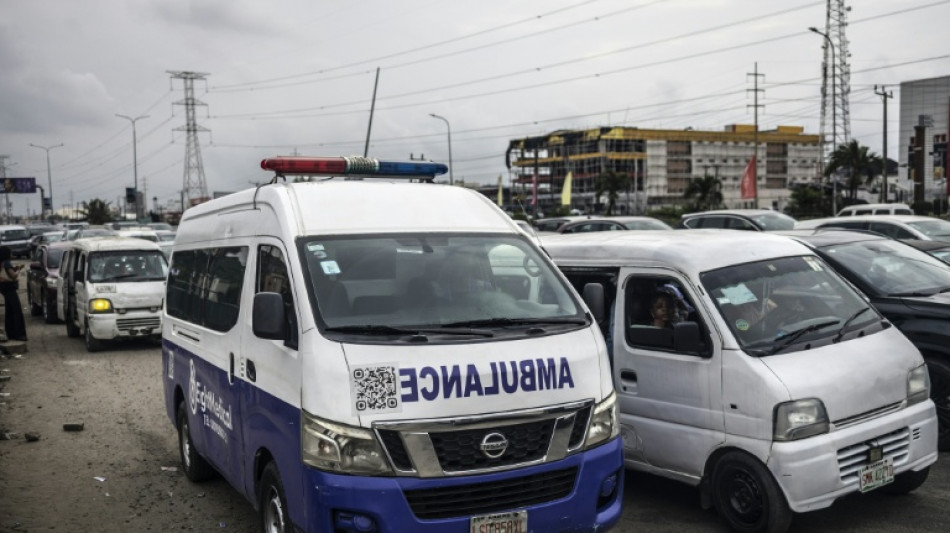
In mega-city Lagos, 20 million count on just 100 ambulances / Photo: OLYMPIA DE MAISMONT - AFP

 Drones hit Moscow as Russians go to the polls

 New England boss Fleming says 'wrong' to ask Stokes to end retirement

 Germans vote in elections threatening fresh blow to Merz

 US fears rapid escalation in Mideast after Houthis attack Riyadh

 Japan triathlete Hojo wins first gold of Asian Games

 IOC president impressed by 'beautiful' Asian Games wooden huts

 First Asian Games gold goes to Japan as China's 13-year-old Yu lights up pool

 Data centre command hub keeps AI up and running

 Pope Leo in France: the issues on the table

 Packing for a pope: behind the scenes on foreign trips

 Republicans find transgender issues a powerful political weapon in midterm campaigning

 German state elections threaten new shock waves for Merz

 Chile's Bachelet quits race to be next UN chief

 Raphinha treble fires perfect Barca to win at Sevilla

 Thiam makes winning heptathlon return at Decastar meet

 Czechs beat USA to qualify for Davis Cup finals

 Dortmund sink Stuttgart to climb to Bundesliga summit

 Trump says will not tolerate attempts to slow AI growth

 'It has to stop': runners protest women's murders in S.Africa district

 Fire erupts near Riyadh airport as Houthis claim strikes

 Cuba works to restore power after another blackout

 England thrash Sri Lanka again to return to top of T20 rankings

 Arsenal thrashed by Brighton, sorry Spurs lose again

 South Korea, Austria qualify for Davis Cup finals

 Seare shocks Ingebrigtsen to win world 5km gold

Standing outside a public hospital in Lagos, Nigeria's biggest city, Michelin Hunsa is still "traumatised" from the two-hour wait it took to get an ambulance for her mother, found unconscious by her neighbours.
Such waits can be deadly and are not unusual in the mega-city, where notorious traffic jams snarl commutes and only about 100 ambulances serve a population of more than 20 million.
"It's a serious problem, we waited far too long," Hunsa, 25, told AFP. Her mother, suffering a cerebral haemorrhage, ultimately survived the ordeal.
Political and business big-wigs regularly bust through traffic in the largest city in west Africa with armed convoys and flashing lights -- despite not being in any actual emergency.
Ambulances blast sirens, take shortcuts and speed as fast as they can -- but sometimes to no avail.
Part of the problem stems from mistrust among other drivers, who are used to a state of quasi-war on the roads from frustrated commuters trying to get ahead.
"I'm sure most of the time they don't transport real emergency cases, that's why I don't move," said Anthony Folayinka, a 38-year-old ride share driver.
Queen Soetan, a 33-year-old ambulance driver, told AFP such sentiments were common.
"Most people will not just want to leave the road, so it does affect our intervention time," she said.
The government currently provides 35 ambulances, Olusegun Ogboye, permanent secretary to the Lagos state ministry of health, told AFP.
That number pads the 80 to 90 operated by companies but still leaves the city with a ratio of roughly one ambulance per 200,000 people -- far below recommended medical guidelines.
- Private companies, floating clinics -
Since its founding in 2021, Eight Medical has run 34 ambulances, day and night.
The name comes from medical experts' recommended response time for ambulances of eight minutes or less.
"In Lagos, we are still far from it, but that's the goal I want to reach with my team," said business founder Ibukun Tunde-Oni, a 36-year-old doctor.
He was motivated to start the service after the deaths of two uncles -- one of whom died from a heart attack and the other who died in an ambulance while having an asthma attack.
Tunde-Oni has had his own lacklustre experiences with ambulances as well, once having to wait for three hours to receive care after breaking his arm in a road accident.
No data is available on how many people have died waiting for an ambulance, or while ensnared in one of the city's infamous "go slows", as traffic jams are known.
But "100 ambulances for Lagos is not enough", Tunde-Oni told AFP.
And the city is only growing.
According to the University of Toronto's Global Cities Institute, Lagos is on track to become the most populated city in the world by 2100, with 88 million residents.
But public services have not kept up with the breakneck growth in Nigeria, already Africa's most populous country with more than 220 million people.
Successive governments have been accused of squandering the nation's vast oil wealth: even if there were more ambulances, they'd still have to contend with Lagos's many pockmarked and unpaved roads.
Those who make it to the hospital are treated in poor conditions and by underpaid staff.
Lack of coordination with hospitals means that ambulances don't always know which locations have open beds, Tunde-Oni added.
Authorities have also tried to get creative: with the city sitting on a massive lagoon, in 2022 they put in place a floating clinic and boat ambulance to serve the 15 to 20 communities on the water's edge, said Ibrahim Famuyiwa, a waterways official.
But lacking funds to expand the initiative, the priority remains increasing Lagos's traditional ambulances, mostly through public-private partnerships.
P.Mira--PC