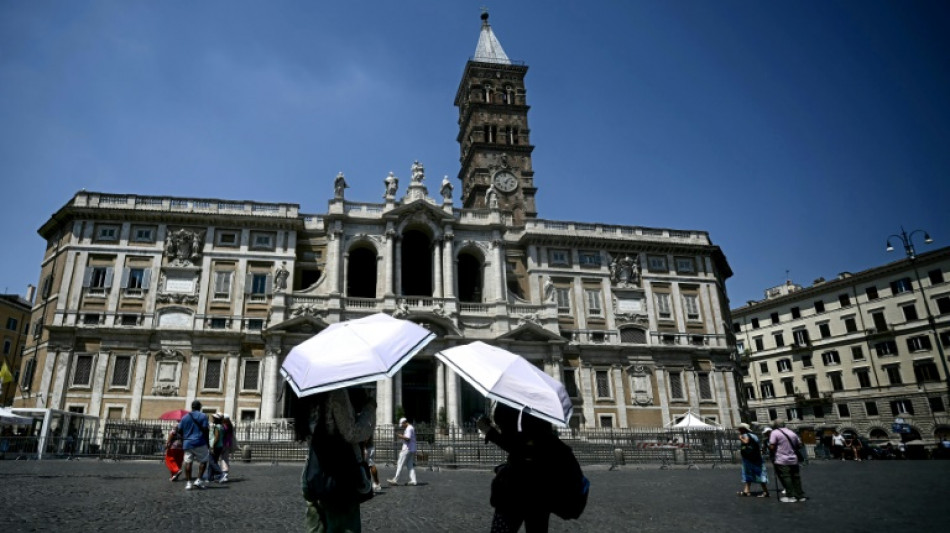
Estimated 16,500 climate change deaths during Europe summer: study / Photo: Filippo MONTEFORTE - AFP/File

 Drones hit Moscow as Russians go to the polls

 New England boss Fleming says 'wrong' to ask Stokes to end retirement

 Germans vote in elections threatening fresh blow to Merz

 US fears rapid escalation in Mideast after Houthis attack Riyadh

 Japan triathlete Hojo wins first gold of Asian Games

 IOC president impressed by 'beautiful' Asian Games wooden huts

 First Asian Games gold goes to Japan as China's 13-year-old Yu lights up pool

 Data centre command hub keeps AI up and running

 Pope Leo in France: the issues on the table

 Packing for a pope: behind the scenes on foreign trips

 Republicans find transgender issues a powerful political weapon in midterm campaigning

 German state elections threaten new shock waves for Merz

 Chile's Bachelet quits race to be next UN chief

 Raphinha treble fires perfect Barca to win at Sevilla

 Thiam makes winning heptathlon return at Decastar meet

 Czechs beat USA to qualify for Davis Cup finals

 Dortmund sink Stuttgart to climb to Bundesliga summit

 Trump says will not tolerate attempts to slow AI growth

 'It has to stop': runners protest women's murders in S.Africa district

 Fire erupts near Riyadh airport as Houthis claim strikes

 Cuba works to restore power after another blackout

 England thrash Sri Lanka again to return to top of T20 rankings

 Arsenal thrashed by Brighton, sorry Spurs lose again

 South Korea, Austria qualify for Davis Cup finals

 Seare shocks Ingebrigtsen to win world 5km gold

Scientists estimated Wednesday that rising temperatures from human-caused climate change were responsible for roughly 16,500 deaths in European cities this summer, using modelling to project the toll before official data is released.
The rapidly-produced study is the latest effort by climate and health researchers to quickly link the death toll during heatwaves to global warming -- without waiting months or years to be published in a peer-reviewed journal.
The estimated deaths were not actually recorded in the European cities, but instead were a projection based on methods such as modelling used in previously peer-reviewed studies.
Death tolls during heatwaves are thought to be vastly underestimated because the causes of death recorded in hospitals are normally heart, breathing or other health problems that particularly affect the elderly when the mercury soars.
To get a snapshot of this summer, a UK-based team of researchers used climate modelling to estimate that global warming made temperatures an average of 2.2 degrees Celsius hotter in 854 European cities between June and August.
Using historical data indicating how such soaring temperatures drive up mortality rates, the team estimated there were around 24,400 excess deaths in those cities during that time.
They then compared this number to how many people would have died in a world that was not 1.3C warmer due to climate change caused by humans burning fossil fuels.
Nearly 70 percent -- 16,500 -- of the estimated excess deaths were due to global warming, according to the rapid attribution study.
This means climate change could have tripled the number of heat deaths this summer, said the study from scientists at Imperial College London and epidemiologists at the London School of Hygiene & Tropical Medicine.
The team had previously used similar methods to find a similar result for a single European heatwave that started in late June.
The researchers said they were not able to compare their estimates to actual excess deaths recorded in European cities this summer because most countries take a long time to publish that data.
"It's impossible to get real-time statistics right now," however the estimates are "in the right ballpark," study co-author Friederike Otto told a press conference.
- 'Even more alarming' -
The estimates did reflect previous peer-reviewed research, such as a Nature Medicine study which determined there were more than 47,000 heat-related deaths during the European summer of 2023.
Numerous prominent climate and health researchers also backed the study.
"What makes this finding even more alarming is that the methods used in these attribution studies are scientifically robust, yet conservative," said atmospheric science researcher Akshay Deoras at the UK's University of Reading.
"The actual death toll could be even higher."
The study said that Rome had the most estimated deaths attributed to climate change with 835, followed by Athens with 630 and Paris with 409.
More than 85 percent of the estimated excess deaths were among people aged 65 or over.
The researchers emphasised the study did not represent Europe as a whole because some areas -- such as the Balkans -- were not included.
"An increase in heatwave temperature of just 2-4C can be the difference between life and death for thousands of people -- this is why heatwaves are known as silent killers," study co-author Garyfallos Konstantinoudis said.
This year was Europe's fourth-hottest summer on record.
V.Dantas--PC