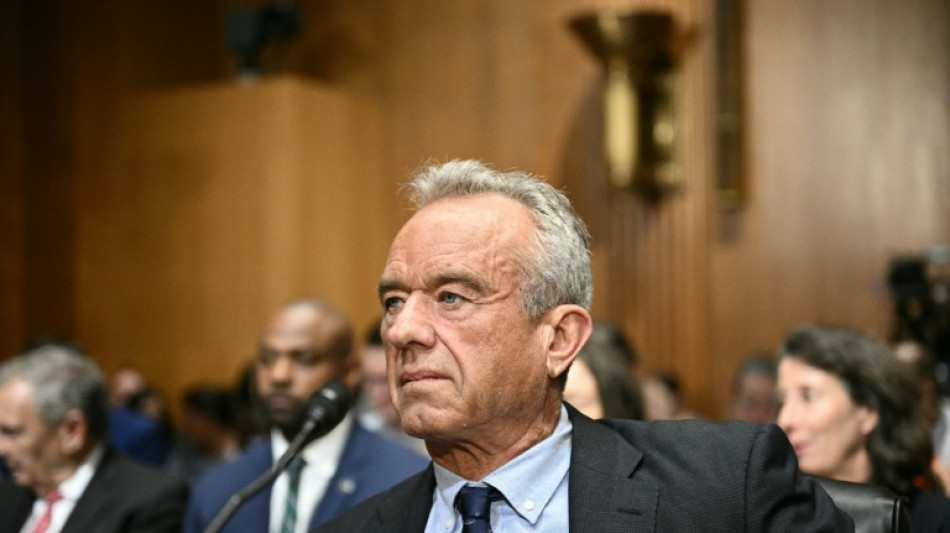
RFK Jr panelists make first changes to childhood vaccine advice / Photo: Alex WROBLEWSKI - AFP/File

 Drones hit Moscow as Russians go to the polls

 New England boss Fleming says 'wrong' to ask Stokes to end retirement

 Germans vote in elections threatening fresh blow to Merz

 US fears rapid escalation in Mideast after Houthis attack Riyadh

 Japan triathlete Hojo wins first gold of Asian Games

 IOC president impressed by 'beautiful' Asian Games wooden huts

 First Asian Games gold goes to Japan as China's 13-year-old Yu lights up pool

 Data centre command hub keeps AI up and running

 Pope Leo in France: the issues on the table

 Packing for a pope: behind the scenes on foreign trips

 Republicans find transgender issues a powerful political weapon in midterm campaigning

 German state elections threaten new shock waves for Merz

 Chile's Bachelet quits race to be next UN chief

 Raphinha treble fires perfect Barca to win at Sevilla

 Thiam makes winning heptathlon return at Decastar meet

 Czechs beat USA to qualify for Davis Cup finals

 Dortmund sink Stuttgart to climb to Bundesliga summit

 Trump says will not tolerate attempts to slow AI growth

 'It has to stop': runners protest women's murders in S.Africa district

 Fire erupts near Riyadh airport as Houthis claim strikes

 Cuba works to restore power after another blackout

 England thrash Sri Lanka again to return to top of T20 rankings

 Arsenal thrashed by Brighton, sorry Spurs lose again

 South Korea, Austria qualify for Davis Cup finals
 Seare shocks Ingebrigtsen to win world 5km gold

A US medical panel handpicked by President Donald Trump's health secretary made its first alteration to the childhood vaccine schedule on Thursday, as public health experts fear more changes that flout prevailing medical advice are in the pipeline.
The Advisory Committee on Immunization Practices (ACIP) was revamped to reflect anti-vax advocate Robert F. Kennedy Jr.'s ideals -- and among its initial moves was voting to advise that no child under four should receive the combination MMRV shot, which covers measles, mumps, rubella and varicella.
Parents should instead be offered the alternative of separate MMR and chicken pox injections for their children, members decided.
The combination shot has a small risk of causing temporary, non-life-threatening febrile seizures.
But in a call with journalists, Sean O'Leary, chair of the American Academy of Pediatrics Committee on Infectious Diseases, said the debate was settled years ago and that today parents already have a choice of both options.
"I'm still puzzled by why this came back as a point of discussion," he said. "The only thing I can think of is it's another strategy to scare parents."
Kennedy has spent decades promoting vaccine misinformation, including the widely debunked claim that the MMR shot causes autism.
After his appointment to the federal government, he sacked every person from ACIP, and replaced them with figures whose anti-vaccine views track more closely with his own.
That skepticism bled into Thursday's discussion: the committee's methods were scrutinized by medical professionals in attendance who can't vote but can offer input.
"You're not looking at all of the aspects of how we evaluate vaccine implementation," said Jason Goldman, president of the American College of Physicians.
"You're looking at very small data points and misrepresenting how it works in the real world and how we take care of our patients."
- 'Illegitimate' -
Following much head-scratching over language, the committee voted that the combination shot would still be covered under the Vaccines for Children federal program -- which helps fund many immunizations in the United States -- even though they were no longer recommending that shot for kids under four.
A couple of members abstained -- because they said they weren't sure what they were voting for.
The decision means some federal programs will cover the shot but others won't, creating a patchwork system that public health experts fear could sow widespread confusion among parents.
"Parents like me depend on a childhood vaccine schedule built on science and trust. Every change should strengthen, not weaken, the safety net -- that keeps our kids healthy," epidemiologist Syra Madad told AFP.
She said Thursday's committee discussions "risk eroding protections we know work."
Committee members put off until Friday a closely watched vote on whether to scrap the longstanding standard of immunizing newborns against Hepatitis B within the first 24 hours of life.
That move has been met with widespread alarm by public health experts, including from some voices on the panel.
Swift vaccination has proven the best way to prevent any maternal transmission of the incurable, highly contagious disease that can cause severe liver damage and cancer later in life, said Adam Langer, a CDC scientist who presented to the panel.
Amending the advice could amount to a "devastating decision," said O'Leary of the AAP, a body that did not attend the committee meeting despite a past history of collaboration.
"This committee is illegitimate," he said. "You should disregard anything that comes from this committee."
In opening the two-day meeting, ACIP chair and biostatistician Martin Kulldorff insisted that the panel was, despite much criticism and fear to the contrary, "pro-vaccine" and will "welcome scientific critique of any of our votes, as there are gray areas."
But Wilbur Chen, an infectious disease physician, cast that defensiveness as disingenuous.
"They do not intend to debate using sound, rigorous, reproducible science; they are echoing poor and falsified information," he told AFP.
Along with the Hepatitis B vote on Friday, the committee will reconvene and consider this season's Covid-19 shot, including who should get it and who should pay for it.
L.Mesquita--PC